Odds in betting represent the probability of an outcome happening and determine how much money you can win from a wager.
They show both the risk involved and the potential reward.
If you are new to sports betting, one of the first things you will notice is a set of numbers next to teams, players, or outcomes. These numbers are called odds, and they are the foundation of all betting markets. This often leads beginners to ask: what do odds mean in betting?
In this guide, we will break down betting odds in a simple, clear, and friendly way. You will learn what odds represent, how to read them, how they affect payouts, and why they matter so much in sports betting.
What Do Odds Mean in Betting?
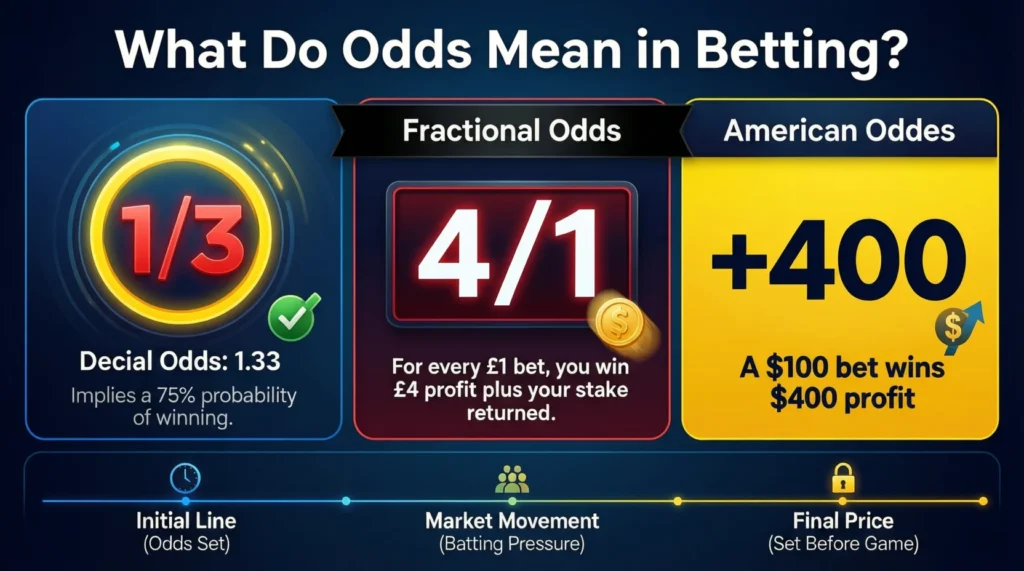
In betting, odds serve two main purposes.
First, they indicate how likely an outcome is to happen according to the sportsbook.
Second, they determine how much money you will win if your bet is successful.
Lower odds suggest a higher probability and lower payout.
Higher odds suggest a lower probability and higher payout.
In simple terms, odds balance risk and reward.
Why Betting Odds Exist
Sportsbooks use odds to create a fair betting market. Their goal is to attract bets on all possible outcomes so they can manage risk and make a profit.
Odds are based on many factors, including:
Team performance
Player injuries
Weather conditions
Public betting trends
Statistical models
Odds are not predictions. They are probabilities adjusted to encourage balanced betting.
Types of Betting Odds
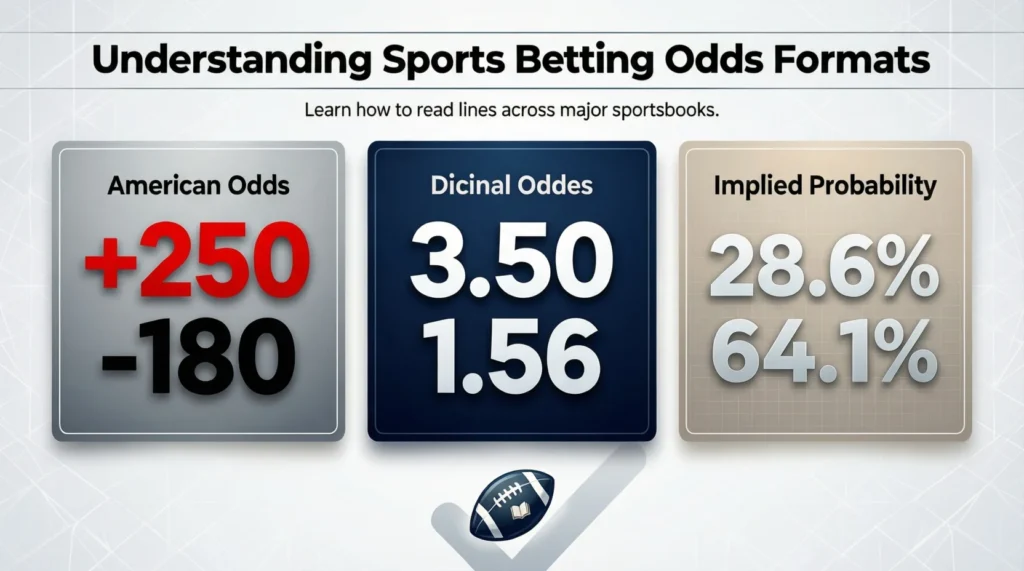
There are three main types of betting odds used worldwide.
American odds
Decimal odds
Fractional odds
Each format presents the same information in a different way.
American Odds Explained
American odds are most common in the United States. They use plus and minus numbers.
Negative odds show the favorite.
Positive odds show the underdog.
For example:
Minus 150 means you must bet 150 to win 100.
Plus 200 means a 100 bet wins 200.
American odds focus heavily on risk and reward.
Decimal Odds Explained
Decimal odds are popular in Europe, Canada, and online sportsbooks.
They show the total payout, including your stake.
For example:
Odds of 2.00 double your money.
Odds of 1.50 return 150 on a 100 bet.
Decimal odds are easy to calculate and beginner friendly.
Fractional Odds Explained
Fractional odds are commonly used in the United Kingdom.
They show profit relative to your stake.
For example:
Odds of 5/1 mean you win 5 for every 1 bet.
Odds of 1/2 mean you win 1 for every 2 bet.
Fractional odds are often used in horse racing.
Betting Odds Comparison Table
| Odds Format | Example | Meaning |
|---|---|---|
| American | -200 | Bet 200 to win 100 |
| Decimal | 2.50 | 250 total return on 100 |
| Fractional | 3/1 | Win 3 for every 1 bet |
This table shows how different formats represent the same concept.
How Odds Reflect Probability
Odds are directly linked to probability.
Lower odds mean a higher chance of winning.
Higher odds mean a lower chance of winning.
For example, a heavy favorite will have short odds, while a long shot will have long odds.
Sportsbooks adjust odds based on both probability and betting behavior.
How Odds Affect Your Payout
Odds determine how much you win if your bet is correct.
A bet with low odds returns less profit.
A bet with high odds returns more profit.
This is why underdogs offer larger payouts but carry more risk.
Odds vs Implied Probability
Implied probability is the chance of an outcome based on the odds.
Bettors often calculate implied probability to find value bets. A value bet occurs when you believe the true probability is higher than what the odds suggest.
Understanding this concept helps bettors think more strategically.
Why Odds Change
Odds are not fixed and can change before a game begins.
Injuries
Weather updates
Team news
Heavy betting on one side
When odds change, it is called line movement. Sharp bettors often watch these movements closely.
Odds in Different Betting Markets
Odds apply to many types of bets.
Moneyline bets
Point spread bets
Totals bets
Prop bets
Futures bets
Each market has its own odds based on risk and probability.
Common Misunderstandings About Odds
Many beginners misunderstand betting odds.
Odds do not guarantee outcomes.
Favorites do not always win.
High odds do not mean impossible outcomes.
Odds are probabilities, not promises.
Are Higher Odds Always Better?
Not necessarily.
Higher odds mean higher payouts but lower chances of winning.
Lower odds mean safer bets but smaller profits.
Smart betting focuses on value, not just big payouts.
Odds and Bankroll Management
Understanding odds helps with bankroll management.
Low odds require larger bets for profit.
High odds can grow a bankroll quickly but increase risk.
Balancing risk is key to long term betting success.
Alternate Meanings of Odds
Outside of betting, odds can mean general chances or likelihood. In sports betting, odds have a specific financial and probability-based meaning.
FAQs
What do odds mean in betting?
Odds show the probability of an outcome and determine payouts.
Do odds predict the winner?
No, they reflect probability, not certainty.
Why do odds have plus and minus signs?
They show favorites and underdogs in American odds.
Can odds change after I place a bet?
No, your odds are locked in once the bet is placed.
Which odds format is best for beginners?
Decimal odds are usually easiest to understand.
Are odds the same at every sportsbook?
No, odds can vary slightly between sportsbooks.
Do higher odds mean better value?
Only if the probability is underestimated.
Are odds used in all sports?
Yes, odds are used in nearly all sports betting markets.
Conclusion
So, what do odds mean in betting? They represent both the likelihood of an outcome and the potential payout if you are correct. Odds are the backbone of sports betting, guiding how much you risk and how much you can win.
Understanding odds helps bettors make smarter decisions, manage risk, and recognize value. Whether you are betting casually or seriously, learning how odds work is essential to long term success.
Discover More Related Articles:
- What Does OBP Mean in Baseball? How On-Base Percentage Works in 2026
- What Does Moneyline Mean in Sports Betting? How Odds Really Work in 2026

Laura Jackson is a writer at textroast.com, where she creates engaging articles that decode the meanings behind slang, phrases, and everyday expressions. Passionate about language and communication, she makes complex or confusing terms easy to understand, turning learning into a fun and relatable experience for readers around the world.