
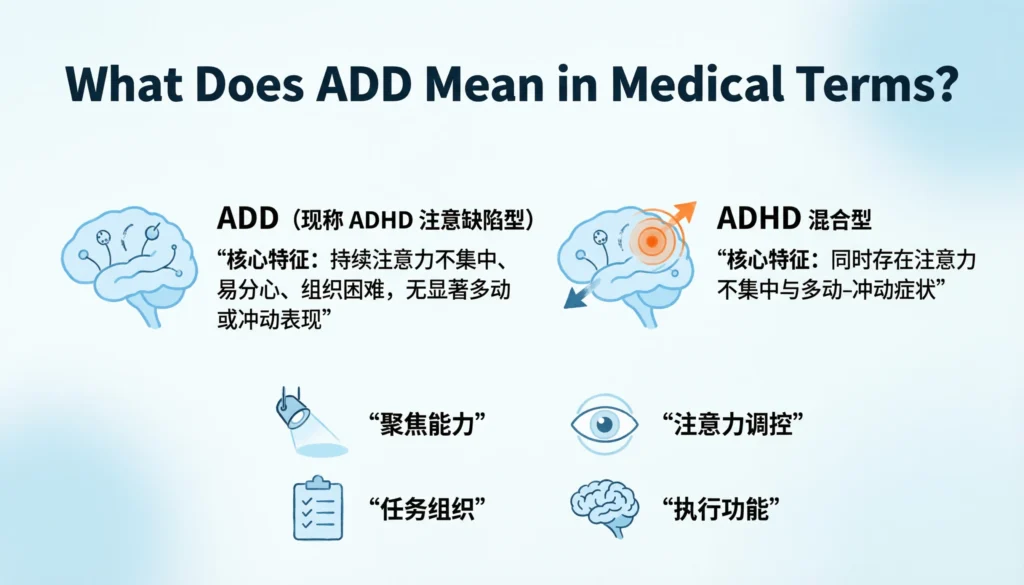
ADD (Attention Deficit Disorder) is a former medical term used to describe a neurodevelopmental condition characterized primarily by difficulty with attention, focus, and organization, without significant hyperactivity. Today, ADD is officially classified under ADHD (Attention-Deficit/Hyperactivity Disorder), specifically the predominantly inattentive presentation.
If you’ve ever looked at a medical report, school evaluation, or mental health assessment and seen the term “ADD,” you might have paused and wondered what exactly does that mean? Is it the same as ADHD? Is it still a real diagnosis? And why do some doctors use one term while others use another?
You’re not alone. The term ADD is widely searched, commonly misunderstood, and often used interchangeably with ADHD. Let’s clear up the confusion in a simple, friendly, and professional way.
Understanding ADD in Medical Terms
In medical language, ADD stands for Attention Deficit Disorder. It was once used to describe individuals who struggled mainly with:
- Inattention
- Distractibility
- Poor concentration
- Forgetfulness
- Disorganization
Unlike hyperactive ADHD, individuals with ADD typically did not show excessive movement or impulsive behavior.
However, here’s the key update:
ADD is no longer a standalone medical diagnosis.
It is now included under the broader diagnosis of ADHD.
The Origin of the Term ADD
The term ADD became popular in the 1980s. It was officially recognized in the:
- 1980 Diagnostic and Statistical Manual of Mental Disorders (DSM-III) by the American Psychiatric Association
At that time, professionals separated attention problems into two categories:
- ADD with hyperactivity
- ADD without hyperactivity
Later, in 1994, the DSM-IV replaced the term ADD with ADHD (Attention-Deficit/Hyperactivity Disorder) and divided it into three types:
- Predominantly Inattentive Type (formerly ADD)
- Predominantly Hyperactive-Impulsive Type
- Combined Type
Today, clinicians use ADHD as the official term, but many people still use ADD informally.
Why Is ADD Still Commonly Used?
Even though ADD is technically outdated in medical documentation, it remains popular because:
- Many adults were diagnosed decades ago using the term ADD
- It feels easier to say than ADHD
- It helps describe attention problems without hyperactivity
- Parents and teachers still use it conversationally
In real life, you might hear:
“I have ADD, not ADHD. I’m not hyper, just distracted.”
Medically speaking, that person likely has ADHD, predominantly inattentive presentation.
What Are the Symptoms of ADD?
Since ADD now falls under ADHD inattentive type, the symptoms include:
Common Symptoms in Children
- Difficulty paying attention in school
- Frequently losing items
- Trouble following instructions
- Appearing not to listen
- Avoiding tasks requiring mental effort
- Daydreaming often
Common Symptoms in Adults
- Chronic disorganization
- Forgetting appointments
- Trouble completing tasks
- Easily distracted at work
- Poor time management
- Difficulty focusing in conversations
Unlike hyperactive ADHD, people with ADD may appear quiet or withdrawn rather than disruptive.
Example Table: ADD vs ADHD
| Feature | ADD (Old Term) | ADHD Inattentive Type | ADHD Hyperactive Type |
|---|---|---|---|
| Official Diagnosis Today | No | Yes | Yes |
| Hyperactivity | No | Minimal or None | Yes |
| Main Issue | Inattention | Inattention | Impulsivity + Activity |
| Common in Adults | Yes | Yes | Less Common |
| Still Used Informally | Yes | Yes | Yes |
Real-World Usage of ADD
Although not medically official anymore, ADD is often used in:
- School evaluations
- Parenting discussions
- Online mental health forums
- Casual conversation
- Self-descriptions
Tone Context Examples
Friendly:
“I totally have ADD brain today 😅 I can’t focus!”
Neutral:
“The patient has a history of ADD diagnosed in childhood.”
Dismissive or Negative:
“You’re just using ADD as an excuse.”
It’s important to remember that ADD or ADHD is a legitimate neurodevelopmental condition, not laziness or lack of effort.
Is ADD a Mental Illness?
ADD, now classified under ADHD, is considered a neurodevelopmental disorder, not a personality flaw or character issue.
According to the American Psychiatric Association, ADHD affects brain development and functioning, especially in areas responsible for attention, impulse control, and executive functioning.
It can impact:
- Academic performance
- Career success
- Relationships
- Emotional regulation
However, with proper treatment and support, individuals with ADHD can thrive.
How Is ADD Diagnosed Today?
Doctors no longer diagnose ADD specifically. Instead, they diagnose ADHD using criteria from the DSM-5.
Diagnosis typically involves:
- Clinical interviews
- Behavior checklists
- Teacher or parent reports
- Evaluation of symptoms before age 12
- Assessment of how symptoms affect daily life
There is no single blood test or brain scan that diagnoses ADHD.
Treatment Options
Treatment depends on severity and individual needs.
Common Treatment Approaches
- Behavioral therapy
- Cognitive behavioral therapy
- Medication (stimulant and non-stimulant options)
- School accommodations
- Coaching and organizational support
Medication options may include stimulant medications like methylphenidate or amphetamine-based treatments, prescribed under medical supervision.
ADD vs Other Similar Medical Abbreviations
Medical abbreviations can be confusing. Here’s how ADD compares to similar terms:
| Abbreviation | Meaning | Related to ADD? |
|---|---|---|
| ADHD | Attention-Deficit/Hyperactivity Disorder | Yes |
| ASD | Autism Spectrum Disorder | No |
| ODD | Oppositional Defiant Disorder | Sometimes co-occurs |
| OCD | Obsessive-Compulsive Disorder | Different condition |
| GAD | Generalized Anxiety Disorder | Separate but can overlap |
While ADHD and anxiety can share concentration issues, they are distinct diagnoses.
Alternate Meanings of ADD
In non-medical contexts, ADD can mean:
- Arithmetic term for addition
- Short form of address in tech
- Abbreviation in military or business contexts
However, in healthcare, ADD almost always refers to Attention Deficit Disorder (historical term).
Professional Alternatives to Using ADD
If you’re writing formally or medically, it’s better to say:
- ADHD, predominantly inattentive presentation
- Attention-deficit/hyperactivity disorder
- Inattentive-type ADHD
Using updated terminology ensures clarity and accuracy.
FAQs
What does ADD stand for in medical terms?
ADD stands for Attention Deficit Disorder, an older term for what is now classified as ADHD predominantly inattentive type.
Is ADD still a real diagnosis?
No. ADD is no longer an official diagnosis. It is now categorized under ADHD.
What is the difference between ADD and ADHD?
ADD was used for attention problems without hyperactivity. ADHD is the current official diagnosis and includes inattentive, hyperactive, and combined types.
Can adults have ADD?
Yes. Adults can have ADHD inattentive type, which many still informally call ADD.
Is ADD a mental illness or a learning disability?
ADD, now ADHD, is a neurodevelopmental disorder. It is not classified as a learning disability, though it can affect learning.
What causes ADD?
Research suggests genetic, neurological, and environmental factors contribute to ADHD.
How is ADD treated?
Treatment may include therapy, medication, behavioral strategies, and lifestyle adjustments.
Is ADD the same as being distracted sometimes?
No. Everyone gets distracted occasionally, but ADHD involves persistent symptoms that significantly affect daily functioning.
Conclusion
So, what does ADD mean in medical terms?
It refers to Attention Deficit Disorder, an older diagnostic label now included under ADHD. While the terminology has evolved, the core challenge remains the same difficulty with attention, organization, and focus.
Understanding the difference between ADD and ADHD helps reduce confusion, remove stigma, and promote accurate conversations about mental health. you’re a parent, student, adult navigating focus challenges, or simply curious, knowing the updated medical terminology empowers you to seek the right support.
Discover More Related Articles:
- High MCHC Meaning: What Your Blood Test Is Telling You in 2026
- Specific Gravity in Urine Tests: Hydration and Kidney Function in 2026

David Brown is a content writer and language enthusiast at textroast.com, where he creates insightful articles that explain the meanings of words, slang, and phrases used in everyday life. His work helps readers decode modern language trends, understand cultural expressions, and make sense of online communication with clarity and fun.