Definition:
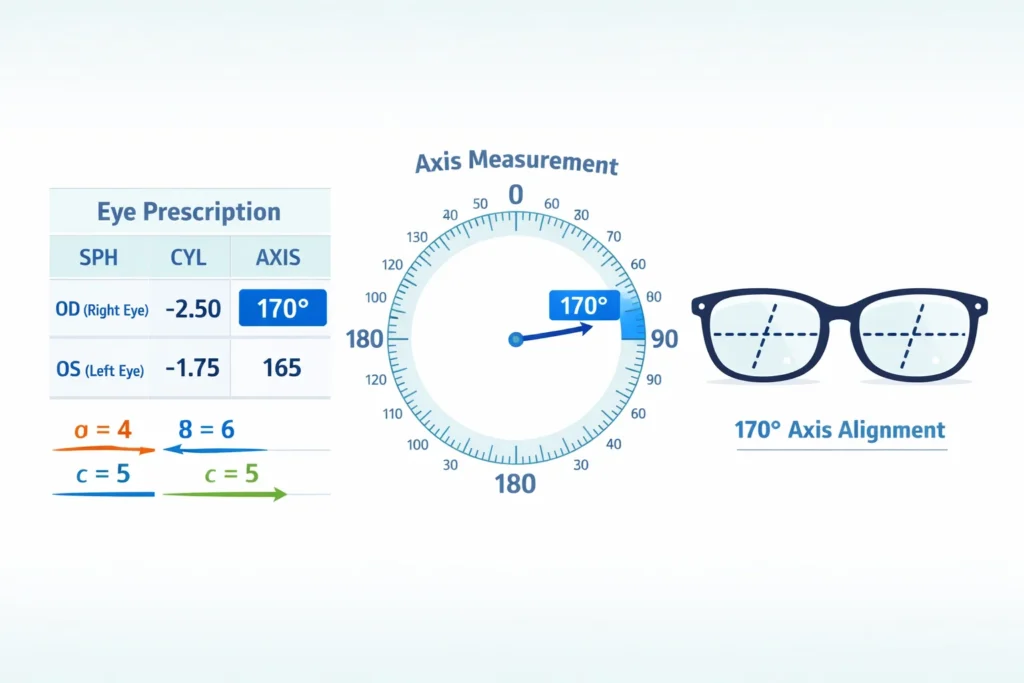
Axis in an eye prescription refers to the orientation (measured in degrees from 1 to 180) of astigmatism in the eye. It indicates the exact angle at which the cylindrical lens should be placed to correct uneven curvature in the cornea or lens.
If you’ve ever looked at your eye prescription and felt confused by terms like SPH, CYL, and AXIS, you’re not alone. Among these, the “axis” value often raises the most questions. What does it mean? Why is it measured in degrees? And how does it affect your vision?
Understanding the axis in your eye prescription is more important than you might think. It plays a key role in correcting astigmatism and ensuring your glasses or contact lenses provide clear, comfortable vision. Even a small error in the axis measurement can make your lenses feel “off,” causing blurry vision or eye strain.
In this detailed guide, we’ll break down everything you need to know about axis in an eye prescription in a simple, friendly, and practical way. By the end, you’ll be able to read your prescription with confidence and understand how it impacts your daily life.
What Is Axis in an Eye Prescription
The axis is a number between 1 and 180 that indicates the direction of astigmatism in your eye. It does not measure the strength of your vision problem but instead shows the angle at which correction is needed.
Think of it like the direction of a line on a clock or compass. It tells your optician exactly how to position the cylindrical lens so it aligns perfectly with your eye’s irregular shape.
Key Points About Axis
- It is measured in degrees from 1 to 180
- It only appears if you have astigmatism
- It works together with the CYL (cylinder) value
- It determines lens orientation, not strength
Origin and Meaning of the Term
The word “axis” comes from Latin, meaning a central line or pivot around which something rotates. In vision science, it refers to an imaginary line that defines the direction of light entering the eye.
In eye care, the term became widely used as optometry advanced and doctors needed a precise way to describe how to correct astigmatism. Over time, axis became a standard part of every prescription involving cylindrical correction.
Why Axis Is Important in Vision Correction
Axis is crucial because astigmatism is not just about how strong the correction is but also about where it is needed.
Astigmatism occurs when the cornea or lens is shaped more like a rugby ball than a perfectly round sphere. This uneven shape causes light to focus at different points, leading to blurred or distorted vision.
The axis ensures that the corrective lens is aligned exactly with this irregular shape.
Without the Correct Axis
- Vision may remain blurry even with glasses
- Objects may appear tilted or stretched
- Eye strain and headaches can occur
- You may feel uncomfortable wearing your lenses
How Axis Works with CYL
Axis and cylinder values always go hand in hand. While CYL measures the strength of astigmatism, axis determines the direction of that correction.
Simple Explanation
- CYL = how much correction you need
- Axis = where that correction should be applied
Example Eye Prescription Table
| Prescription Element | Meaning | Example Value | Explanation |
|---|---|---|---|
| SPH (Sphere) | Nearsighted or farsighted power | -2.00 | Mild nearsightedness |
| CYL (Cylinder) | Astigmatism strength | -1.25 | Moderate astigmatism |
| Axis | Astigmatism angle | 90 | Correction applied vertically |
Real World Examples of Axis
Example 1 Friendly Context 😊
You get a prescription with CYL -1.00 and Axis 180. This means your astigmatism correction is applied horizontally. Your glasses will be designed to align perfectly with that direction.
Example 2 Neutral Context
A patient with Axis 45 has astigmatism at a diagonal angle. The lens must be rotated precisely to 45 degrees to provide clear vision.
Example 3 Negative or Dismissive Context 😕
If your glasses have the wrong axis, you might say, “These don’t feel right at all.” That’s because even a small misalignment can distort your vision.
Understanding Axis Values
Axis values range from 1 to 180 degrees, forming a half circle.
Common Axis Orientations
- 90 degrees = vertical orientation
- 180 degrees = horizontal orientation
- 45 or 135 degrees = diagonal orientation
Important Note
Axis does not indicate better or worse vision. It simply describes direction.
How Eye Doctors Measure Axis
Eye doctors use specialized tools to measure how light enters your eye and where it focuses.
Common Methods
- Phoropter testing during eye exams
- Retinoscopy
- Digital eye scanning technology
These methods help determine both the strength and direction of astigmatism.
Axis vs Other Prescription Terms
Understanding axis becomes easier when compared with other common terms.
Comparison Table
| Term | What It Measures | Unit | Purpose |
|---|---|---|---|
| SPH | Overall vision power | Diopters | Corrects nearsightedness or farsightedness |
| CYL | Astigmatism strength | Diopters | Corrects uneven curvature |
| Axis | Direction of astigmatism | Degrees | Aligns correction properly |
Usage in Everyday Life
Axis plays a role in several real world situations.
Glasses
Your lenses are manufactured with the axis built into their design. Even a slight rotation can affect clarity.
Contact Lenses
Toric lenses are used for astigmatism and must stay in the correct position to maintain the axis.
Eye Surgery
Procedures like LASIK also consider axis to reshape the cornea accurately.
Tips for Understanding and Using Your Axis Value
- Always double check your prescription before ordering glasses
- Make sure your optician aligns lenses correctly
- If glasses feel uncomfortable, get your axis checked again
- Avoid guessing or estimating your prescription
Alternate Meanings of Axis
While axis in eye prescriptions refers to orientation, the word has other meanings in different contexts.
Other Uses
- In mathematics, it refers to a reference line on a graph
- In anatomy, it can refer to a central structure
- In general use, it means a line around which something rotates
These meanings are different but share the idea of direction or alignment.
Professional or Polite Alternatives
In medical or professional settings, axis is already the correct and standard term. However, it may be explained in simpler ways such as:
- Direction of astigmatism
- Angle of correction
- Lens alignment angle
These alternatives are helpful when explaining to patients.
Common Mistakes People Make
- Thinking axis measures vision strength
- Ignoring axis when ordering glasses online
- Assuming all lenses are the same regardless of axis
- Believing higher axis numbers mean worse vision
FAQs
What does axis mean in eye prescription?
Axis refers to the angle at which astigmatism correction is applied in your lenses, measured between 1 and 180 degrees.
Is axis important in eye prescription?
Yes, it is very important because it ensures the lens is aligned correctly to fix astigmatism.
What is a normal axis range?
Axis values range from 1 to 180. All values are normal depending on your eye condition.
Can axis change over time?
Yes, your axis can change slightly as your eyes change, which is why regular eye exams are important.
What happens if axis is wrong?
Incorrect axis can cause blurry vision, discomfort, and eye strain.
Does everyone have an axis value?
No, only people with astigmatism have an axis value in their prescription.
Is 180 axis better than 90?
No, neither is better. They simply represent different directions of correction.
Can I wear glasses with slightly wrong axis?
You might, but your vision may not be clear or comfortable, so it’s best to have the correct value.
Conclusion
Understanding what axis means in an eye prescription can make a big difference in how you approach your vision care. While it may seem like just another number, it plays a critical role in correcting astigmatism and ensuring your glasses or contacts work properly.
Remember that axis is all about direction, not strength. It works alongside the cylinder value to give you clear, sharp vision. If your prescription feels confusing, don’t hesitate to ask your eye doctor for clarification.
By knowing how axis works, you can make better decisions when buying glasses, understand your eye health more clearly, and avoid common mistakes that lead to discomfort.
Discover More Related Articles:
- From Confusion to Clarity: Understanding Vertices in Geometry In 2026
- Construction Made Simple: What ROM Really Means & Why It Matters In 2026
- Math Symbols Explained: What the ‘ (Prime) Sign Means In 2026

David Brown is a content writer and language enthusiast at textroast.com, where he creates insightful articles that explain the meanings of words, slang, and phrases used in everyday life. His work helps readers decode modern language trends, understand cultural expressions, and make sense of online communication with clarity and fun.