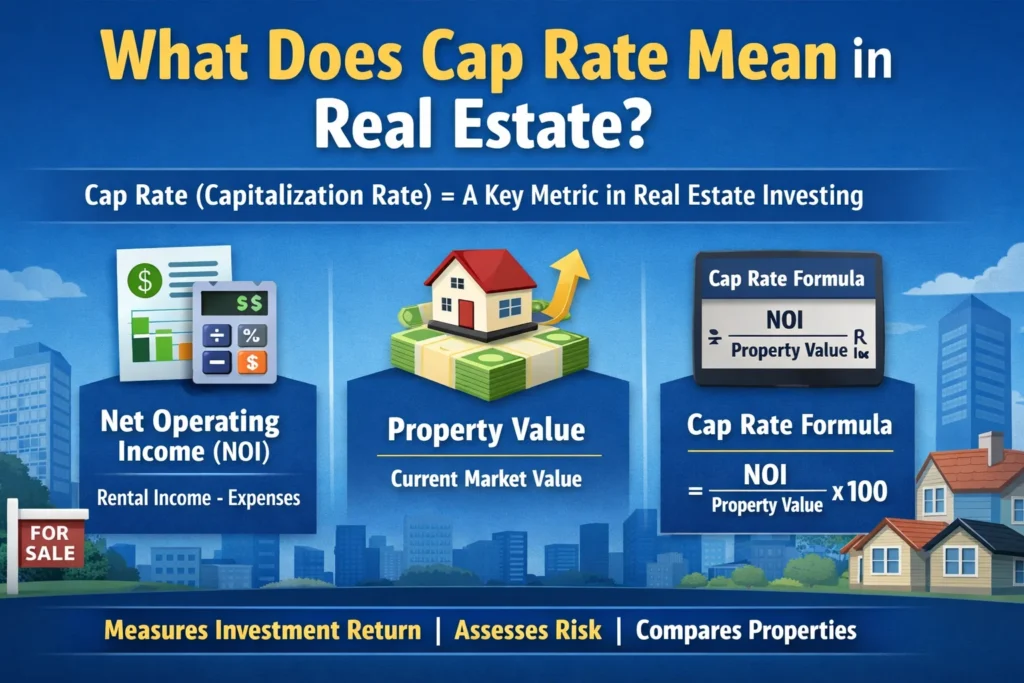
In real estate, the capitalization rate (cap rate) is the ratio of a property’s net operating income (NOI) to its current market value, expressed as a percentage. It measures the potential return on an investment property.
If you’re venturing into real estate investing, you may have come across the term cap rate. It’s a key metric that helps investors evaluate the profitability of a property. But what exactly does it mean, and how is it calculated?
Understanding the cap rate can help you make smarter investment decisions, compare properties, and assess risk. This guide explains what cap rate means in real estate, provides practical examples, and answers frequently asked questions.
In simple terms:
Cap rate shows how much return you can expect relative to the property’s value.
Understanding Cap Rate in Simple Terms
Cap rate gives investors a quick snapshot of a property’s profitability without considering financing.
The formula is:
Cap Rate = (Net Operating Income ÷ Current Market Value) × 100
Where:
- Net Operating Income (NOI) = Revenue from property (rent, fees) – Operating expenses (maintenance, taxes, insurance)
- Current Market Value = Price of the property
Example:
- NOI = $50,000 per year
- Market Value = $500,000
Cap Rate = (50,000 ÷ 500,000) × 100 = 10%
This means the property yields a 10% return based on its value.
Why Cap Rate Matters
Cap rate is useful for:
- Comparing investment properties
- Estimating potential returns
- Evaluating risk
- Making buy vs. hold decisions
A higher cap rate usually indicates higher potential returns but higher risk. A lower cap rate implies lower returns but potentially lower risk.
Cap Rate vs ROI
It is sometimes confused with ROI (Return on Investment).
| Metric | Cap Rate | ROI |
|---|---|---|
| Definition | Ratio of NOI to property value | Overall return on investment including financing |
| Includes Debt? | No | Can include mortgage or loans |
| Purpose | Measure property’s income-generating potential | Measure investor’s total return |
| Calculation | NOI ÷ Market Value | (Gain – Cost) ÷ Investment |
Cap rate focuses on property performance, while ROI accounts for the investor’s total capital and financing.
Factors Affecting Cap Rate
- Property Location – Prime locations often have lower cap rates but higher stability.
- Property Type – Commercial vs residential properties have different typical cap rates.
- Market Conditions – Supply, demand, and interest rates influence cap rates.
- Operating Expenses – Higher expenses lower NOI and reduce cap rate.
- Risk Profile – Higher-risk properties usually have higher cap rates to attract investors.
High Cap Rate vs Low Cap Rate
- High Cap Rate (e.g., 10–12%)
- Potentially higher returns
- May indicate higher risk or less desirable property
- Low Cap Rate (e.g., 4–6%)
- Lower returns
- Often reflects stable, prime locations with less risk
Examples of Cap Rate in Real Life
Example 1: Apartment Building
- Purchase Price: $1,000,000
- Annual Rental Income: $120,000
- Operating Expenses: $30,000
- NOI = $120,000 – $30,000 = $90,000
Cap Rate = 90,000 ÷ 1,000,000 × 100 = 9%
Example 2: Commercial Office
- Market Value: $2,000,000
- NOI: $100,000
Cap Rate = 100,000 ÷ 2,000,000 × 100 = 5%
This shows a lower return but potentially less risk due to location or tenant stability.
Limitations of Cap Rate
While cap rate is a useful metric, it has limitations:
- Ignores financing costs
- Does not consider property appreciation or depreciation
- Based on projected NOI, which may fluctuate
- Doesn’t account for tax implications
Investors should use cap rate alongside other metrics like cash-on-cash return and ROI.
How to Use Cap Rate for Investment Decisions
- Compare similar properties in the same market
- Evaluate risk vs return
- Check operating expenses and potential income
- Consider future growth or market trends
- Factor in financing if applicable
Example: Two properties:
- Property A: 6% cap rate, low risk
- Property B: 10% cap rate, higher risk
Your choice depends on your investment strategy and risk tolerance.
FAQs
What does cap rate mean in real estate?
It’s the ratio of a property’s net operating income to its market value, showing potential return.
How do you calculate cap rate?
Cap Rate = (Net Operating Income ÷ Property Value) × 100
Is a higher cap rate better?
Higher cap rates mean higher potential returns, but usually higher risk.
Does cap rate include mortgage or loans?
No, cap rate ignores financing. ROI may include debt.
What is a good cap rate?
It varies by market. Generally, 6–10% is considered typical, depending on property type and location.
Can cap rate change over time?
Yes. Market conditions, income, and expenses affect cap rates.
Is cap rate the same as ROI?
No. Cap rate measures property income potential, while ROI measures total investor return.
Does cap rate include appreciation?
No. Cap rate focuses only on current income, not future property value changes.
Conclusion
The capitalization rate is a crucial tool for real estate investors. It offers a quick snapshot of how profitable a property may be and helps compare different investment options.
While cap rate does not tell the whole story, understanding it helps investors make informed decisions, balance risk, and assess potential returns effectively.
You’re investing in residential or commercial properties, knowing how to calculate and interpret cap rate is essential for successful real estate investing.
Discover More Related Articles:
- RCV Meaning in Insurance: Replacement Cost Value Explained in 2026
- Redacted Meaning in Legal Terms: What It Really Means in 2026

Daniel Moore is a content writer and language enthusiast at TextRoast.com, specializing in decoding slang, abbreviations, and trending text expressions. He creates engaging and informative articles that help readers understand the meaning behind everyday words and online communication.