
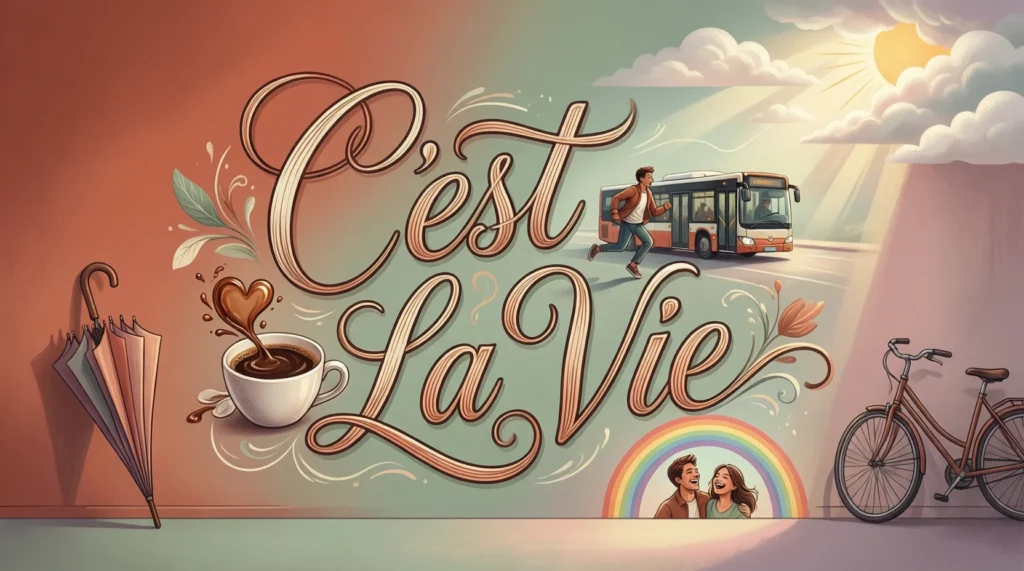
C’est la vie is a French expression that literally means “that’s life” in English. It is used to express acceptance or resignation about a situation, especially when things do not go as planned.
The French phrase c’est la vie is widely recognized around the world, even among those who don’t speak French. It has a certain charm, often appearing in movies, books, music, and everyday conversation to express acceptance of life’s ups and downs. But what does it really mean, how is it used, and what cultural nuances are attached to it?
In this comprehensive guide, you will learn what c’est la vie means in English, its literal and idiomatic translations, examples of usage in different contexts, tone and emotion, comparisons with similar phrases, and how to use it naturally in conversation.
Literal Meaning of C’est La Vie
Breaking the phrase down:
- C’est = It is
- La = The
- Vie = Life
So literally, c’est la vie translates to “it is the life” or more naturally, “that’s life.”
It captures the idea that life has unexpected twists, some good, some bad, and sometimes there’s nothing you can do but accept it.
Idiomatic Meaning
Beyond its literal translation, c’est la vie functions as an idiom.
It conveys:
- Acceptance of misfortune
- Philosophical resignation
- A shrug of the shoulders at life’s unpredictability
- Sometimes light-hearted acknowledgment of minor setbacks
Example:
J’ai raté le train, c’est la vie.
I missed the train, that’s life.
Here, it expresses mild disappointment but acknowledges that life goes on.
Pronunciation
The correct French pronunciation is:
seh lah vee
- C’est – pronounced “seh”
- La – pronounced “lah”
- Vie – pronounced “vee”
The emphasis is natural and smooth, flowing like a French phrase rather than English words pronounced separately.
Emotional Tone of C’est La Vie
C’est la vie is neutral but nuanced. Depending on context, it can express:
- Lightheartedness: “Well, you win some, you lose some.”
- Resignation: “Things didn’t go as planned, and that’s just how life is.”
- Humor: Sometimes used to shrug off minor inconveniences sarcastically.
It rarely conveys strong anger or sadness; it’s more reflective, philosophical, or casual.
Common Situations to Use C’est La Vie
- Minor setbacks:
You spilled coffee on your shirt. C’est la vie! - Unexpected outcomes:
You didn’t get the promotion. C’est la vie. - Life lessons:
Sometimes, life is unfair or unpredictable. C’est la vie. - Humorous or sarcastic use:
Your team loses a game. Well, c’est la vie!
C’est La Vie in English Conversation
Although it is French, English speakers often use c’est la vie in casual conversation to add a touch of sophistication or flair.
Example:
Person 1: I lost my keys again.
Person 2: Ah, c’est la vie.
It conveys sympathy, understanding, and acknowledgment without dwelling on negativity.
C’est La Vie in Popular Culture
The phrase appears in:
- Songs: Multiple artists including Robbie Nevil and B*Witched have used it in lyrics.
- Movies: Characters often use it to shrug off mishaps.
- Books: Authors use it to add a French cultural flair or philosophical undertone.
- Social Media: Used as captions for situations out of one’s control.
Its popularity has made it globally recognized, even among people who don’t speak French.
Variations and Similar Phrases
- Ainsi va la vie – Another French expression meaning “Such is life”
- Que sera, sera – Spanish/Italian origin, meaning “Whatever will be, will be”
- Such is life – English equivalent
- That’s just the way it goes – Informal English variant
All of these expressions share the theme of acceptance and resignation.
C’est La Vie in Positive Contexts
While often used for misfortune, it can also celebrate life’s unpredictability:
Example:
J’ai trouvé un nouvel emploi et j’ai perdu mon ancien travail. C’est la vie!
I found a new job and lost my old one. That’s life!
Here, c’est la vie acknowledges change, both positive and negative.
Cultural Significance
C’est la vie reflects a philosophical approach common in French culture:
- Acceptance of life’s imperfections
- Emphasis on resilience and moving forward
- A focus on living with humor and grace
Using c’est la vie signals awareness that life is beyond complete control.
Common Mistakes Learners Make
- Mispronouncing it: Saying “say la vee” instead of “seh lah vee.”
- Using it for serious tragedies: It’s better for light-hearted or philosophical contexts.
- Overusing in English: Using it too frequently may sound affected.
- Misinterpreting it as sad: It’s more reflective than sorrowful.
Examples in Conversation
| Situation | Example in French | English Translation | Tone |
|---|---|---|---|
| Missed a bus | J’ai raté le bus, c’est la vie | I missed the bus, that’s life | Resigned |
| Spilled coffee | J’ai renversé mon café… c’est la vie! | I spilled my coffee… that’s life! | Lighthearted |
| Job loss | J’ai perdu mon emploi, c’est la vie | I lost my job, that’s life | Philosophical |
| Minor accident | La voiture est rayée… c’est la vie | The car got scratched… that’s life | Casual |
Using C’est La Vie in Writing
You can use it in:
- Emails (informal)
- Social media posts
- Stories or blogs
- Captions or personal reflections
It adds cultural sophistication and a philosophical tone.
Can Non-French Speakers Use C’est La Vie
Yes. Most people understand it globally. Using it in English conversations can be charming and shows awareness of French culture.
Tip: Match the tone to the situation—light-hearted, reflective, or philosophical.
FAQs
What does c’est la vie mean in English?
It means “That’s life.”
Is c’est la vie formal or informal?
It is generally informal but can be used in reflective writing.
Can c’est la vie be used sarcastically?
Yes, often to shrug off minor inconveniences.
Is c’est la vie used only in France?
No, it is widely recognized internationally.
Is c’est la vie a positive or negative expression?
It is neutral; context determines tone.
How do you pronounce c’est la vie?
It is pronounced seh lah vee.
Can c’est la vie be used in serious situations?
It is better for casual, philosophical, or light-hearted scenarios.
Are there similar phrases in English?
Yes, “Such is life,” “That’s life,” or “Whatever will be, will be.”
Conclusion
So what does c’est la vie mean in English? C’est la vie translates to “that’s life” and is used to acknowledge the unpredictability of life with acceptance, humor, or philosophical reflection. It is versatile, culturally rich, and globally recognized, making it a charming way to express resilience in both French and English conversations.
You hear it in music, read it in books, or use it yourself, c’est la vie reminds us that life’s twists and turns are inevitable, and sometimes the best response is simply acceptance.
Discover More Related Articles:
- También in Spanish: Pronunciation, and Common Uses for 2026
- Chingar in Spanish: Meaning, Variations, and Common Phrases for 2026
- What Does Nemo Mean in Latin? Cultural Significance in 2026

Laura Jackson is a writer at textroast.com, where she creates engaging articles that decode the meanings behind slang, phrases, and everyday expressions. Passionate about language and communication, she makes complex or confusing terms easy to understand, turning learning into a fun and relatable experience for readers around the world.