Definition
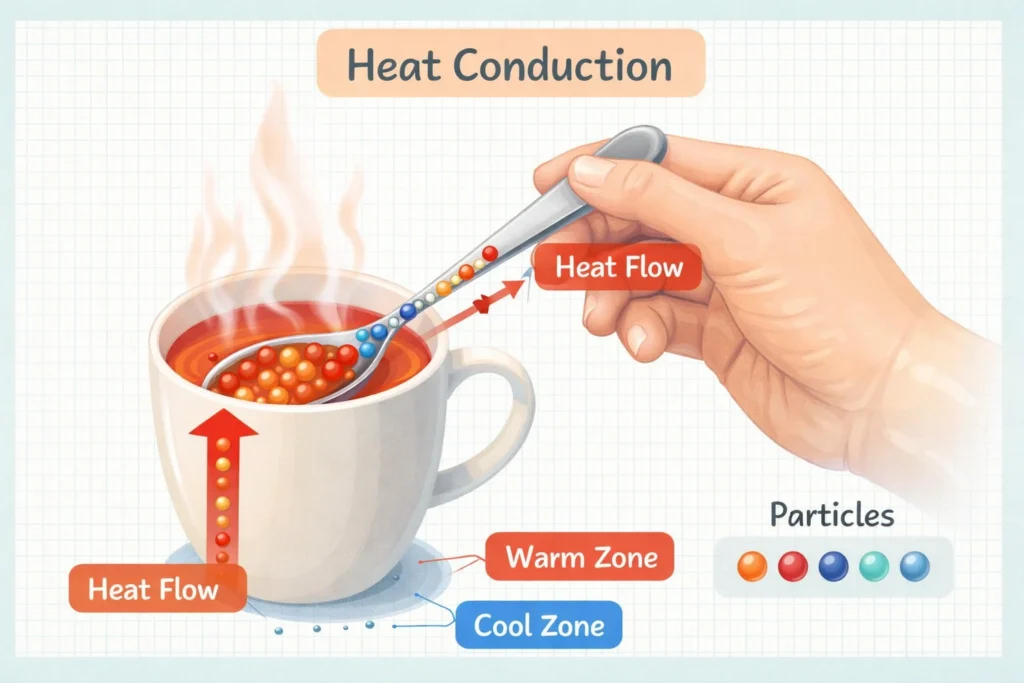
Conduction in science is the process by which heat or energy is transferred through a material without the movement of the material itself. This transfer occurs due to direct contact between particles, where energy passes from high-energy (hotter) particles to low-energy (cooler) ones.
Have you ever touched a metal spoon sitting in a hot cup of tea and felt the heat travel up to your fingers? That simple experience is a perfect example of conduction in action. Conduction is one of the most fundamental ways energy moves in the world around us, yet many people don’t fully understand how it works or where it applies.
From cooking food on a stove to understanding how buildings stay warm in winter, conduction plays a vital role in everyday life. You are a student, teacher, or simply curious about science, this guide will break down conduction in a clear, engaging, and practical way.
What Does Conduction Mean in Science?
In scientific terms, conduction refers to the transfer of heat energy through a substance due to a temperature difference, without any movement of the substance as a whole.
Key Points to Remember
- It happens through direct contact
- Energy moves from hot to cold regions
- No bulk movement of the material occurs
- Common in solids, especially metals
Origin and Background of Conduction
The concept of conduction has been studied for centuries, particularly in the field of physics. Early scientists observed how heat traveled through materials and began to understand that energy could move even when objects themselves remained still.
The term “conduction” comes from the Latin word conducere, meaning “to lead or bring together.” This perfectly reflects the idea of energy being passed along through contact.
Popularity in Modern Science
Today, conduction is a core concept in:
- Physics education
- Engineering applications
- Material science
- Everyday technology
It is one of the three main methods of heat transfer, alongside convection and radiation.
How Conduction Works
At the microscopic level, conduction occurs when particles collide with each other.
Simple Explanation
- Hot objects have fast-moving particles
- Cold objects have slower-moving particles
- When they touch, energy transfers through collisions
Example
Imagine a row of dominoes. When one falls, it hits the next, transferring energy. Similarly, in conduction, particles pass energy along like a chain reaction.
Real-World Examples of Conduction
Conduction is everywhere in daily life. Here are some common examples:
Everyday Situations
- Touching a hot pan 🍳
- Ice melting in your hand 🧊
- Ironing clothes
- Cooking food in a metal pot
Scientific Examples
- Heat transfer in metals
- Thermal conductivity in materials
- Heat flow in the Earth’s crust
Labeled Example Table of Conduction
| Scenario | Material | What Happens | Type of Conduction |
|---|---|---|---|
| Metal spoon in hot tea | Metal | Heat travels up the spoon | Good conductor |
| Wooden spoon in hot soup | Wood | Heat transfer is slow | Poor conductor |
| Ice cube in hand | Skin + ice | Heat moves from hand to ice | Energy loss |
| Electric wire heating | Copper | Heat spreads through wire | Thermal conduction |
Types of Conduction
While conduction is generally one concept, it can occur in different ways depending on the material.
1. Thermal Conduction
This is the most common type and involves heat transfer.
2. Electrical Conduction
This involves the flow of electric current through materials like metals.
Materials and Conduction
Different materials conduct heat at different rates.
Good Conductors
- Metals like copper, aluminum, and iron
- Fast energy transfer
Poor Conductors (Insulators)
- Wood
- Plastic
- Rubber
- Slow energy transfer
Quick Comparison
| Property | Conductors | Insulators |
|---|---|---|
| Heat Transfer | Fast | Slow |
| Examples | Metal, copper | Wood, plastic |
| Use | Cooking, wiring | Safety, insulation |
Tone-Based Examples of “Conduction” in Use
Although conduction is mainly a scientific term, it can appear in different tones depending on context.
Friendly Tone 😊
“Heat travels through the spoon by conduction, which is why it gets warm so quickly.”
Neutral Tone
“Conduction is a method of heat transfer observed in solids.”
Technical or Formal Tone
“Thermal conduction occurs due to molecular collisions within a medium.”
Conduction vs Other Heat Transfer Methods
Understanding conduction is easier when you compare it with similar concepts.
Comparison Table
| Method | How It Works | Medium Required | Example |
|---|---|---|---|
| Conduction | Direct contact | Yes | Hot pan heating food |
| Convection | Fluid movement | Yes | Boiling water |
| Radiation | Energy waves | No | Sun heating Earth |
Key Difference
- Conduction needs contact
- Convection needs movement
- Radiation needs no medium
Alternate Meanings of Conduction
While conduction is mostly used in science, it can have other meanings depending on context.
In Electricity
Refers to the flow of electric current through a conductor.
In Music
Sometimes loosely used to describe guiding or directing (though the correct term is conducting).
Professional and Everyday Alternatives
Depending on your context, you may use alternative phrases:
Scientific Alternatives
- Heat transfer through contact
- Thermal energy transfer
- Particle energy exchange
Simple Everyday Alternatives
- Heat moving through something
- Passing heat along
- Heat spreading
Practical Uses of Conduction
Understanding conduction helps in many real-world applications:
In Cooking
- Using metal pans for even heating
- Avoiding burns with insulated handles
And in Construction
- Insulating homes to reduce heat loss
- Choosing materials wisely
In Technology
- Cooling systems in computers
- Heat sinks in electronics
FAQs
What does conduction mean in simple words?
Conduction means heat moving through a material by direct contact, without the material itself moving.
What is an example of conduction in everyday life?
A metal spoon getting hot in a cup of tea is a common example of conduction.
How is conduction different from convection?
Conduction transfers heat through contact, while convection involves the movement of fluids like air or water.
Why do metals conduct heat better?
Metals have free-moving electrons that transfer energy quickly, making them excellent conductors.
Does conduction happen in liquids and gases?
Yes, but it is much more effective in solids because particles are closer together.
What is thermal conduction?
Thermal conduction is the transfer of heat energy through a substance due to temperature differences.
What are poor conductors called?
Poor conductors are called insulators, such as wood, plastic, and rubber.
Can conduction transfer electricity as well as heat?
Yes, conduction can also refer to the movement of electrical energy through materials like copper wires.
Conclusion
Conduction is one of the simplest yet most important concepts in science. It explains how heat moves through materials and helps us understand everything from cooking to advanced engineering systems.
The key takeaway is that conduction requires direct contact and involves energy moving from warmer areas to cooler ones.
By understanding how conduction works, you can make smarter choices in daily life, it’s selecting cookware, improving home insulation, or learning how energy flows in the natural world.
Discover More Related Articles:
- Double Spaced… Double Confused: Here’s What It Really Means In 2026
- Mastering Mean in Excel: Learn How to Do Mean with Formulas In 2026
- Intermediate Language Skills: What You Should Know & Do In 2026

David Brown is a content writer and language enthusiast at textroast.com, where he creates insightful articles that explain the meanings of words, slang, and phrases used in everyday life. His work helps readers decode modern language trends, understand cultural expressions, and make sense of online communication with clarity and fun.