
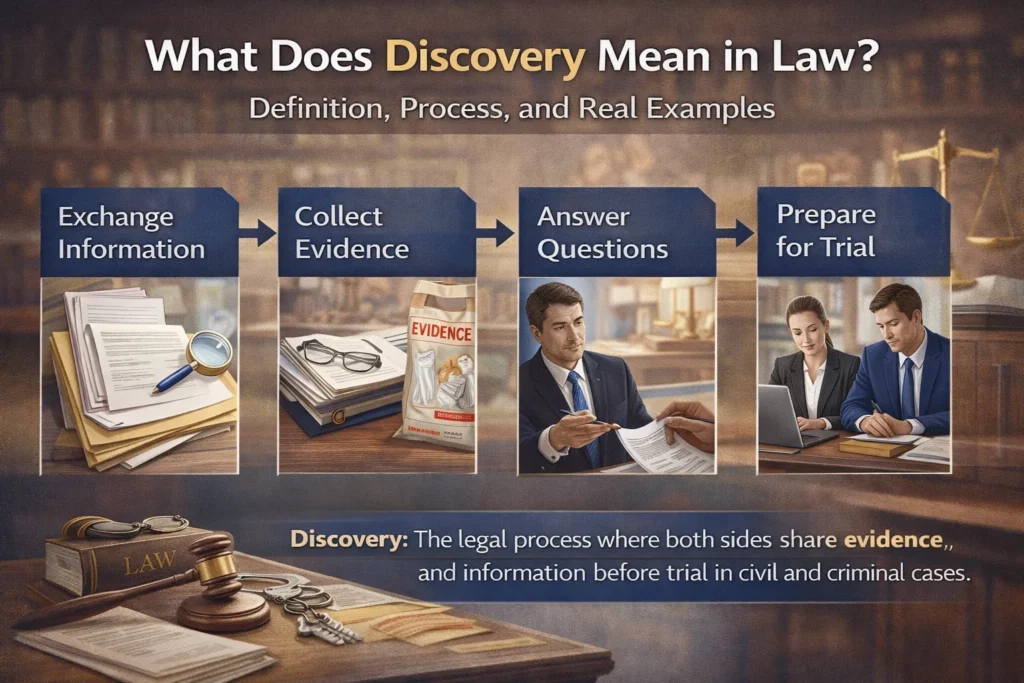
Discovery in law is the pre-trial process where both parties exchange relevant information, documents, and evidence to prepare for trial.
If you have ever watched a courtroom drama or followed a real legal case, you have probably heard the term discovery. But what does discovery actually mean in law? Is it about finding new evidence? Is it part of the trial? And why is it so important?
Discovery is one of the most critical stages in both civil and criminal cases. It shapes strategy, reveals evidence, and often determines a case settles or goes to trial.
Let’s break it down in clear, simple terms so you fully understand what discovery means in legal proceedings.
It allows each side to know what evidence the other has, preventing surprises in court and promoting fairness.
Understanding Discovery in Simple Terms
Discovery is essentially the information-gathering phase of a lawsuit.
Before a case goes to trial, both sides have the right to request:
- Documents
- Emails
- Contracts
- Witness statements
- Physical evidence
- Expert opinions
This ensures that trials are based on facts, not hidden evidence.
Think of discovery as the “investigation stage” where both sides prepare their arguments.
Why Discovery Is Important
Discovery serves several important purposes:
- Promotes fairness by preventing surprise evidence
- Encourages settlement before trial
- Helps lawyers evaluate strengths and weaknesses
- Narrows down disputed issues
- Saves court time
Without discovery, legal proceedings would be chaotic and unfair.
Types of Discovery in Law
Discovery includes several formal legal tools.
1. Interrogatories
Written questions sent from one party to another.
The receiving party must answer under oath.
Example
A plaintiff asks a company to identify all employees present during an incident.
2. Requests for Production
Requests for documents or tangible items.
Examples include:
- Contracts
- Financial records
- Medical reports
- Emails
- Photos
If relevant to the case, they must be produced.
3. Depositions
A deposition is sworn, out-of-court testimony given before trial.
Witnesses answer questions under oath while a court reporter records everything.
Depositions allow attorneys to:
- Assess credibility
- Clarify statements
- Lock in testimony
4. Requests for Admissions
These are written statements the other party must admit or deny.
Example
“Admit that you signed the contract on June 5.”
If admitted, that fact no longer needs to be proven in court.
5. Subpoenas
A subpoena compels a third party to provide documents or testimony.
For example, a bank may be subpoenaed to provide financial records.
Discovery in Civil vs Criminal Cases
Discovery applies to both civil and criminal law, but the process differs slightly.
| Aspect | Civil Case | Criminal Case |
|---|---|---|
| Parties | Private individuals or businesses | Government vs defendant |
| Evidence Sharing | Both sides exchange evidence | Prosecutor must disclose evidence |
| Depositions | Common | Less common |
| Goal | Prepare for trial or settlement | Protect defendant’s rights |
In criminal cases, prosecutors must share exculpatory evidence under constitutional requirements.
Example of Discovery in Action
Imagine a personal injury lawsuit.
A person claims they slipped and fell in a grocery store.
During discovery:
- The plaintiff requests store surveillance footage
- The defendant requests medical records
- Both sides depose witnesses
- Experts analyze safety conditions
After reviewing all evidence, the case may settle without trial.
Discovery often leads to resolution before a jury is ever involved.
How Long Does Discovery Last?
The discovery phase can last:
- Several months in simple cases
- Over a year in complex cases
- Multiple years in major corporate litigation
Courts set deadlines to prevent unnecessary delays.
What Happens If Someone Refuses Discovery?
If a party refuses to provide required information, the court may:
- Issue a motion to compel
- Impose fines
- Exclude evidence
- Dismiss claims
- Enter default judgment
Courts take discovery obligations seriously.
Discovery Disputes
Not all discovery requests are automatic.
A party may object if:
- The request is irrelevant
- It invades privacy
- It is overly broad
- It seeks privileged information
Judges resolve disputes about what must be disclosed.
Privileged Information in Discovery
Some information is protected from disclosure, including:
- Attorney client communications
- Work product materials
- Doctor patient communications
- Spousal communications
These privileges ensure confidentiality in certain relationships.
Discovery vs Trial
Discovery happens before trial.
During discovery:
Evidence is exchanged privately.
During trial:
Evidence is presented publicly before a judge or jury.
Discovery prepares the case for that public presentation.
Real World Impact of Discovery
Discovery often determines:
- Whether a case settles
- How much compensation is awarded
- Whether charges are reduced
- Whether a case is dismissed
In many cases, discovery reveals weaknesses that change the entire strategy.
Common Misunderstandings About Discovery
Myth: Discovery means finding brand-new evidence.
Reality: It means exchanging already existing evidence.
Myth: Discovery only happens in major lawsuits.
Reality: It applies to most formal court cases.
Myth: Discovery guarantees a win.
Reality: It only ensures both sides have access to relevant information.
Practical Tips if You Are Involved in Discovery
- Keep all relevant documents organized
- Do not destroy evidence
- Respond to requests on time
- Consult your attorney before answering questions
- Be truthful in depositions
Honesty and preparation are critical.
FAQs
What does discovery mean in law?
Discovery is the pre-trial process where parties exchange evidence and information relevant to the case.
Is discovery required in every lawsuit?
Most formal court cases include a discovery phase, though minor claims may have simplified procedures.
What happens during discovery?
Parties exchange documents, answer written questions, provide testimony, and request admissions.
How long does discovery take?
It can last from a few months to over a year, depending on case complexity.
Can discovery be denied?
Courts may limit discovery if requests are irrelevant, privileged, or overly burdensome.
What is a deposition in discovery?
A deposition is sworn testimony taken before trial and recorded by a court reporter.
Can a case settle during discovery?
Yes. Many cases settle after evidence is exchanged.
What happens if someone lies during discovery?
Lying under oath can result in perjury charges and serious legal consequences.
Conclusion
Discovery in law is the structured process where both sides exchange evidence before trial. It promotes fairness, transparency, and informed decision-making.
In civil litigation or criminal proceedings, discovery ensures that no party is caught off guard by hidden evidence. It helps lawyers evaluate their case, negotiate settlements, and prepare for trial.
Understanding discovery gives you insight into how legal cases truly work behind the scenes. It is not just paperwork. It is the foundation of modern legal procedure.
Discover More Related Articles:
- CAP Rate vs. ROI: What Every Property Investor Should Know in 2026
- Incurred Expenses Explained: What the Term Means in Accounting in 2026
- CC in Outlook: Meaning, Etiquette, and Best Practices in 2026

David Brown is a content writer and language enthusiast at textroast.com, where he creates insightful articles that explain the meanings of words, slang, and phrases used in everyday life. His work helps readers decode modern language trends, understand cultural expressions, and make sense of online communication with clarity and fun.