
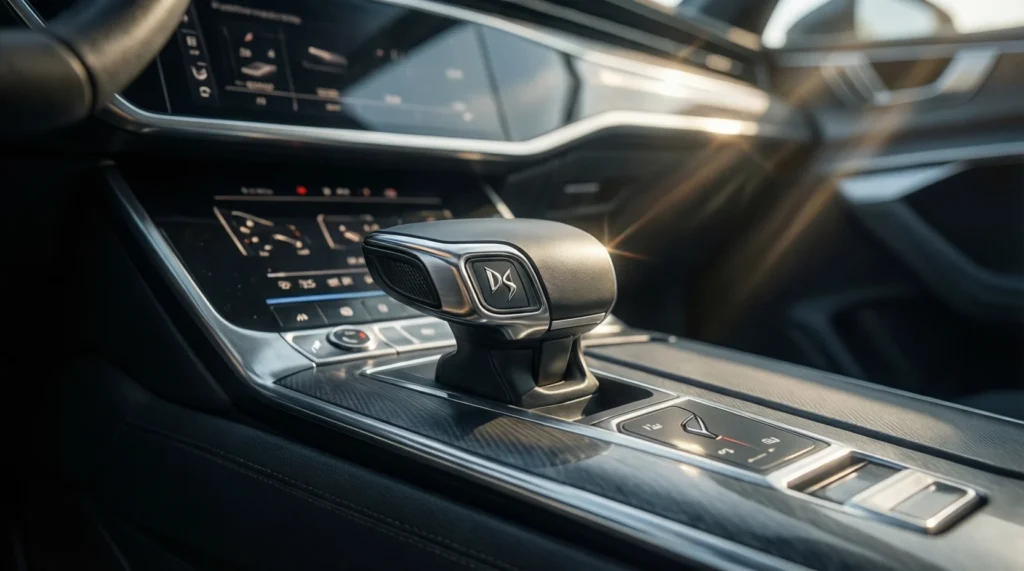
If you’ve ever glanced at your car dashboard or transmission lever and noticed the letters DS, you might have wondered: “What does DS mean in a car?” 🤔 Understanding this simple abbreviation can help you drive smarter, maintain your vehicle better, and even make informed choices when buying a new car.
In this guide, we’ll break down everything you need to know about DS in cars space from its origin and real-world usage to comparisons with other drive modes, examples, alternatives, and practical tips for drivers.
Definition:
DS in a car typically stands for “Drive Sport” or “Dynamic Sport,” a transmission mode that allows for more responsive acceleration and sporty driving performance.
Origin of DS Mode in Cars
The abbreviation DS originated in the automotive industry as car manufacturers sought to enhance the driving experience beyond standard automatic transmission modes.
History:
Modern automatic transmissions initially offered only standard drive (D), neutral (N), and reverse (R) modes. As drivers desired more control and sportier performance, automakers introduced DS or Drive Sport modes.
Popularization:
European brands like BMW, Audi, and Volkswagen first widely promoted DS mode in the late 2000s. Japanese brands, such as Honda and Toyota, followed suit. Today, DS is common in both luxury and mid-range vehicles.
Technology behind DS:
DS mode often adjusts:
- Gear shift points for quicker acceleration
- Engine responsiveness
- Steering feedback for a sportier feel
- Suspension settings in some advanced models
Think of it as your car saying: “Hey, I’m ready to be more fun!” 🚗💨
Real-World Usage of DS Mode
DS mode is designed to give you a more engaging, performance-oriented driving experience, especially in urban settings, hilly terrains, or when merging onto highways.
How DS Works in Practice:
| Feature | Standard Drive (D) | Drive Sport (DS) |
| Gear Shift Points | Earlier, fuel-efficient | Later, higher RPMs for power |
| Acceleration Response | Smooth, relaxed | Quick, responsive |
| Fuel Efficiency | Higher | Slightly lower |
| Steering Feedback | Standard | Sportier, more direct |
| Best Used For | Daily commuting | Dynamic driving, overtaking |
Example:
- Friendly context: “I switched to DS mode for the mountain drive space it was super fun!” 😎
- Neutral context: “DS mode slightly reduced fuel economy but improved responsiveness.”
- Negative context: “I don’t really use DS; it feels unnecessary for city driving.”
DS vs Other Transmission Modes
Understanding DS fully requires a comparison with related terms.
- D (Drive): Standard automatic mode focused on comfort and fuel efficiency.
- S (Sport) / DS (Drive Sport): Enhances throttle response, keeps RPMs higher for dynamic driving.
- Eco Mode: Optimizes fuel efficiency, reduces engine power output.
- Manual Mode (M): Lets drivers manually select gears.
Quick Comparison Table:
| Mode | Purpose | Fuel Economy | Performance |
| D | Daily driving, comfort | High | Moderate |
| DS/S | Sporty, dynamic driving | Moderate | High |
| Eco | Fuel-saving, city driving | Very High | Low |
| M | Manual gear control | Depends | High |
Tip: DS mode doesn’t replace manual driving but enhances automatic performance. It’s perfect when you want a sportier experience without shifting gears yourself.
Alternate Meanings of DS in Cars
Although DS usually refers to “Drive Sport”, it can sometimes appear in other contexts:
- DS – Dual Clutch Sport: Some brands use it for cars with dual-clutch automatic transmissions.
- DS – Citroën DS Models: A legendary French car line called DS (from 1955) that is unrelated to modern drive modes.
- DS – Downshift: Occasionally, older manuals or transmissions may abbreviate downshift as DS.
Professional Alternative
If you want to explain it politely, say:
“DS is a sport or dynamic mode in your automatic transmission that optimizes gear shifts for better performance.”
Practical Examples of DS in Cars
Let’s look at how different brands implement DS mode:
| Brand | DS Feature Details | User Experience |
| Volkswagen | DS mode adjusts shift timing and throttle response in DSG automatic transmissions | Smooth yet sporty city and highway driving |
| Honda | DS in CVT cars changes shift points for sportier acceleration | Feels more responsive, especially on inclines |
| Toyota | Some models call it “Sport Mode,” similar to DS | Engaging for overtaking, less fuel-efficient |
| Audi | DS mode integrates with drive select systems and adjusts suspension | Highly responsive, premium driving feel |
Example Scenario:
Imagine merging onto a busy freeway. In D mode, your car shifts early and feels gentle. Switch to DS, and the engine holds a higher RPM, accelerating faster for a smoother and safer merge.
Tips for Using DS Mode
- Use DS when:
- Driving on highways or hilly terrain
- Merging or overtaking other vehicles
- Seeking a more engaging driving experience
- Driving on highways or hilly terrain
- Avoid using DS:
- In heavy traffic or stop-and-go conditions (fuel may drop)
- On slippery roads, unless your car has advanced traction control
- In heavy traffic or stop-and-go conditions (fuel may drop)
- Combine with:
- Steering feel adjustments (if available)
- Suspension sport modes (on luxury cars)
- Steering feel adjustments (if available)
Conclusion:
In conclusion, DS mode is a practical way to enjoy a sportier driving experience without fully switching to manual control. It enhances acceleration and handling, making it ideal for overtaking, highways, or hilly roads, while still remaining convenient for everyday use. Although it may slightly reduce fuel efficiency, DS offers a balanced mix of performance, responsiveness, and driving enjoyment.
FAQs
1. Is DS mode bad for my car?
No. DS mode is safe if used responsibly. It slightly increases fuel consumption but doesn’t harm the engine.
2. How is DS different from S mode?
DS is usually a variant of S (Sport) mode but may integrate dynamic driving features like engine tuning or suspension changes.
3. Does DS mode reduce fuel efficiency?
Yes, marginally. DS keeps RPMs higher for power, which uses slightly more fuel.
4. Can I leave my car in DS all the time?
You can, but it’s not ideal for city driving due to increased fuel consumption.
5. Is DS mode only in automatic cars?
Yes, primarily. Some CVT or dual-clutch manuals may feature similar sport modes.
6. What cars have DS mode?
Volkswagen, Honda, Toyota, Audi, BMW, and other modern automatic cars often include DS or Drive Sport modes.
7. Does DS mode change braking or traction?
Typically, no. DS affects transmission and engine response, but some advanced models may adjust traction or suspension.
8. How do I activate DS mode?
Usually, shift the gear lever from D to DS or press a dedicated sport button, depending on the vehicle.

Daniel Moore is a content writer and language enthusiast at TextRoast.com, specializing in decoding slang, abbreviations, and trending text expressions. He creates engaging and informative articles that help readers understand the meaning behind everyday words and online communication.