
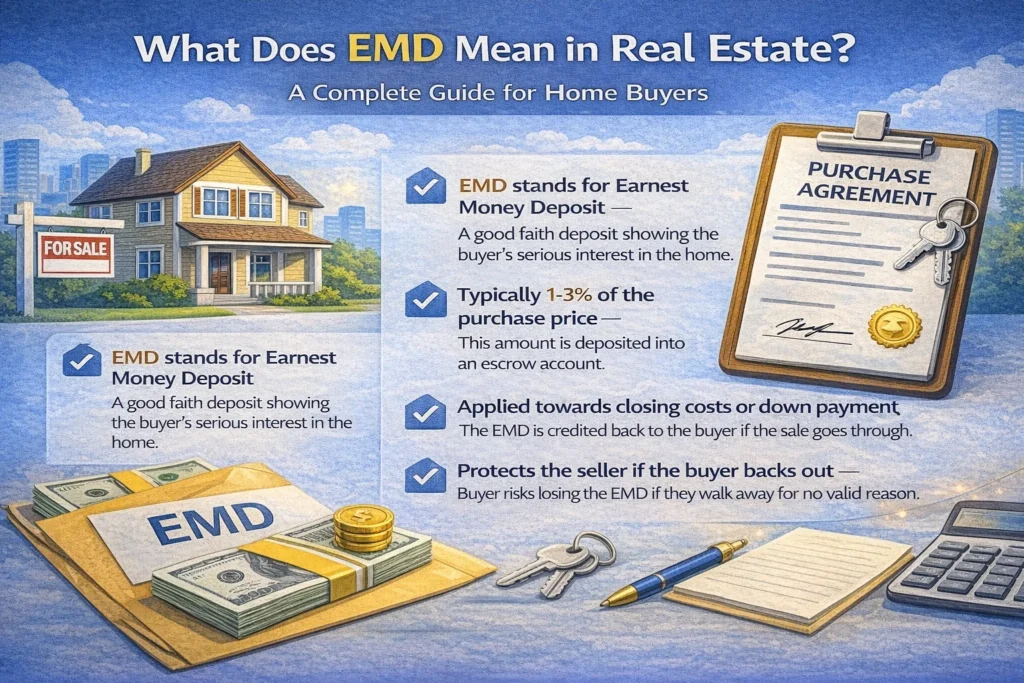
EMD in real estate stands for Earnest Money Deposit. It is a good-faith deposit a buyer makes to show serious intent to purchase a property.
When buying or selling a home, you’ll likely hear the term EMD during the offer stage. It’s one of the most important financial steps in a real estate transaction, yet many first-time buyers are unsure what it really means.
So what does EMD mean in real estate? Why is it required? And what happens to it if a deal falls through?
Let’s break it down clearly and simply so you can navigate your next property transaction with confidence.
In simple terms:
EMD is money you put down when making an offer to prove you’re serious about buying the home.
Understanding Earnest Money Deposit in Simple Terms
When a buyer submits an offer on a property, the seller wants assurance that the buyer won’t walk away casually. The Earnest Money Deposit provides that reassurance.
It shows:
- The buyer is financially capable
- The buyer intends to complete the purchase
- The offer is serious, not speculative
The EMD is usually held in an escrow account until closing.
How Much Is an EMD?
EMD amounts vary depending on:
- Market conditions
- Property price
- Location
- Seller expectations
Typically, the Earnest Money Deposit is:
- 1% to 3% of the purchase price in balanced markets
- 5% or more in competitive markets
Example:
If a home costs $400,000 and the buyer offers a 2% EMD:
EMD = $8,000
Where Does the EMD Go?
The deposit is usually held by:
- An escrow company
- A real estate brokerage
- A title company
- An attorney’s trust account
The funds remain secure until closing or contract termination.
What Happens to the EMD at Closing?
At closing, the EMD is:
- Applied toward the buyer’s down payment, or
- Applied toward closing costs
It is not an extra fee. It becomes part of the total purchase amount.
When Can a Buyer Get the EMD Back?
Buyers can typically receive a refund if they cancel the contract within contingency periods.
Common contingencies include:
- Inspection contingency – If major issues are discovered.
- Financing contingency – If the buyer cannot secure a mortgage.
- Appraisal contingency – If the property appraises below the purchase price.
- Title contingency – If legal issues arise with ownership.
If the buyer cancels within the contract’s terms, the EMD is usually refunded.
When Can the Seller Keep the EMD?
If a buyer backs out without a valid contractual reason, the seller may keep the deposit as compensation for lost time and opportunity.
For example:
- Buyer changes their mind with no contingency reason
- Buyer fails to secure financing due to negligence
- Buyer misses agreed deadlines
This protects sellers from non-serious buyers.
Example of EMD in Action
1 Scenario: Successful Closing
- Buyer offers $300,000
- EMD is $6,000
- Closing costs and down payment total $30,000
- At closing, the $6,000 EMD is credited toward that $30,000
2 Scenario: Deal Falls Through
- Buyer discovers foundation damage during inspection
- Cancels within inspection contingency
- EMD is returned
3 Scenario: Buyer Defaults
- Buyer decides not to proceed without valid reason
- Seller retains the $6,000 EMD
EMD vs Down Payment
Many people confuse EMD with down payment. They are different.
| Feature | EMD | Down Payment |
|---|---|---|
| Purpose | Show serious intent | Portion of purchase price |
| Timing | At offer acceptance | At closing |
| Refundable | Yes, under contingencies | No, unless deal fails |
| Amount | Usually 1%–5% | Often 5%–20% or more |
EMD is part of the total funds needed but serves a different purpose.
Why EMD Matters in Competitive Markets
In hot real estate markets:
- Larger EMDs make offers stronger
- Sellers may favor buyers offering higher deposits
- It signals financial stability
A strong EMD can sometimes help win bidding wars.
Risks of EMD
While generally safe when handled properly, there are risks:
- Missing contingency deadlines
- Not understanding contract terms
- Disputes between buyer and seller
- Incomplete documentation
Always review the purchase agreement carefully.
Tips for Protecting Your Earnest Money
- Read your purchase contract thoroughly
- Understand contingency deadlines
- Work with an experienced real estate agent
- Use reputable escrow or title companies
- Get everything in writing
These steps reduce the risk of losing your deposit.
EMD in Commercial Real Estate
In commercial property transactions:
- EMD amounts are often larger
- Due diligence periods are longer
- Negotiations may be more complex
However, the core concept remains the same: good-faith intent.
FAQs
What does EMD mean in real estate?
EMD stands for Earnest Money Deposit, a good-faith payment showing serious intent to purchase property.
Is EMD refundable?
Yes, if the buyer cancels under valid contingencies in the contract.
How much is a typical EMD?
Usually 1% to 3% of the purchase price, but it can be higher in competitive markets.
Is EMD part of the down payment?
Yes. At closing, the EMD is credited toward the down payment or closing costs.
Who holds the earnest money deposit?
Typically an escrow company, title company, or real estate brokerage.
Can a seller keep the EMD?
Yes, if the buyer breaches the contract without valid reason.
When is EMD paid?
Usually shortly after the offer is accepted and the contract is signed.
Does EMD make an offer stronger?
Yes. A larger deposit can signal commitment and improve competitiveness.
Conclusion
The Earnest Money Deposit plays a vital role in real estate transactions. It balances trust between buyer and seller, strengthens offers, and protects both parties from unnecessary risk.
For buyers, understanding EMD ensures you protect your deposit while demonstrating seriousness. For sellers, it offers financial assurance that the buyer intends to follow through.
In short, EMD is more than just a deposit it’s a commitment that moves a property transaction forward with confidence.
Discover More Related Articles:
- Everything About LDW in Cars: How to Use It Properly in 2026
- Incurred Expenses Explained: What the Term Means in Accounting in 2026
- Why FTE Is Crucial for Your Business: Understanding Workload in 2026

Laura Jackson is a writer at textroast.com, where she creates engaging articles that decode the meanings behind slang, phrases, and everyday expressions. Passionate about language and communication, she makes complex or confusing terms easy to understand, turning learning into a fun and relatable experience for readers around the world.