
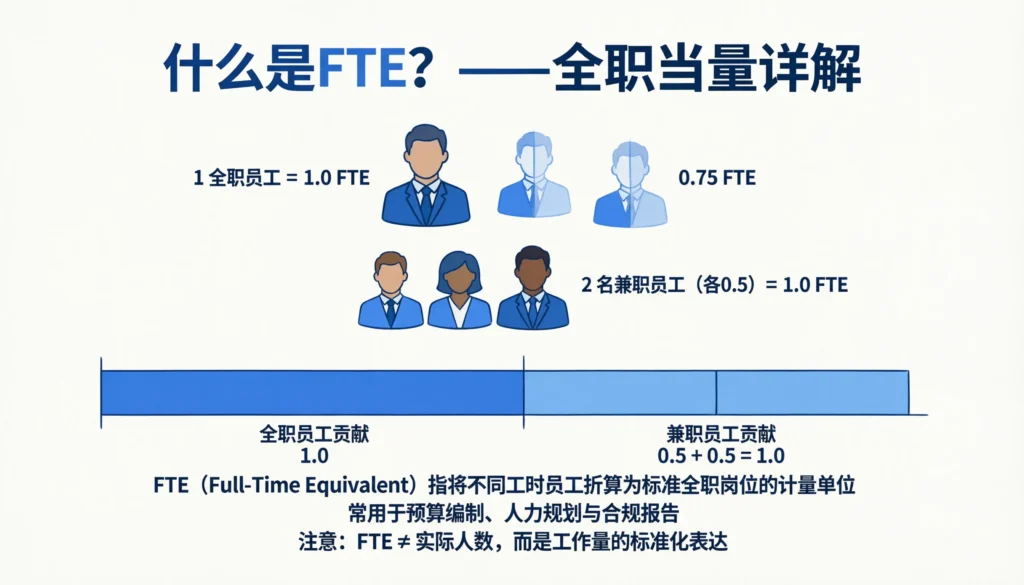
FTE in business stands for Full-Time Equivalent. It is a unit that measures an employee’s workload in comparison to a full-time schedule, typically used to standardize workforce analysis.
In business discussions about workforce, staffing, or budgeting, you may have come across the term FTE. It’s a common term in HR, finance, and management, but it can be confusing if you’re new to corporate lingo.
So what does FTE mean in business, and why is it important? Whether you’re planning headcount, evaluating employee productivity, or budgeting labor costs, understanding FTE is essential.
This article will explain what FTE means, how it is calculated, real-world examples, related terms, and answers to frequently asked questions.
In simple terms:
One FTE equals the workload of one full-time employee. Part-time employees are calculated as fractions of FTEs.
Understanding FTE in Simple Terms
FTE is a way to standardize staffing regardless of whether employees work full-time or part-time.
For example:
- One full-time employee working 40 hours per week = 1 FTE
- Two part-time employees working 20 hours each per week = 1 FTE
This allows companies to compare staffing, productivity, and costs consistently.
Why Businesses Use FTE
FTE is used for:
- Workforce planning
- Budgeting salaries and labor costs
- Resource allocation
- Analyzing productivity
- Reporting to government or regulatory agencies
It simplifies complex staffing scenarios where employees work varying hours.
How to Calculate FTE
The general formula for FTE is:
FTE = Total hours worked by all employees ÷ Number of hours considered full-time
Example 1: Simple Calculation
- Full-time hours per week: 40
- Employee A works 40 hours → 1 FTE
- Employee B works 20 hours → 0.5 FTE
- Employee C works 30 hours → 0.75 FTE
Total FTE = 1 + 0.5 + 0.75 = 2.25 FTE
Example 2: Monthly FTE
If a full-time employee works 160 hours per month:
- Employee D works 80 hours → 0.5 FTE
- Employee E works 160 hours → 1 FTE
Total FTE = 1.5 FTE
This approach standardizes staffing numbers for analysis.
FTE vs Headcount
FTE and headcount are related but different:
| Metric | Definition | Example |
|---|---|---|
| Headcount | Number of individual employees | 5 employees |
| FTE | Total workload standardized to full-time | 3.5 FTE (because some are part-time) |
It accounts for hours worked, while headcount only counts people.
Full-Time vs Part-Time in FTE
FTE is particularly helpful when employees have varying schedules:
- Full-time: 1 FTE
- Part-time 20 hours/week (out of 40) = 0.5 FTE
- Temporary contractors are calculated similarly based on hours worked
This allows management to understand total workforce capacity, not just the number of people.
FTE in Financial Planning
Businesses use FTE to plan labor costs efficiently:
- Budgeting salaries: FTE helps calculate total labor expenses based on full-time equivalents.
- Forecasting staffing needs: Determines how many FTEs are required for a project or department.
- Compliance reporting: Some government programs require reporting FTEs for benefits eligibility.
Example: If a company needs 10 FTEs for a project, they could hire:
- 10 full-time employees
- 20 part-time employees working 20 hours each
Both scenarios provide the same workforce capacity in FTE terms.
FTE in Project Management
Project managers also use FTE to:
- Allocate resources accurately
- Track team workload
- Predict project timelines based on staff availability
For example, a project requiring 200 total hours could be assigned to:
- 2 FTE employees (100 hours each)
- 4 part-time employees (50 hours each)
FTE in Healthcare and Education
FTE is widely used in industries with varying work schedules:
Healthcare
Hospitals calculate FTEs to ensure adequate staffing for patient care, considering part-time nurses, interns, and specialists.
Education
Schools use FTE to account for part-time teachers, aides, and administrative staff in budgeting and reporting.
FTE in Government Reporting
Some government programs and labor laws require organizations to report FTEs for:
- Health insurance eligibility
- Retirement benefits
- Workforce statistics
FTE provides a standardized measure, ensuring consistency across organizations.
Advantages of Using FTE
- Standardizes workforce measurement
- Helps with labor cost management
- Simplifies staffing analysis
- Improves productivity tracking
- Ensures regulatory compliance
Common Misconceptions About FTE
- FTE equals employee headcount → False. FTE measures hours worked, not number of employees.
- FTE applies only to full-time staff → False. Part-time employees are included proportionally.
- FTE determines workload precisely → False. It standardizes hours but does not reflect individual efficiency.
Example Scenario
A company has the following employees:
- Alice: Full-time 40 hours/week → 1 FTE
- Bob: Part-time 20 hours/week → 0.5 FTE
- Charlie: Part-time 30 hours/week → 0.75 FTE
Total FTE = 1 + 0.5 + 0.75 = 2.25 FTE
Even though there are three employees (headcount), the workforce capacity equals 2.25 full-time employees.
FAQs
What does FTE mean in business?
FTE stands for Full-Time Equivalent, a unit that measures employee workload relative to a full-time schedule.
How do you calculate FTE?
Add total hours worked by all employees and divide by the number of hours considered full-time.
Is FTE the same as headcount?
No. Headcount counts employees, while FTE measures total workload standardized to full-time hours.
Can part-time employees count as FTE?
Yes. Their hours are converted to a fraction of a full-time schedule.
Why do businesses use FTE?
To standardize workforce capacity, manage labor costs, and plan staffing efficiently.
Does FTE include contractors?
It can, if contractors’ hours are accounted for in workforce calculations.
What is 1 FTE?
1 FTE equals the work hours of one full-time employee, typically 40 hours/week or 160 hours/month.
How is FTE used in budgeting?
FTE is used to calculate total labor costs, forecast staffing needs, and allocate resources for projects.
Conclusion
Understanding FTE in business is essential for HR, finance, and management. It provides a clear, standardized way to measure workforce capacity, budget for labor costs, and allocate resources efficiently.
You’re analyzing your company’s staffing, preparing budgets, or managing projects, FTE gives you an accurate view of your workforce beyond simple headcount.
Using FTE wisely helps organizations make informed decisions about hiring, scheduling, and resource allocation.
Discover More Related Articles:
- CC in Outlook: Meaning, Etiquette, and Best Practices in 2026
- Archive Feature Explained: How It Works Across Messaging Platforms in 2026

Daniel Moore is a content writer and language enthusiast at TextRoast.com, specializing in decoding slang, abbreviations, and trending text expressions. He creates engaging and informative articles that help readers understand the meaning behind everyday words and online communication.