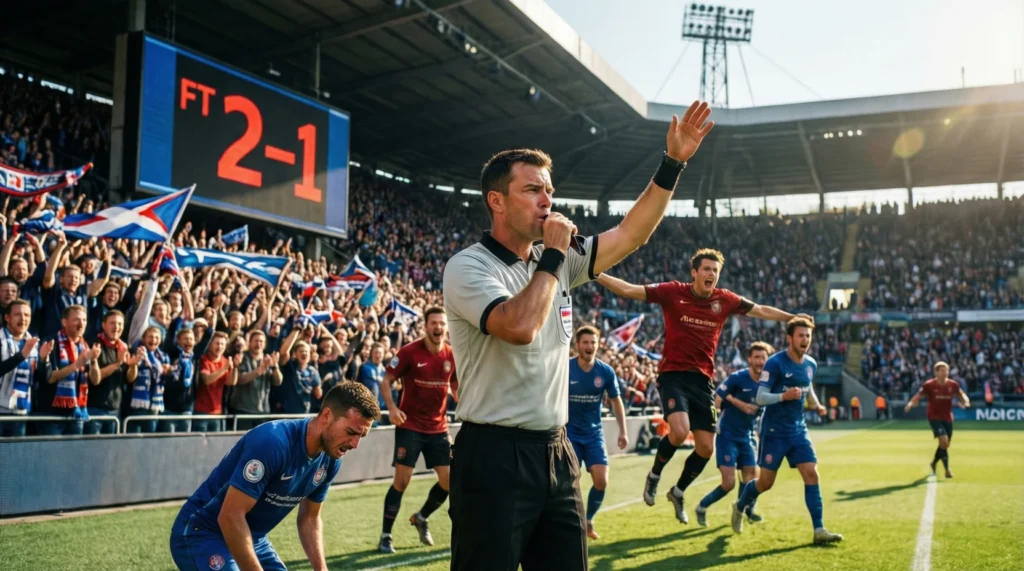
Full time in soccer means the moment a match officially ends after the regulation playing time, usually 90 minutes, plus any added stoppage time, with the score at that moment recorded as the final result.
If you have ever watched a soccer match, you have probably heard the commentator say, “That’s full time,” just as the referee blows the final whistle. I’ve noticed that this simple phrase carries huge importance in soccer.
For fans, full time is the emotional peak of the game. For players, it is the moment when effort turns into outcome. Whether you are watching a local league match, following the Premier League, or reading a match report online, understanding what full time means in soccer helps you follow the game with clarity and confidence.
This guide explains the meaning of full time in soccer in a clear, friendly, and professional way. I will cover its origin, real-world usage, examples, comparisons with similar terms, and common questions people ask.
What Does Full Time Mean in Soccer?
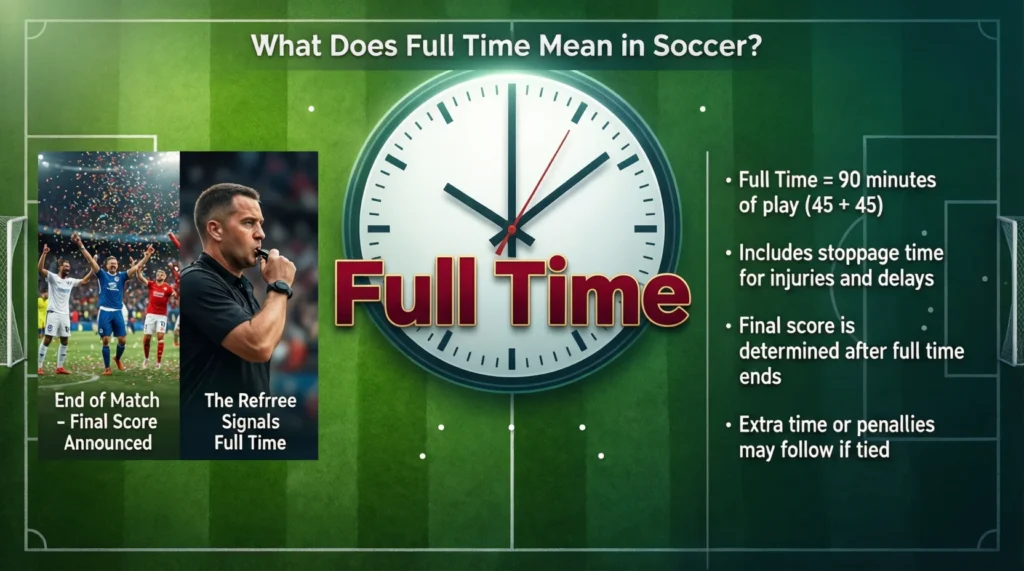
A standard soccer match includes:
- Two halves of 45 minutes each
- Additional stoppage time added by the referee
- A final whistle that signals full time
Origin of the Term “Full Time” in Soccer
The term full time comes from the early days of organized football in England. When soccer rules were first standardized, matches were given a fixed length to ensure fairness and consistency.
Before this standardization, match durations could vary. Once official rules were introduced, the idea of completing the entire allotted time became important.
Popularity and Global Usage
Full time is one of the most commonly used terms in soccer across the globe. You will see or hear it in:
- Live match commentary
- Scoreboards and match summaries
- Sports news headlines
- League tables and statistics
- Soccer betting platforms
How Full Time Works in a Soccer Match
Regulation Time
A standard soccer match lasts 90 minutes:
- 45 minutes in the first half
- 45 minutes in the second half
Stoppage Time
The referee adds stoppage time at the end of each half to compensate for:
- Injuries
- Substitutions
- VAR reviews
- Time-wasting
Final Whistle
When the referee blows the final whistle after regulation and stoppage time, the match reaches full time. The score at that moment is the official result.
Soccer Match Timeline Table
| Match Phase | Time Duration | Included in Full Time |
|---|---|---|
| First half | 45 minutes | Yes |
| Stoppage time first half | Variable | Yes |
| Second half | 45 minutes | Yes |
| Stoppage time second half | Variable | Yes |
| Extra time | 30 minutes | No |
| Penalty shootout | Variable | No |
Real-World Examples of “Full Time” Usage
Neutral or Informative Use
- The match ended 2 to 2 at full time.
- It was goalless at full time.
Excited or Emotional Use
- What a comeback, 3 to 2 at full time.
- The crowd erupted at full time.
Negative or Critical Use
- A disappointing performance, 0 to 0 at full time.
- They failed to score again at full time.
The tone depends on the result and expectations of the teams involved.
Full Time vs Similar Soccer Terms
Understanding full time becomes easier when compared with related soccer terms.
Comparison Table
| Term | Meaning | When It Applies |
|---|---|---|
| Full time | End of regulation and stoppage time | All matches |
| Half time | End of first half | Mid-match |
| Extra time | Additional 30 minutes | Knockout matches |
| Penalties | Shootout to decide winner | After extra time |
| Full-time result | Score at full time only | Leagues and betting |
Full Time vs Extra Time
A common point of confusion is the difference between full time and extra time.
- Full time ends the regular match
- Extra time is played only if competition rules require a winner
For example:
- The match ends 1 to 1 at full time
- Extra time is played
- The final score after extra time becomes 2 to 1
Even in this case, the match was still tied at full time.
Does Full Time Always End the Match?
In league matches, full time usually ends the match completely. A draw is allowed and points are shared.
In knockout competitions, a draw at full time may lead to:
- Extra time
- Penalty shootouts
Even then, full time still marks the end of normal play.
Alternate Meanings of “Full Time”
Outside of soccer, full time can mean:
- Working full time at a job
- Being a full-time student
In soccer, however, the meaning is specific and always related to match duration.
Professional Alternatives to “Full Time”
In formal writing or commentary, you may see:
- At the end of regulation
- After 90 minutes
- At the conclusion of normal time
These phrases mean the same thing as full time.
FAQs
What does full time mean in soccer?
It means the match has ended after regulation and stoppage time, and the score is final.
Is full time always 90 minutes?
The regulation time is 90 minutes, but stoppage time is added.
Does full time include extra time?
No, extra time is a separate phase.
What does FT mean on scoreboards?
FT stands for full time and shows the final regulation score.
Can a match end in a draw at full time?
Yes, especially in league competitions.
Is full time used in youth soccer?
Yes, though match length may be shorter.
What happens if the score is tied at full time?
It may end as a draw or continue to extra time, depending on the rules.
Is full time the same in all soccer leagues?
The concept is the same worldwide, with minor variations in match length.
Conclusion
Full time in soccer marks the official end of a match after regulation and stoppage time.
It determines the final score, shapes league standings, and defines match outcomes.
Understanding this term helps fans, writers, and new viewers follow soccer more confidently and enjoy the game with greater clarity.
Discover More Related Articles:
- What Does ACP Stand For in Ammunition? Easy Explanation (2026)
- Cara in Italian: Meaning, How to Use It & Examples (2026)

David Brown is a content writer and language enthusiast at textroast.com, where he creates insightful articles that explain the meanings of words, slang, and phrases used in everyday life. His work helps readers decode modern language trends, understand cultural expressions, and make sense of online communication with clarity and fun.