Definition
In language learning, “intermediate” refers to a level where a learner can understand and communicate in everyday situations with some confidence, but still makes mistakes and lacks full fluency or advanced vocabulary.
If you’ve ever taken a language course, downloaded a learning app, or even described your own skills, you’ve probably come across the term intermediate. It’s one of those labels that sounds clear at first but when you actually think about it, it can feel a little vague.
Are you truly intermediate if you can hold a conversation?
Does intermediate mean you’re “almost fluent”?
Or does it simply mean you’re no longer a beginner?
Understanding what intermediate really means in language learning is important not just for setting goals, but also for tracking your progress and communicating your abilities accurately.
In this guide, we’ll break down everything you need to know about the term “intermediate” in language learning, including its meaning, origin, real-life usage, examples, comparisons, and practical tips.
What Does Intermediate Mean in Language?
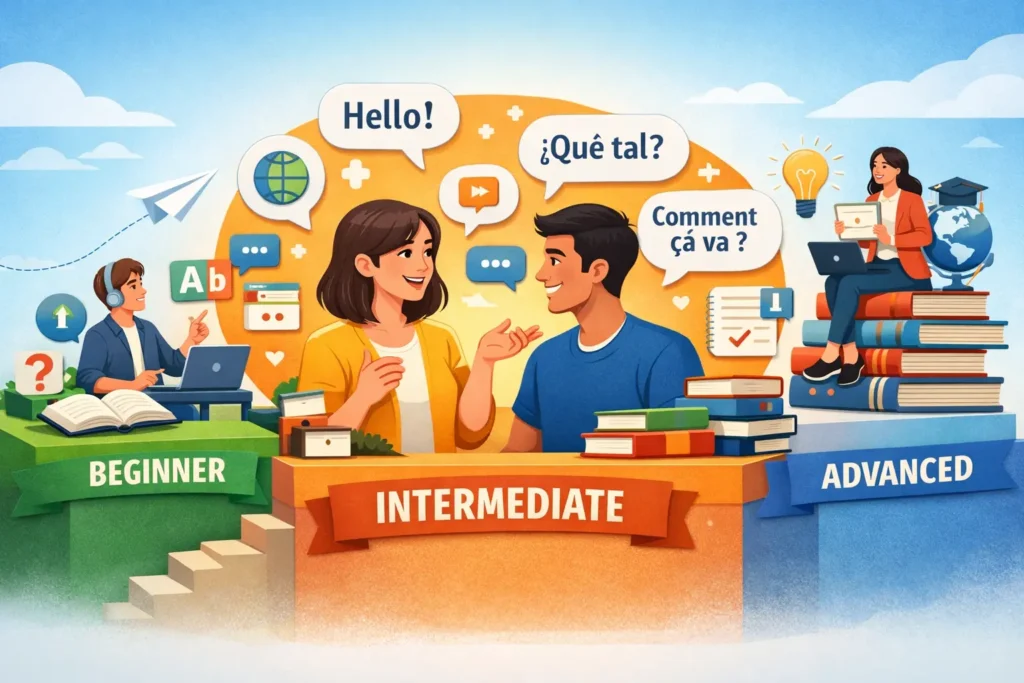
At its core, the word intermediate means “in between.” In language learning, it sits between beginner and advanced levels.
Key Characteristics of an Intermediate Language Learner
An intermediate learner typically:
- Understands common vocabulary and phrases
- Can participate in everyday conversations
- Makes grammatical mistakes but is still understandable
- Can read simple texts and understand the main idea
- Has limited but growing confidence
Simple Breakdown
| Level | Description |
|---|---|
| Beginner | Knows basic words and phrases |
| Intermediate | Can communicate in daily situations |
| Advanced | Speaks fluently with accuracy and nuance |
Origin and Meaning of the Word “Intermediate”
The word intermediate comes from the Latin word intermedius, which means “in the middle.”
- Inter = between
- Medius = middle
Originally, the term was used in general contexts like education, skill levels, and processes. Over time, it became widely adopted in language learning systems to describe a middle stage of proficiency.
Why It Became Popular in Language Learning
Language learning needed a simple way to divide progress into stages:
- Beginner (starting point)
- Intermediate (developing stage)
- Advanced (mastery stage)
This three-level structure became popular because it’s easy to understand and widely applicable.
Intermediate Language Levels in Modern Systems
Today, many structured systems define “intermediate” more precisely.
CEFR Framework (Common European Framework of Reference)
The most widely used system divides language levels into:
- A1–A2: Beginner
- B1–B2: Intermediate
- C1–C2: Advanced
Intermediate Levels Explained
| CEFR Level | Description |
|---|---|
| B1 (Lower Intermediate) | Can handle travel, daily conversations, and simple topics |
| B2 (Upper Intermediate) | Can discuss more complex ideas and understand detailed content |
Real-World Usage of “Intermediate”
The term “intermediate” is used in many real-life situations:
1. Language Courses
- “This is an intermediate English class.”
2. Job Applications
- “Intermediate Spanish required.”
3. Self-Assessment
- “I’m at an intermediate level in French.”
4. Language Apps
Apps often label lessons as:
- Beginner
- Intermediate
- Advanced
Examples of Intermediate Language Skills
Let’s look at practical examples of what intermediate learners can do.
Speaking
- “I went to the market yesterday and bought some fruits.”
- “I think this movie is interesting because the story is emotional.”
Listening
- Understands basic conversations, podcasts, or TV shows (with some difficulty)
Reading
- Can read short articles, emails, or simple stories
Writing
- Can write short paragraphs or messages
Tone-Based Examples of “Intermediate” Usage
Even though intermediate is a neutral term, context can affect tone.
Friendly Tone 😊
- “You’re already intermediate that’s great progress!”
Neutral Tone
- “This course is designed for intermediate learners.”
Slightly Dismissive Tone 😐
- “Your skills are still at an intermediate level.”
Example Table: Beginner vs Intermediate vs Advanced
| Skill Area | Beginner | Intermediate | Advanced |
|---|---|---|---|
| Speaking | Basic phrases | Conversations with errors | Fluent and natural |
| Listening | Simple words | Understands main ideas | Understands details |
| Reading | Short sentences | Paragraphs and articles | Complex texts |
| Writing | Simple sentences | Structured paragraphs | Professional writing |
Intermediate vs Similar Terms
Understanding how intermediate compares to related terms can prevent confusion.
Beginner vs Intermediate
- Beginner = Just starting
- Intermediate = Can communicate in real situations
Advanced vs Intermediate
- Intermediate = Functional communication
- Advanced = Fluent, accurate, and expressive
Fluent vs Intermediate
- Intermediate ≠ Fluent
- Fluent means speaking smoothly and confidently with minimal mistakes
Intermediate vs Proficient
- Proficient usually means high-level ability
- Intermediate is still developing
Alternate Meanings of “Intermediate”
While this article focuses on language learning, intermediate can have other meanings:
1. Education
- Intermediate school (middle level education)
2. Skills
- Intermediate level in sports or music
3. Business/Finance
- Intermediate goods (used in production)
Common Challenges at the Intermediate Level
Many learners feel “stuck” at intermediate. This is often called the intermediate plateau.
Why This Happens
- Vocabulary growth slows down
- Grammar becomes more complex
- Progress feels less noticeable
How to Overcome It
- Practice speaking regularly
- Consume real content (movies, podcasts)
- Expand vocabulary daily
- Focus on weak areas
Polite or Professional Alternatives
Instead of saying “intermediate,” you might use:
- “Working proficiency”
- “Conversational level”
- “Moderate fluency”
- “Developing proficiency”
These alternatives can sound more polished, especially in professional contexts.
Usage Tips: When to Say You’re Intermediate
Be Honest
Don’t overestimate your level. Employers or teachers may test you.
Give Context
Instead of just saying “intermediate,” add details:
- “Intermediate speaking, basic writing”
- “Upper-intermediate reading skills”
Use Recognized Levels
Mention CEFR levels if possible:
- “B1 English level”
FAQs
1. What does intermediate mean in language learning?
It means you can communicate in everyday situations but are not yet fluent.
2. Is intermediate the same as fluent?
No, intermediate learners still make mistakes and lack full confidence.
3. What level is intermediate in English?
Typically B1 or B2 in the CEFR system.
4. How long does it take to reach intermediate level?
It depends on the language, but usually 3–12 months with consistent study.
5. Can an intermediate speaker understand native speakers?
Yes, but only in slower or clearer conversations.
6. What comes after intermediate?
The next level is advanced.
7. Is intermediate good enough for jobs?
For some roles, yes but many require advanced or fluent skills.
8. How can I move from intermediate to advanced?
Practice speaking daily, learn complex grammar, and immerse yourself in the language.
Conclusion
The term intermediate in language learning represents an important and exciting stage, where learners move beyond basic phrases and begin using the language in real, meaningful ways. At this level, “intermediate” essentially means being in between beginner and advanced, and it focuses on developing practical, real-world communication skills.
This stage is often divided into two sub-levels: lower intermediate (B1) and upper intermediate (B2), each reflecting a deeper level of understanding and fluency. Although progress at this stage may feel slower compared to the early phases, improvement is still happening steadily.
Discover More Related Articles:
- iReady Level G Explained: What It Means & Why It Matters in 2026
- i-Ready Level C Explained: What It Means & Why It Matters In 2026

Laura Jackson is a writer at textroast.com, where she creates engaging articles that decode the meanings behind slang, phrases, and everyday expressions. Passionate about language and communication, she makes complex or confusing terms easy to understand, turning learning into a fun and relatable experience for readers around the world.