Definition:
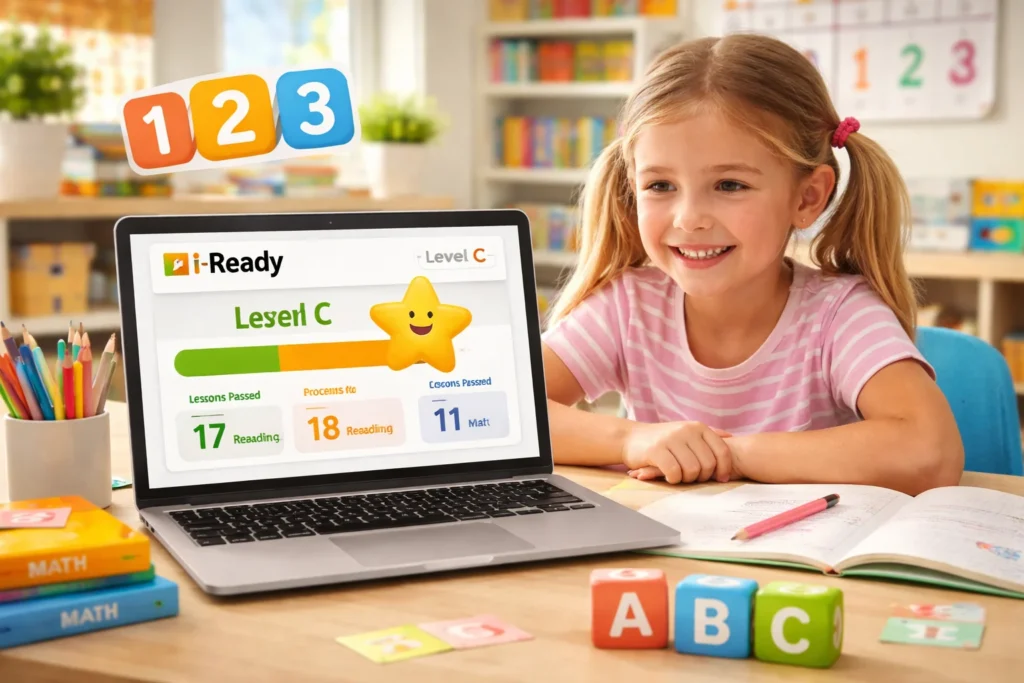
Level C in i-Ready typically corresponds to a mid–1st grade learning level. It indicates that a student is working on foundational reading and math skills such as basic phonics, simple sentence comprehension, number sense, and early problem-solving.
If you’ve ever opened your child’s i-Ready report and seen “Level C,” you might have paused and wondered is that good, bad, or average? You’re not alone.
i-Ready is widely used in schools to assess and personalize learning, but its level system (A through H and beyond) can feel confusing at first glance. Level C, in particular, sits at an important stage in a student’s development. It represents a shift from basic beginner skills to more structured learning.
In this complete guide, you’ll learn exactly what Level C means in i-Ready, how it compares to other levels, what skills students are expected to have and how parents and teachers can support progress.
What Does Level C Mean in i-Ready?
Level C in i-Ready is designed for students performing at a 1st-grade level, usually in the middle of the academic year.
Key Highlights:
- 📘 Grade Equivalent: Mid–1st Grade
- 🧠 Skill Focus: Foundational literacy and math
- 📊 Assessment Role: Indicates current performance level, not necessarily grade placement
- 🎯 Purpose: Helps tailor lessons to the student’s needs
It’s important to understand that i-Ready levels don’t strictly match a student’s actual grade. A student in Grade 2 could be placed at Level C if they need support in foundational skills.
How i-Ready Levels Work
Before diving deeper into Level C, let’s quickly understand the level system.
| i-Ready Level | Approximate Grade Equivalent |
|---|---|
| Level A | Kindergarten (early) |
| Level B | Kindergarten (late) |
| Level C | 1st Grade (mid) |
| Level D | 2nd Grade |
| Level E | 3rd Grade |
| Level F | 4th Grade |
| Level G | 5th Grade |
| Level H | 6th Grade |
👉 Level C acts as a bridge between early learning and more structured academic thinking.
Skills Covered in Level C
📖 Reading Skills in Level C
Students at Level C are developing early literacy skills that form the foundation for fluent reading.
Key Reading Skills:
- Recognizing common sight words
- Understanding simple sentences
- Identifying beginning, middle, and ending sounds
- Basic phonics (blending and decoding words)
- Reading short passages with comprehension
Example:
A student may read a sentence like:
👉 “The cat is on the mat.”
Then answer a question like:
👉 “Where is the cat?”
➗ Math Skills in Level C
Math at this level focuses on understanding numbers and simple operations.
Key Math Skills:
- Counting up to 100
- Basic addition and subtraction (within 20)
- Understanding place value (tens and ones)
- Comparing numbers (greater than / less than)
- Solving simple word problems
Example:
👉 “If you have 5 apples and get 3 more, how many apples do you have?”
Origin and Purpose of i-Ready Levels
i-Ready was developed by Curriculum Associates as a diagnostic and instructional tool to help teachers understand each student’s abilities.
Why Levels Like C Exist:
- To identify skill gaps
- To personalize learning paths
- To track progress over time
- To support differentiated instruction
Popularity in Schools:
i-Ready is used in thousands of schools worldwide because it:
- Adapts to each student’s level
- Provides real-time performance data
- Aligns with educational standards
Real-World Usage of Level C
Let’s look at how Level C is used in everyday school scenarios.
🏫 In the Classroom
Teachers use Level C results to:
- Group students by skill level
- Assign targeted lessons
- Monitor improvement
👨👩👧 For Parents
Parents might see Level C in:
- Progress reports
- Diagnostic results
- Online dashboards
Tone and Interpretation: Is Level C Good or Bad?
Here’s the truth: Level C is neither “good” nor “bad.” It’s simply a data point.
😊 Positive Interpretation
- The student is building essential foundational skills
- They are progressing at an early elementary level
😐 Neutral Interpretation
- The student is working at a 1st-grade level regardless of actual grade
⚠️ Concern (Context Matters)
- If a 3rd-grade student is at Level C, it may indicate a need for support
Example Scenarios (With Context and Tone)
| Scenario | Interpretation | Tone |
|---|---|---|
| 1st grader at Level C | On track | 👍 Positive |
| Kindergarten student at Level C | Above average | 🌟 Exciting |
| 3rd grader at Level C | Needs support | ⚠️ Concerned but constructive |
| Student improving from Level B to C | Progress | 🎉 Encouraging |
Comparison: Level C vs Other i-Ready Levels
Level B vs Level C
- Level B: Basic kindergarten skills
- Level C: More structured learning (reading simple sentences, early math)
Level C vs Level D
- Level C: Foundational skills
- Level D: More independence and complexity (2nd grade level)
Key Difference:
👉 Level C is where students transition from learning basics to applying them.
Alternate Meanings of “Level C”
While “Level C” in i-Ready refers to a learning level, it can have different meanings in other contexts:
- Education Systems: Grade levels or reading benchmarks
- Gaming: Difficulty levels
- Workplace Training: Skill tiers
However, in this article, we focus specifically on i-Ready.
Polite or Professional Alternatives (When Discussing Progress)
Instead of saying:
❌ “My child is only at Level C.”
You can say:
✔️ “My child is currently working at a Level C, focusing on foundational skills.”
Other alternatives:
- “Developing early literacy skills”
- “Building core math understanding”
- “Progressing through foundational levels”
Tips to Help a Student Move Beyond Level C
📚 For Reading
- Read daily (even 10–15 minutes helps!)
- Practice sight words
- Use phonics-based games
➗ For Math
- Practice counting and simple addition
- Use real-life examples (e.g., counting toys 🍎)
- Try fun math apps or worksheets
🎯 General Tips
- Celebrate small progress 🎉
- Avoid pressure or comparison
- Stay consistent with practice
FAQs
1. What grade level is Level C in i-Ready?
Level C corresponds to approximately mid–1st grade.
2. Is Level C good in i-Ready?
It depends on the student’s grade. It’s appropriate for 1st graders but may indicate gaps for older students.
3. Can a student skip Level C?
Yes, if they demonstrate higher skills during diagnostic assessments.
4. How can my child move from Level C to Level D?
Consistent practice in reading and math, along with targeted support, helps students advance.
5. Is Level C below grade level?
Not necessarily. It depends on the student’s current grade.
6. How long does it take to move past Level C?
It varies, but typically a few months with regular practice.
7. What subjects are included in Level C?
Reading and math are the main focus areas.
8. Should I be worried if my child is at Level C?
Only if it’s significantly below their grade level. Otherwise, it’s part of normal progress.
Conclusion
Level C in i-Ready represents an important stage in a child’s learning journey. It’s where foundational skills in reading and math begin to solidify and grow.
Level C represents a mid–1st grade learning level and focuses on building essential foundational skills in reading and math. It’s important to remember that this level is not a judgment of a student’s ability, but rather a helpful guide that shows where they are in their learning journey and what they need to improve.
Ultimately, progress matters far more than the level itself, as every step forward reflects growth and development.
Discover More Related Articles:
- TR in College Schedule Explained: How to Read Your Timetable in 2026
- What It Means to Be Admitted to College: Steps After Acceptance in 2026

David Brown is a content writer and language enthusiast at textroast.com, where he creates insightful articles that explain the meanings of words, slang, and phrases used in everyday life. His work helps readers decode modern language trends, understand cultural expressions, and make sense of online communication with clarity and fun.