
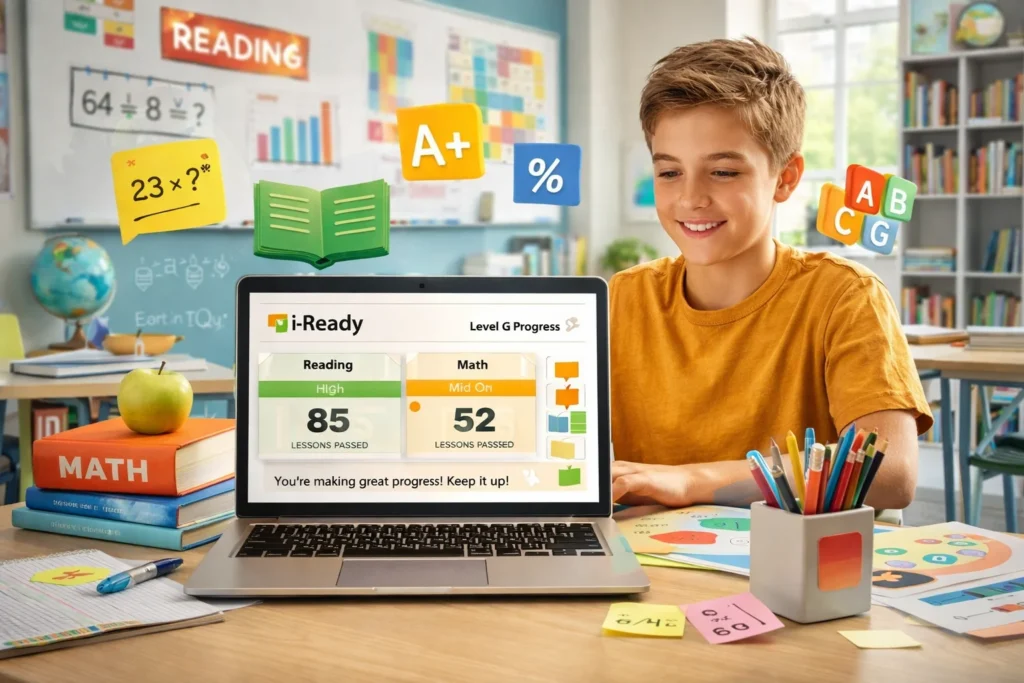
Definition:
Level G in i-Ready refers to a mid-to-late elementary or early middle school instructional level, typically aligned with 7th-grade academic skills in reading and math. It indicates that a student is working on concepts such as advanced comprehension, critical thinking, ratios and pre-algebra foundations.
If you’ve ever opened an i-Ready report and seen your child placed at Level G, you might have wondered: Is that good? Is it on grade level? Should I be concerned?
You’re not alone.
Thousands of parents and students search for “what does Level G mean in iReady” every month because i-Ready uses its own leveling system and it’s not always intuitive. Unlike traditional grade labels, these levels (A through H and beyond) represent skill progression, not just grade placement.
Understanding Level G can help you:
- Track academic progress accurately
- Identify strengths and gaps
- Support learning at home more effectively
Let’s break it all down in a clear, simple, and practical way.
What Is i-Ready? A Quick Overview
Before diving deeper, it helps to understand the platform itself.
i-Ready is an adaptive learning program used in many schools across the U.S. It assesses and teaches:
- Reading comprehension
- Vocabulary
- Grammar
- Mathematics skills
The system adjusts in real-time, meaning students move up or down levels based on performance.
What Does Level G Mean in i-Ready?
Core Explanation
Level G generally corresponds to:
| Category | Description |
|---|---|
| Grade Equivalent | Around 7th Grade |
| Skill Level | Intermediate to Advanced |
| Focus Areas | Critical thinking, complex reading, algebra readiness |
In Simple Terms:
If a student is at Level G, it means:
- They are working on middle school-level material
- They have solid foundational skills
- They are ready for more complex problem-solving and analysis
Skills Covered in Level G
Level G isn’t just one thing it covers a wide range of skills in both reading and math.
📚 Reading Skills (Level G)
Students typically learn:
- Analyzing themes and central ideas
- Understanding author’s purpose
- Comparing texts
- Interpreting figurative language
- Drawing evidence-based conclusions
👉 Example:
A student might read a passage and answer questions like:
“What is the author trying to imply about society?”
🔢 Math Skills (Level G)
Key topics include:
- Ratios and proportional relationships
- Expressions and equations
- Basic algebra concepts
- Percentages and word problems
- Data analysis
👉 Example:
If 3 pencils cost $6, how much do 10 pencils cost?
Is Level G Good in i-Ready?
Short Answer: Yes Generally, It’s a Strong Level
But context matters.
Here’s how to interpret it:
| Student Grade | Level G Meaning |
|---|---|
| 5th Grade | Above Grade Level 🚀 |
| 6th Grade | Slightly Above Grade Level 👍 |
| 7th Grade | On Grade Level ✅ |
| 8th Grade | Slightly Below Grade Level ⚠️ |
Key Insight:
Level G is not inherently “good” or “bad” it depends on the student’s current grade.
How i-Ready Levels Work (A–H Breakdown)
To understand Level G fully, it helps to see the bigger picture.
| Level | Approx Grade | Description |
|---|---|---|
| A | K | Beginner skills |
| B | 1st Grade | Early foundational |
| C | 2nd Grade | Basic comprehension |
| D | 3rd Grade | Developing skills |
| E | 4th Grade | Intermediate |
| F | 5th–6th | Strong foundational |
| G | 7th Grade | Advanced intermediate |
| H | 8th Grade | Advanced |
Why Students Are Placed at Level G
i-Ready uses a diagnostic test to determine placement.
Factors include:
- Accuracy in answers
- Speed of response
- Consistency
- Difficulty level of questions answered correctly
Important:
A student might not be at their actual grade level if:
- They rushed through the test
- They guessed answers
- They had test anxiety
Real-World Usage: What Level G Looks Like in Practice
Let’s explore how Level G appears in everyday learning.
🧑🎓 Classroom Scenario
A 7th-grade student:
- Reads a complex article about climate change
- Identifies bias and supporting evidence
- Solves multi-step algebra problems
🏠 At Home
Parents might notice:
- Homework involving word problems
- Reading assignments with deeper analysis
- More independent thinking tasks
Examples of Level G in Context
Example Table: Reading vs Math Tasks
| Subject | Example Task | Skill Tested | Tone |
|---|---|---|---|
| Reading | Analyze a poem’s meaning | Interpretation | Neutral |
| Reading | Compare two articles | Critical thinking | Analytical |
| Math | Solve 2-step equations | Problem-solving | Logical |
| Math | Calculate percentages | Application | Practical |
Tone-Based Examples
Even though “Level G” itself isn’t slang, the way it’s discussed can vary:
- Friendly:
“You’re at Level G? That’s awesome you’re doing great! 😊” - Neutral:
“The student is currently performing at Level G in reading.” - Concerned:
“They’re in 8th grade but still at Level G we may need extra support.”
Comparison: Level G vs Other Levels
Level F vs Level G
| Feature | Level F | Level G |
|---|---|---|
| Grade Range | 5th–6th | 7th |
| Complexity | Moderate | Higher |
| Math Focus | Fractions, basics | Algebra intro |
| Reading | Literal understanding | Deep analysis |
Level G vs Level H
| Feature | Level G | Level H |
|---|---|---|
| Grade Range | 7th | 8th |
| Difficulty | Advanced | More rigorous |
| Skills | Pre-algebra | Algebra-ready |
| Reading | Analytical | Highly critical |
Common Misunderstandings About Level G
❌ Myth 1: Level G Means You’re Exactly in 7th Grade
✔️ Reality: It reflects skill level, not actual grade.
❌ Myth 2: Level G Is the Highest Level
✔️ Reality: Levels go beyond G (like H and beyond).
❌ Myth 3: Being Below Level G Is Bad
✔️ Reality: Learning is a process growth matters more than placement.
Alternate Meanings of “Level G”
While this article focuses on i-Ready, “Level G” can appear in other contexts:
- Gaming: Difficulty level
- Reading programs (like F&P): Guided reading level
- Education systems: Grade or tier classification
👉 Always check the context to avoid confusion.
Professional or Polite Alternatives to Saying “Level G”
In formal settings (like meetings or reports), you might say:
- “The student is performing at a mid-middle school level.”
- “The learner demonstrates 7th-grade competencies.”
- “Skill level aligns with Level G benchmarks.”
Tips for Students at Level G
🎯 How to Improve
- Practice word problems daily
- Read non-fiction and complex texts
- Focus on understanding, not memorizing
📘 Helpful Habits
- Ask “why” and “how” questions
- Review mistakes carefully
- Take i-Ready lessons seriously (don’t rush!)
Tips for Parents
- Don’t panic over levels focus on progress
- Encourage consistent practice
- Talk to teachers if unsure
- Celebrate improvements 🎉
FAQs
1. Is Level G in i-Ready good?
Yes, especially if the student is in 6th or 7th grade. It indicates solid academic progress.
2. What grade is Level G in reading?
It generally aligns with 7th-grade reading skills.
3. Is Level G above grade level?
It can be, depending on the student’s actual grade.
4. What comes after Level G?
Level H, which represents more advanced 8th-grade skills.
5. Can a student move out of Level G?
Yes. Progress depends on performance in lessons and diagnostics.
6. Why is my child stuck at Level G?
They may need more practice, or the system is reinforcing key skills.
7. Is Level G the same for math and reading?
Not always. A student can be Level G in math but Level F in reading.
8. How can I help my child move to Level H?
Encourage consistent practice, reading, and problem-solving.
Conclusion
Level G in i-Ready marks an important step in a student’s academic development, where foundational knowledge transitions into more advanced thinking and problem-solving skills. It typically reflects 7th-grade-level abilities, including deeper reading comprehension and early algebra concepts.
The most important thing to remember is that Level G is not just a label it’s a snapshot of current progress. Whether a student is exactly on level, above, or slightly below, what truly matters is consistent improvement over time.
Discover More Related Articles:
- CRN in College Explained: How Course Reference Numbers Work in 2026
- Associate of Arts (AA) in College: Everything You Need to Know in 2026

Daniel Moore is a content writer and language enthusiast at TextRoast.com, specializing in decoding slang, abbreviations, and trending text expressions. He creates engaging and informative articles that help readers understand the meaning behind everyday words and online communication.