Definition:
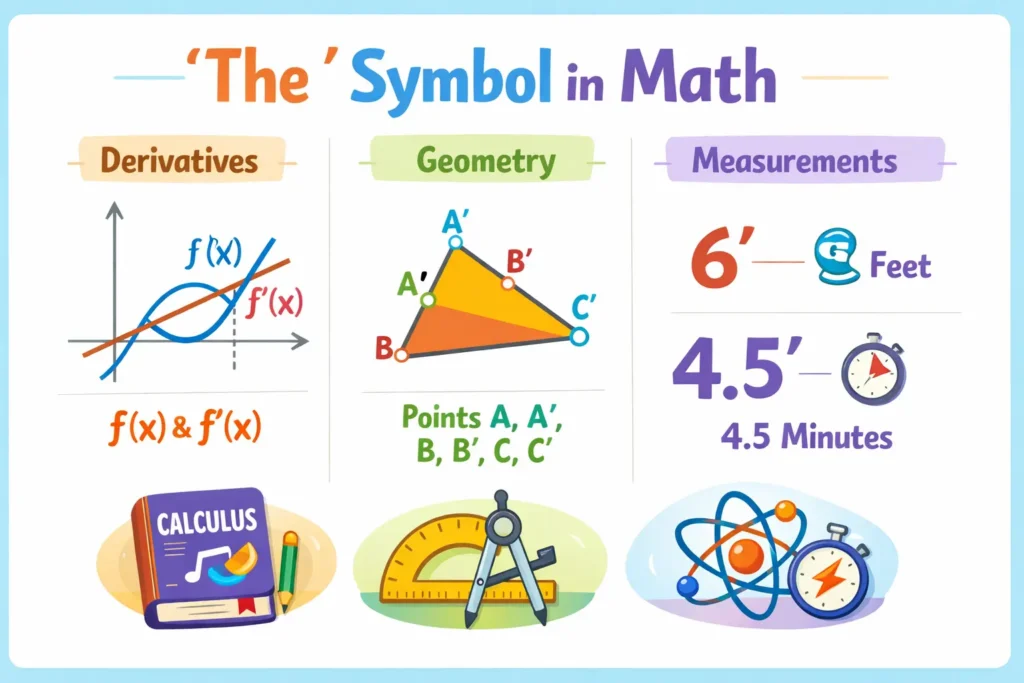
In mathematics, the symbol ‘ (apostrophe or prime) is primarily used to denote a derivative, a modified version of a variable, or a unit of measurement, depending on context. Its usage varies across algebra, calculus, geometry and physics, serving as a concise shorthand for related mathematical concepts.
Origin of the ‘ Symbol in Math
The apostrophe or prime symbol (‘) has a long history in mathematics. Its origin can be traced back to early notations in calculus and physics, where mathematicians needed a simple, compact way to indicate differentiation or modified variables.
In calculus, the prime symbol was popularized by Joseph-Louis Lagrange in the 18th century to indicate derivatives. Instead of writing dxdy, Lagrange used y′ for the first derivative and y′′ for the second derivative. This notation quickly became standard in textbooks and academic papers because of its simplicity.
In geometry, the apostrophe often marks transformed points or angles. For example, if point A is rotated, it might be labeled A′ to signify the new location.
In measurement, especially in astronomy and navigation, the prime symbol denotes minutes (‘) and double prime (“) denotes seconds, such as in angular measurements.
Popularity and Real-World Usage
The ‘ symbol in math is widely recognized and used across multiple disciplines:
- Calculus and Algebra: Denotes derivatives and modified variables.
- Geometry: Marks transformed or corresponding points and angles.
- Physics: Represents quantities that are slightly different or measured in another frame of reference, such as v′ for velocity after a collision.
- Measurement: Represents minutes (‘) in degrees, and feet (‘) in length.
Its popularity stems from its simplicity and versatility. Instead of creating new symbols for every mathematical scenario, the apostrophe serves multiple purposes without cluttering the notation.
How the ‘ Symbol is Used in Math
1. As a Derivative Symbol in Calculus
The prime symbol is most commonly used to indicate derivatives.
- First derivative: f′(x) means the derivative of f(x) with respect to x.
- Second derivative: f′′(x) means the second derivative of f(x).
- Higher-order derivatives: f′′′(x) for the third derivative, and f(n)(x) for the n-th derivative.
Example:
If f(x)=x3, thenf′(x)=3×2,f′′(x)=6x,f′′′(x)=6
2. To Denote a Modified Variable
In algebra or physics, the apostrophe often marks a modified variable or value.
Example:
If x is the original value, x′ may represent a new or adjusted value:
- Original length: L
- Modified length after expansion: L′
This usage avoids confusion when referencing original versus transformed quantities.
3. In Geometry for Points and Angles
The prime symbol is used to identify transformed points, lines, or angles in geometric constructions.
Example:
If triangle ABC is reflected over a line, the reflected points are labeled A′B′C′.
| Original Point | Transformed Point |
|---|---|
| A | A’ |
| B | B’ |
| C | C’ |
4. In Measurement
The ‘ symbol represents minutes in angles or feet in measurements:
- 45° 30′ → 45 degrees, 30 minutes
- 6′ → 6 feet
The double prime (“) denotes seconds in angular measurements or inches in length.
Examples in Different Contexts
Here’s how the ‘ symbol can appear in real scenarios:
- Calculus (Friendly tone 🙂):
- y=x2, then y′=2x
- Quick and neat way to find slopes of curves!
- Geometry (Neutral tone 🟢):
- Original triangle: ABC
- After rotation: A′B′C′
- Makes labeling clear without long explanations.
- Physics (Professional tone ⚡):
- v = initial velocity
- v′ = velocity after impact
- Shows change clearly in equations.
- Measurements (Everyday tone 📏):
- Map coordinate: 32° 45′ N
- Room height: 10′ 6″
- Easy shorthand for length and angles.
Comparison With Related Symbols
It’s helpful to compare ‘ with similar symbols to avoid confusion:
| Symbol | Meaning in Math | Example |
|---|---|---|
| ‘ (prime) | Derivative or modified variable | f′(x),x′ |
| ” (double prime) | Second derivative, seconds, or inches | f′′(x),10″ |
| ˚ (degree) | Angles | 45˚ |
| ^ (caret) | Exponentiation | x2 |
| _ (underscore) | Subscript for indices | x1,x2 |
While similar-looking, each symbol has a unique purpose. Using them correctly prevents misinterpretation.
Alternate Meanings of ‘ in Math
Although mostly used as a prime or derivative symbol, ‘ can have other minor meanings depending on the field:
- Foot (length measurement) – common in construction or architecture.
- Minutes (time/angles) – in navigation or astronomy.
- Transformed variables or points – in geometry or physics.
Being aware of context is key. For instance, 6′ could be six feet in a building plan or six minutes in an angular measurement.
Polite or Professional Alternatives
In academic writing or formal settings, instead of using ‘, you can:
- Write “derivative of f” instead of f′ for clarity.
- Use “transformed variable x” instead of x′ when explaining in words.
- Write “minutes” or “feet” fully in descriptive text when the audience might misinterpret symbols.
These alternatives maintain clarity for readers unfamiliar with shorthand notation.
FAQs
1. What does ‘ mean in calculus?
It represents the derivative of a function, e.g., f′(x) is the first derivative of f(x).
2. How is ‘ used in geometry?
It marks transformed points or angles, such as A′ being a rotated version of point A.
3. Can ‘ represent measurement units?
Yes, it can denote minutes (angles/time) or feet (length).
4. What is the difference between ‘ and “?
‘ is used for minutes or first derivatives, while ” is used for seconds, inches, or second derivatives.
5. Why is ‘ called the prime symbol?
It originated as “prime” in calculus notation for derivatives and modified variables.
6. Is x’ the same as x1?
Not necessarily. x′ usually represents a transformed or new value of x, while x1 indicates the first in a sequence.
7. How do I write higher-order derivatives with ‘?
Use multiple primes: f′′ = second derivative, f′′′ = third derivative. For higher than three, use f(n).
8. Are there professional alternatives to using ‘?
Yes, you can write “derivative of f” or “modified variable x” to clarify for broader audiences.
Conclusion
The apostrophe (‘) in math is a simple yet versatile symbol with multiple roles. Marking derivatives, transformed variables, angles, or units of measurement, it provides a concise and widely recognized shorthand.
Understanding its usage, context, and alternatives ensures accurate interpretation and communication. With these tips, you can confidently read, write, and teach mathematical concepts involving the ‘ symbol.
Discover More Related Articles:
- Candescent Explained: The Meaning of “Cand” Made Easy In 2026
- Confused About Conduction in Science: Here’s What It Really Means In 2026
- Understanding TDS in Water: Meaning, Measurement & Health Impact In 2026

Daniel Moore is a content writer and language enthusiast at TextRoast.com, specializing in decoding slang, abbreviations, and trending text expressions. He creates engaging and informative articles that help readers understand the meaning behind everyday words and online communication.