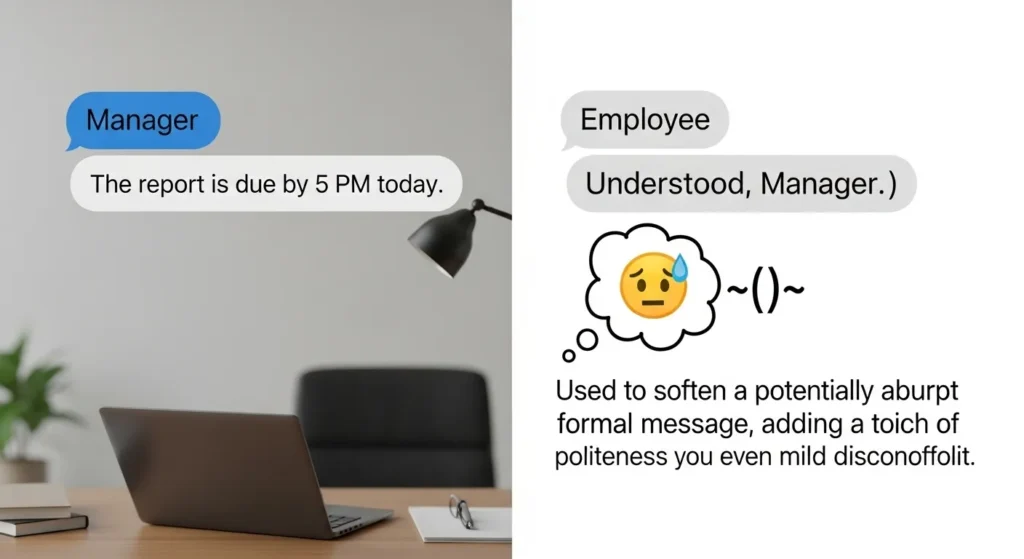
)in texting: The closing parenthesis)is a minimalistic smiley, used to express friendliness, warmth, or subtle happiness. It’s derived from the traditional:)smiley but omits the colon for a cleaner and understated look.
Texting has created a whole new language. From abbreviations like LOL, BRB, and FOMF to emojis and punctuation-based symbols, people constantly find creative ways to convey emotions quickly. One symbol that often confuses users is the closing parenthesis ).
If you’ve ever wondered, “What does ) mean in texting?”, this complete guide will explain everything from its meaning and origin to tone, examples, and proper usage.
By the end of this article, you’ll understand how to use ) naturally in your texts and social media messages without creating confusion.
The Origin of ) in Texting
The use of punctuation to show emotion dates back to the early internet and SMS era. Before emojis existed, users relied on ASCII characters to represent facial expressions:
:)= Smile:(= Frown;)= Wink
Over time, people began dropping the colon, leaving only ) as a subtle smile. This minimalistic style became particularly popular in Russian and Eastern European texting culture, where users often repeat the symbol like ))) to express different levels of happiness.
What Does ) Mean? Detailed Explanation
At its core, ) conveys a friendly, light-hearted smile. It’s subtle, making it suitable for:
- Casual acknowledgment
- Adding warmth to short messages
- Signaling friendliness without exaggeration
Unlike full emojis, ) is understated and simple, perfect for situations where you want a soft positive tone.
Examples:
- Friendly acknowledgment
- “Got it)`” → Meaning: Understood, friendly tone
- Light happiness
- “Sounds good)`” → Meaning: Agreement with a soft smile
- Polite gratitude
- “Thanks for your help)`” → Meaning: Grateful and friendly, yet reserved
Using Multiple ) Symbols
Repeating the symbol increases intensity, especially in Russian/Eastern European texting:
))→ Slightly happier smile)))→ Very cheerful or playful tone))))→ Strongly happy, excited, or joking
Example:
- “See you tomorrow)))” → Very friendly, enthusiastic, or playful
This works similarly to repeating emojis for emphasis: 😄😄😄.
) vs :) – Understanding the Difference
| Symbol | Meaning | Tone | Usage |
|---|---|---|---|
:) | Smile | Neutral/friendly | Classic smiley, clear emotion |
) | Minimalist smile | Subtle/lighthearted | Casual or understated |
)) | Intensified smile | Happy/playful | Friendly and cheerful |
))) | Very cheerful smile | Excited/playful | Strong emotional emphasis |
Tip: ) is perfect when you want to be friendly without being overt, while :) is explicit, and multiple ) show increasing happiness.
Contexts Where ) Is Used
1. Casual Conversations
- “Okay)`” → Friendly acknowledgment
- “See you later)`” → Lighthearted goodbye
2. Flirty or Playful Messaging
- “Can’t wait to see you)`” → Soft, playful smile
- “You’re funny)`” → Friendly teasing
3. Professional or Semi-Professional
- “Thanks for your help)`” → Friendly and polite
- “I appreciate your feedback)`” → Warm but professional
Tip: In professional emails, it’s best to avoid punctuation smiles, but in chat apps like Slack or Teams, a single ) can subtly convey warmth.
Minimalist Punctuation vs Emojis
| Symbol | Meaning | Tone |
|---|---|---|
:) | Smile | Friendly/neutral |
;) | Wink | Playful/flirty |
:( | Frown | Disappointed |
)) | Slightly stronger smile | Friendly/cheerful |
))) | Very cheerful | Playful/excited |
(: | Reversed smile | Quirky/playful |
Why People Prefer ) Over Emojis
- Simplicity: Fast to type without switching keyboards
- Subtlety: Less overt than emojis like 😀 or 😄
- Cultural Preference: Popular in Eastern European texting
- Tone Control: Works well in short or minimalist texts
Common Mistakes with )
- ❌ Overusing in professional emails
- ❌ Using in negative messages (can seem sarcastic)
- ❌ Assuming everyone interprets multiple
)the same - ❌ Adding
)after criticism can confuse tone
Tip: Always consider context. A single ) is subtle, but overuse can feel over-friendly or playful inappropriately.
Polite and Professional Alternatives
When you want to remain professional:
- “Thanks!”
- “I appreciate it.”
- “Looking forward to it.”
- “Great!”
These convey positivity without using informal punctuation.
Real-Life Examples Table
| Message | Meaning | Tone |
|---|---|---|
| “Okay)`” | Friendly acknowledgment | Casual/friendly |
| “See you tomorrow)))” | Very happy/excited | Playful/cheerful |
| “Thanks for your help)`” | Polite gratitude | Friendly/professional |
| “You’re funny)`” | Friendly teasing | Playful/flirty |
| “Got it)`” | Agreement | Casual/friendly |
FAQs
- What does
)mean in texting?- It represents a subtle smile, indicating friendliness or happiness.
- It represents a subtle smile, indicating friendliness or happiness.
- Is
)the same as:)?- Yes, but
)is understated and minimalist.
- Yes, but
- What does multiple
)symbols mean?- They indicate stronger happiness or excitement.
- They indicate stronger happiness or excitement.
- Can
)be used in professional messages?- Sparingly; suitable in casual work chats but not formal emails.
- Sparingly; suitable in casual work chats but not formal emails.
- Where is
)most common?- WhatsApp, Telegram, Discord, SMS, and casual social media chats.
- WhatsApp, Telegram, Discord, SMS, and casual social media chats.
- Is
)flirty?- It can be, depending on context.
- It can be, depending on context.
- Can it be misunderstood?
- Yes; tone and context affect interpretation.
- Yes; tone and context affect interpretation.
- Which culture popularized
)?- Eastern European and Russian texting culture widely popularized this minimalistic smile.
Conclusion
The closing parenthesis ) is a minimalist smile used to express friendliness, warmth, or subtle happiness.
Its understated style makes it perfect for lighthearted messages, casual chats, or semi-professional contexts. Multiple ) symbols intensify the emotion, while a single ) conveys a simple, approachable tone.
When used thoughtfully, ) adds a human touch to digital communication, making messages feel friendly and emotionally intelligent.
Discover More Related Articles:
- What Does GTG Mean in Texting: Definition and Examples(2026)
- What FS Means in Text Conversations and Social Media Chats (2026)

Laura Jackson is a writer at textroast.com, where she creates engaging articles that decode the meanings behind slang, phrases, and everyday expressions. Passionate about language and communication, she makes complex or confusing terms easy to understand, turning learning into a fun and relatable experience for readers around the world.