MSRP (Manufacturer’s Suggested Retail Price) is the price a car manufacturer recommends a dealer sell a vehicle for. It serves as a guideline for pricing but is not always the final price a buyer pays.
If you’ve ever shopped for a car, whether new or used, you’ve probably seen the letters MSRP on window stickers, advertisements, or dealership websites. But what does it really mean? And why does it matter when buying a car?
Don’t worry we’ll break it down in a simple, friendly, and professional way, explain why it’s important, and answer all the frequently asked questions about MSRP in cars.
Understanding MSRP in Cars
MSRP stands for Manufacturer’s Suggested Retail Price. It is sometimes also called the sticker price, because it is the price listed on the car’s window sticker (Monroney sticker in the U.S.).
The MSRP is not set in stone. Dealers may sell the car for more or less depending on demand, location, inventory, and promotions.
Why Does MSRP Exist?
MSRP exists to:
- Provide a baseline – It gives buyers a reference point for what the car should cost.
- Standardize pricing – Helps avoid huge price differences between dealerships.
- Assist negotiations – Buyers know the suggested price and can negotiate from there.
- Include options – MSRP often lists base prices and the cost of optional packages.
For example, a new sedan may have a base MSRP of $25,000, but adding a premium audio system or safety package could raise the MSRP to $28,500.
How Is MSRP Calculated?
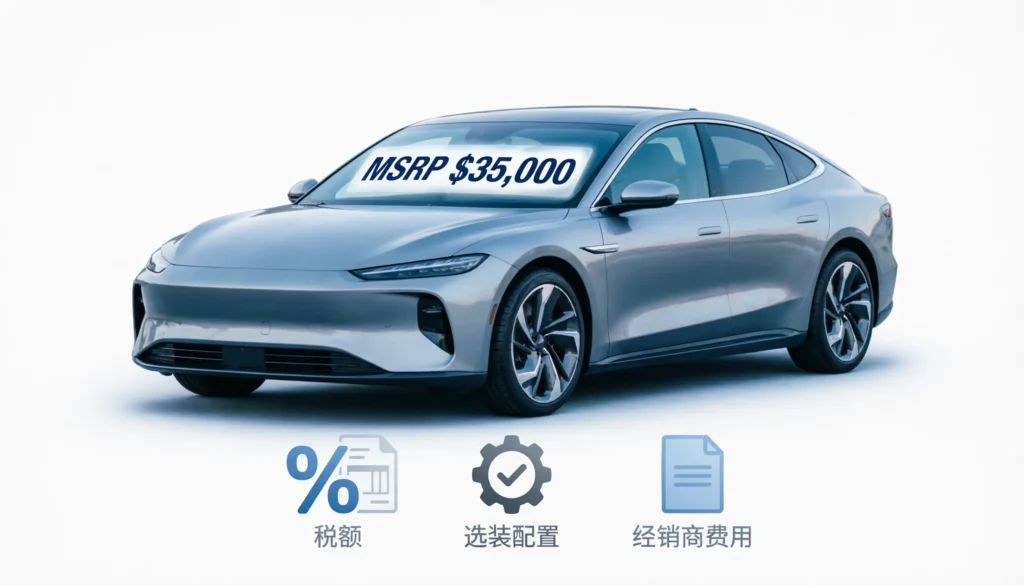
MSRP includes:
- Base price of the vehicle
- Optional equipment and packages
- Destination fees (shipping from manufacturer to dealer)
It does not include:
- Taxes
- Registration or title fees
- Dealer fees
- Negotiated discounts or incentives
Think of MSRP as a starting point — not the “take it or leave it” price.
Real-World Usage of MSRP
Example 1: Buying New Cars
You see a car with an MSRP of $35,000, but the dealer offers it for $33,500 due to a promotion. The MSRP helps you understand the original manufacturer price.
Example 2: Comparing Models
If two SUVs have MSRPs of $40,000 and $45,000, you know the relative price range and can compare features.
Example 3: Leasing or Financing
MSRP is often used to calculate lease payments or determine residual value in financing options.
Difference Between MSRP, Invoice Price, and Market Price
| Term | Meaning | Key Point |
|---|---|---|
| MSRP | Manufacturer’s Suggested Retail Price | Recommended price, sticker price, starting point |
| Invoice Price | Amount dealer pays manufacturer | Usually lower than MSRP, shows dealer’s cost |
| Market Price | Actual price buyers pay | Can be above, below, or equal to MSRP depending on demand |
Knowing the difference can help you negotiate a better deal.
Tips for Using MSRP When Buying a Car
- Don’t treat MSRP as the final price – Always negotiate.
- Check for incentives or rebates – They may reduce the actual cost below MSRP.
- Compare with invoice price – Shows how much margin the dealer has.
- Consider add-ons separately – Some options are included in MSRP, others may be extra.
- Research local pricing trends – Some regions may have higher or lower market prices.
Alternate Terms Related to MSRP
- Sticker Price – Another name for MSRP
- Suggested Retail Price – Less commonly used, but means the same
- Monroney Sticker – U.S. law requires a label on new cars showing MSRP and other details
FAQs
What does MSRP mean in cars?
MSRP is the Manufacturer’s Suggested Retail Price the price the manufacturer recommends a dealer sell the car for.
Is MSRP the same as the price I pay?
No. You can often negotiate below MSRP, or sometimes pay above it if the car is in high demand.
Does MSRP include taxes and fees?
No. MSRP usually only includes the vehicle price and optional equipment. Taxes, registration, and dealer fees are extra.
Why is MSRP important when buying a car?
MSRP gives you a baseline for negotiations and helps compare different models.
Can I get a car for less than MSRP?
Yes. Dealers often offer discounts, incentives, or promotions that reduce the price below MSRP.
Does MSRP change over time?
MSRP can increase each model year as manufacturers add features, improve technology, or adjust for inflation.
Is MSRP the same as invoice price?
No. Invoice price is what the dealer pays the manufacturer, which is usually lower than MSRP.
Why do some cars sell for more than MSRP?
High-demand cars, limited editions, or popular trims may sell above MSRP due to scarcity and market demand.
Conclusion
In conclusion, MSRP, or Manufacturer’s Suggested Retail Price, is the price a car manufacturer recommends for a vehicle. While it serves as a helpful starting point for buyers, it is not necessarily the final price you will pay.
Understanding MSRP allows you to compare vehicles, evaluate dealer offers, and negotiate better deals. Always consider additional factors like dealer incentives, taxes, fees, and market demand when using MSRP to make informed car-buying decisions.
Being informed about MSRP empowers you to make smarter, more confident purchases.
Discover More Related Articles:
- Low Hematocrit in Blood Tests: Causes and What It Indicates in 2026
- How to Become an FNP: Education and Certification Explained in 2026

Daniel Moore is a content writer and language enthusiast at TextRoast.com, specializing in decoding slang, abbreviations, and trending text expressions. He creates engaging and informative articles that help readers understand the meaning behind everyday words and online communication.