In statistics, mutually exclusive events are events that cannot happen at the same time. If one event occurs, the other cannot occur.
If you’ve ever taken a statistics class or looked at probability problems, you’ve probably seen the term mutually exclusive. It sounds technical, maybe even intimidating. But once you understand the idea, it’s actually very simple.
You’re a student, researcher, or just curious about probability concepts, this guide will explain what mutually exclusive means in statistics, how it works, real-life examples, formulas, comparisons, and frequently asked questions all in clear, plain English.
In probability terms:
If events A and B are mutually exclusive, then
P(A and B) = 0
This means there is zero probability that both events occur together.
Understanding Mutually Exclusive in Simple Terms
Let’s imagine you flip a coin.
There are two possible outcomes:
- Heads
- Tails
You cannot get both heads and tails in a single flip.
That makes heads and tails mutually exclusive events.
If one happens, the other automatically cannot.
Real-Life Examples of Mutually Exclusive Events
Understanding the concept becomes easier with everyday examples.
1. Rolling a Die
If you roll a six-sided die:
- Event A: Rolling a 2
- Event B: Rolling a 5
You cannot roll both a 2 and a 5 at the same time.
These events are mutually exclusive.
2. Selecting a Card
From a standard deck:
- Event A: Drawing a King
- Event B: Drawing a Queen
You cannot draw a card that is both a King and a Queen simultaneously.
Mutually exclusive.
3. Weather Example
- Event A: It rains today.
- Event B: It does not rain today.
Both cannot be true at the same time.
4. Exam Result
- Event A: You pass the exam.
- Event B: You fail the exam.
You cannot both pass and fail.
The Formula for Mutually Exclusive Events
In probability, the key rule is:
If A and B are mutually exclusive, then:
P(A ∩ B) = 0
This means the probability that both A and B happen together is zero.
Addition Rule for Mutually Exclusive Events
When events are mutually exclusive:
P(A or B) = P(A) + P(B)
There is no overlap to subtract.
Example:
If
P(A) = 0.3
P(B) = 0.4
Then
P(A or B) = 0.3 + 0.4 = 0.7
Simple because there’s no shared probability.
Mutually Exclusive vs Independent Events
These two are commonly confused, but they are very different.
| Feature | Mutually Exclusive | Independent |
|---|---|---|
| Can happen at same time? | No | Yes |
| P(A ∩ B) | Always 0 | Not necessarily 0 |
| Example | Heads and Tails | Two separate coin flips |
| Relationship | One prevents the other | One does not affect the other |
Important:
Mutually exclusive events cannot be independent.
Why?
Because if A happens, B is impossible. That means they affect each other.
Visualizing Mutually Exclusive Events
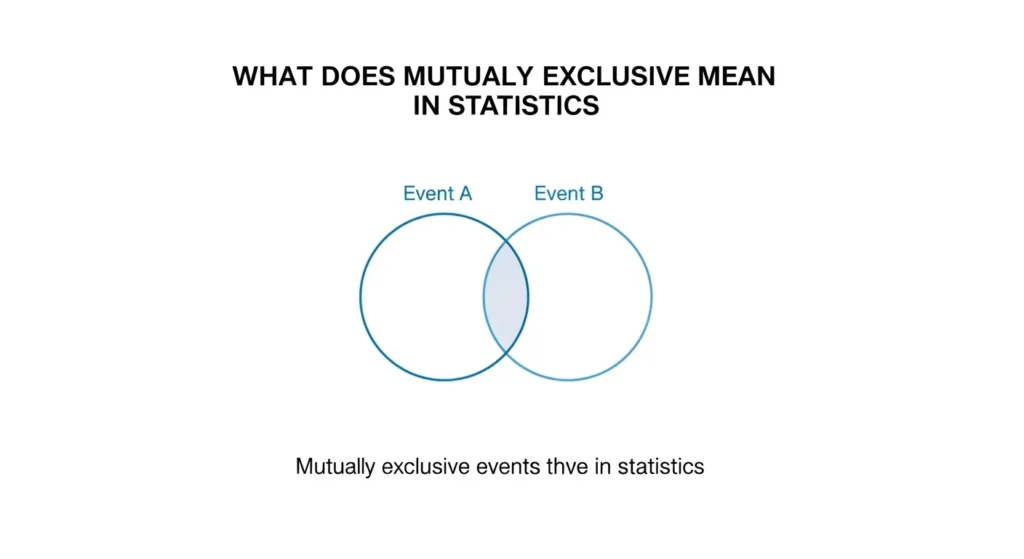
Imagine a Venn diagram.
For mutually exclusive events:
- The circles do not overlap at all.
There is no shared area between Event A and Event B.
When Events Are NOT Mutually Exclusive
Let’s look at a counterexample.
Suppose:
- Event A: A student studies math.
- Event B: A student studies science.
A student can study both math and science.
These events can happen at the same time.
So they are NOT mutually exclusive.
In this case, the formula becomes:
P(A or B) = P(A) + P(B) − P(A ∩ B)
You subtract the overlap to avoid double counting.
Why Mutually Exclusive Events Matter in Statistics
Understanding this concept helps in:
- Solving probability problems
- Designing surveys
- Analyzing data correctly
- Avoiding calculation mistakes
- Creating accurate statistical models
If you assume events are mutually exclusive when they’re not, your results will be incorrect.
Common Mistakes Students Make
- Confusing mutually exclusive with independent
- Forgetting to subtract overlap when events are not exclusive
- Assuming events are exclusive without checking
- Using the wrong probability formula
Practice Example
Suppose:
P(A) = 0.5
P(B) = 0.2
If A and B are mutually exclusive:
P(A or B) = 0.5 + 0.2 = 0.7
But if they overlap with P(A ∩ B) = 0.1:
P(A or B) = 0.5 + 0.2 − 0.1 = 0.6
That subtraction makes a big difference.
Mutually Exclusive in Research and Surveys
In surveys, response options are often designed to be mutually exclusive.
Example:
What is your employment status?
- Employed full time
- Employed part time
- Unemployed
- Student
A well-designed survey ensures respondents can select only one option, making categories mutually exclusive.
This improves data accuracy.
FAQs
What does mutually exclusive mean in statistics?
It means two events cannot occur at the same time. If one happens, the other cannot happen.
Can mutually exclusive events happen together?
No. Their probability of occurring together is zero.
Are mutually exclusive events independent?
No. If one event prevents the other, they are not independent.
What is the formula for mutually exclusive events?
If A and B are mutually exclusive, then P(A ∩ B) = 0 and P(A or B) = P(A) + P(B).
How do I know if events are mutually exclusive?
Ask whether both events can happen at the same time. If not, they are mutually exclusive.
Are heads and tails mutually exclusive?
Yes. In a single coin toss, you cannot get both at the same time.
Are mutually exclusive events always complementary?
No. Complementary events are a special case where the two events cover all possible outcomes.
Why is this concept important in probability?
It ensures correct probability calculations and prevents double counting outcomes.
Conclusion
Mutually exclusive events in statistics are events that cannot happen at the same time. If one occurs, the other becomes impossible.
From coin flips and dice rolls to survey design and data analysis, this concept plays a crucial role in probability and statistical reasoning.
Once you understand that mutually exclusive events have no overlap, probability calculations become much easier and more accurate.
Master this idea, and you’ll avoid one of the most common mistakes in statistics while building stronger analytical skills.
Discover More Related Articles:
- Adjudicated vs Dismissed: Understanding the Difference in 2026
- How Subrogation Works in Insurance Claims: Step-by-Step Guide in 2026

David Brown is a content writer and language enthusiast at textroast.com, where he creates insightful articles that explain the meanings of words, slang, and phrases used in everyday life. His work helps readers decode modern language trends, understand cultural expressions, and make sense of online communication with clarity and fun.