
Nemo is a Latin pronoun meaning no one, nobody, or no person, used to indicate the absence of any individual.
The word nemo may sound familiar from literature movies or phrases like Captain Nemo or Finding Nemo, but its roots go much deeper than modern pop culture. Nemo is a Latin word with a clear meaning, strong philosophical weight, and lasting influence on many languages and stories. Understanding what nemo means in Latin helps unlock layers of meaning behind its historical, linguistic, and symbolic use.
In this complete article, you will learn the literal meaning of nemo in Latin, its grammatical role, origin, philosophical significance, famous uses in literature, how it influenced modern languages, and why it continues to be powerful today.
Basic Meaning of Nemo in Latin
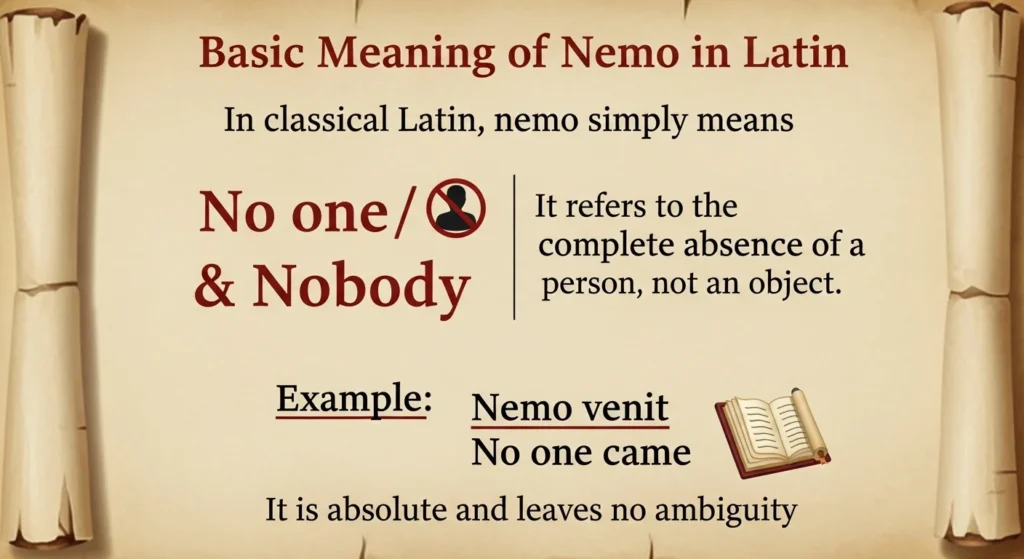
In classical Latin, nemo simply means
No one
Nobody
It refers to the complete absence of a person, not an object.
Example
Nemo venit
No one came
It is absolute and leaves no ambiguity.
Grammatical Role of Nemo
Nemo is an indefinite pronoun.
It is used when the subject of a sentence is intentionally undefined or nonexistent.
Important grammatical points
It is singular
It refers only to people
It does not have a plural form
Even though it means no one, verbs used with nemo are singular.
Declension of Nemo in Latin
Nemo is irregular and does not follow standard noun declension.
| Case | Form |
|---|---|
| Nominative | Nemo |
| Genitive | Neminis |
| Dative | Nemini |
| Accusative | Neminem |
| Ablative | Nemine |
This irregularity makes it unique in Latin grammar.
Origin of the Word Nemo
Nemo comes from older Latin roots meaning
Not one person
It likely evolved from combining negation and number concepts.
Its meaning was always absolute.
There was never a version of nemo that meant someone or anyone.
Nemo vs Nullus
Both nemo and nullus express negation but they are not the same.
Nemo refers only to people.
Nullus refers to
Nothing
None
No object
Example
Nemo adest
No one is present
Nulla spes est
There is no hope
Nemo in Classical Latin Literature
Nemo appears frequently in Roman texts.
Authors like
Cicero
Virgil
Seneca
used nemo to express moral truths philosophical ideas and rhetorical emphasis.
Famous Latin Phrases Using Nemo
Several famous Latin phrases include nemo.
Nemo est supra legem
No one is above the law
its me impune lacessit
No one attacks me with impunity
Nemo sibi nascitur
No one is born for himself alone
These phrases emphasize equality fate and moral responsibility.
Philosophical Meaning of Nemo
Beyond grammar, nemo carries deep philosophical weight.
It often symbolizes
Humility
Equality
Human limitation
By saying no one, Roman thinkers reminded audiences that all humans are subject to the same laws and fate.
Nemo and Roman Law
In Roman legal texts, nemo was used to assert universal rules.
Example
Nemo ignorare legem censetur
No one is considered ignorant of the law
This principle still exists in modern legal systems.
Nemo in Medieval Latin
During the Middle Ages, nemo gained symbolic meaning.
It was sometimes used to represent
An anonymous person
Human insignificance
Spiritual humility
Monks and scholars used it in moral teachings.
Nemo as a Name in Literature
One of the most famous uses of nemo is as a name.
Captain Nemo
In Jules Verne’s Twenty Thousand Leagues Under the Sea, Captain Nemo chooses the name Nemo to mean
No one
This symbolizes
Rejection of society
Loss of identity
Freedom from nations
The name is deeply symbolic not accidental.
Nemo in Modern Pop Culture
Although popular culture uses nemo playfully, the original meaning remains.
In Finding Nemo, the name suggests
Smallness
Vulnerability
Everyman quality
While not explicitly Latin, the influence is clear.
Nemo in Modern Languages
Many modern languages inherited nemo directly or indirectly.
English
Nemo appears in legal and literary contexts.
French
Nemo is used in philosophical references.
Italian and Spanish
Nemo is understood in academic contexts.
Nemo vs Someone vs Anyone
Nemo is absolute.
Someone implies existence.
Anyone implies possibility.
Nemo implies certainty of absence.
This makes nemo powerful in argument and storytelling.
Pronunciation of Nemo in Latin
Classical pronunciation
NEH mo
Ecclesiastical pronunciation
NEH moh
Both are acceptable depending on context.
Nemo in Academic and Scientific Use
Nemo is sometimes used symbolically in
Philosophy
Law
Logic
It represents an undefined or nonexistent subject.
Why Nemo Is Still Used Today
Nemo survives because it is
Short
Clear
Universal
Few words express absolute absence so cleanly.
Common Misunderstandings About Nemo
It does not mean nothing
It does not refer to objects
It is not a name originally
It is not plural
Understanding this avoids confusion.
Nemo vs Nihil
Nemo means no one.
Nihil means nothing.
Both express negation but apply to different categories.
Can Nemo Be Used Figuratively
Yes.
Writers use nemo to symbolize
Loss of identity
Isolation
Anonymity
It is powerful in storytelling.
Nemo in Mottoes and Inscriptions
Many coats of arms and institutions use nemo in mottos.
It reinforces
Equality
Justice
Honor
Cultural Impact of Nemo
Nemo reminds us that
No one is above rules
No one is immune to fate
No one exists alone
This universal message explains its longevity.
FAQs
What does nemo mean in Latin?
Nemo means no one or nobody.
Is nemo a noun or pronoun?
It is an indefinite pronoun.
Does nemo refer to objects?
No it refers only to people.
Why is Captain Nemo called Nemo?
It symbolizes being no one or rejecting identity.
Is nemo singular or plural?
It is grammatically singular.
What is the opposite of nemo?
Aliquis meaning someone.
Is nemo used in modern Latin?
Yes especially in academic and legal contexts.
Does nemo mean nothing?
No nihil means nothing.
Conclusion
So what does nemo mean in Latin Nemo means no one, and while the definition is simple, its significance is profound. From Roman law and philosophy to literature and modern culture, nemo has represented equality humility anonymity and the limits of human identity.
Its clarity and depth have allowed it to survive for centuries. Understanding nemo gives insight not only into Latin language but into how humans think about identity power and existence itself.
Discover More Related Articles:
- What Does Paisa Mean in Spanish? Regional Meaning Explained in 2026
- What Does Nuna Mean in Korean? You Should Know in 2026

David Brown is a content writer and language enthusiast at textroast.com, where he creates insightful articles that explain the meanings of words, slang, and phrases used in everyday life. His work helps readers decode modern language trends, understand cultural expressions, and make sense of online communication with clarity and fun.