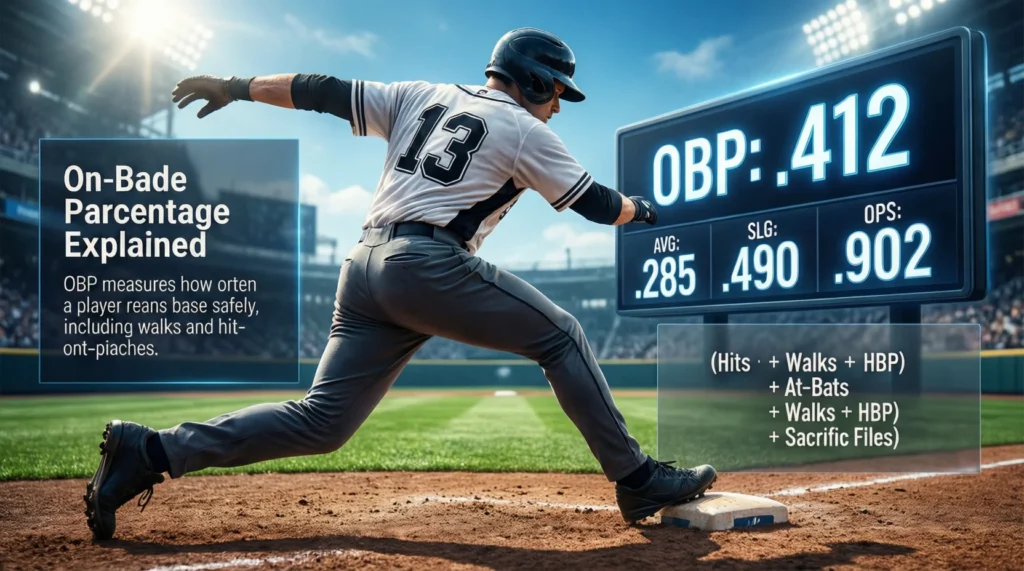
OBP in baseball stands for On-Base Percentage.
It measures how often a player reaches base by hit, walk, or hit by pitch, excluding errors and fielder’s choices.
Baseball statistics can feel overwhelming, especially when you move beyond traditional numbers like batting average and home runs. One stat you will see often in modern baseball analysis is OBP. That raises a common question among fans and beginners alike: what does OBP mean in baseball?
This article explains OBP in a clear, friendly, and professional way. You will learn what OBP stands for, how it is calculated, why it is important, and how it compares to other hitting stats. By the end, you will understand why OBP is one of the most valued offensive statistics in baseball today.
What Does OBP Mean in Baseball?
On-base percentage, commonly shortened to OBP, tells you how frequently a batter reaches base safely. Unlike batting average, which only counts hits, OBP includes walks and hit by pitches.
This makes OBP a more complete measure of offensive value. A player does not need to hit safely to help the team. Drawing a walk or getting hit by a pitch still puts the player on base and creates scoring opportunities.
In simple terms, OBP answers one key question: How often does this player avoid making an out?
OBP Formula Explained Simply
OBP is calculated using this formula:
It equals hits plus walks plus hit by pitch, divided by plate appearances.
Sacrifice flies are included in the denominator, while sacrifice bunts are excluded in most calculations.
You do not need to memorize the formula to understand OBP. Just remember that OBP tracks how often a player reaches base, not how often they get a hit.
Why OBP Is Important in Baseball
OBP is important because getting on base is the foundation of scoring runs. Teams that consistently put runners on base have more chances to score.
A player with a high OBP keeps innings alive.
They force pitchers to throw more pitches.
They increase opportunities for teammates to drive in runs.
This is why many managers and front offices value OBP more than batting average.
OBP vs Batting Average
Batting average only measures hits divided by at-bats. It ignores walks and hit by pitches.
OBP includes all common ways a player can reach base safely. Because of this, OBP often paints a more accurate picture of a hitter’s value.
For example, a player with a modest batting average but a lot of walks can still have an excellent OBP. That player may be more valuable than someone who hits more singles but rarely walks.
How to Read OBP Numbers
OBP is shown as a three-digit decimal, similar to batting average.
Here is a general guide to understanding OBP levels:
An OBP around .300 is below average.
Or An OBP around .320 is average.
An OBP around .350 is good.
An OBP around .380 or higher is excellent.
Elite players often finish seasons with OBP numbers well above league average.
Example OBP Table
| Player Type | Typical OBP |
|---|---|
| Below Average | .300 |
| League Average | .320 |
| Above Average | .350 |
| All-Star Level | .380 |
| Elite On-Base Hitter | .400 or higher |
This table helps show why OBP is so useful for quick comparisons.
OBP and Plate Discipline
OBP is closely connected to plate discipline.
Players with strong plate discipline recognize pitches better. They swing at strikes and lay off bad pitches. This leads to more walks and fewer weak outs.
Because of this, OBP often reflects a player’s approach and baseball intelligence, not just raw hitting ability.
OBP vs OPS
OPS is another popular stat that includes OBP.
OPS stands for on-base plus slugging.
OBP measures getting on base.
Slugging percentage measures power.
OPS combines both to give a broader picture of offensive production. OBP is often considered the more important half of OPS because avoiding outs is so valuable.
OBP vs Slugging Percentage
Slugging percentage focuses on power and extra-base hits. OBP focuses on consistency and patience.
A power hitter may have a high slugging percentage but a lower OBP if they rarely walk.
A contact hitter may have a high OBP without much power.
Both skills matter, but OBP is often more consistent year to year.
OBP in Real Game Situations
During broadcasts, announcers often mention OBP when discussing lineup construction.
Players with high OBP are often placed at the top of the lineup. Their job is to get on base and set the table for power hitters behind them.
Managers rely on OBP when deciding who should bat leadoff or near the top of the order.
Does OBP Have Any Limitations?
While OBP is very useful, it does have limits.
OBP does not measure power.
It does not account for baserunning ability.
Or It does not reflect defensive value.
OBP at Different Levels of Baseball
OBP is used at all levels of baseball.
It is taught in youth and high school baseball.
OBP is heavily emphasized in college baseball.
It is a key stat in professional leagues and analytics departments.
As baseball analysis has evolved, OBP has become more important than ever.
Alternate Meanings of OBP
Outside of baseball, OBP can stand for other phrases depending on context. In baseball discussions, statistics, and broadcasts, OBP almost always means on-base percentage.
Professional Alternatives to Saying OBP
In formal writing or commentary, OBP may be referred to as:
On-base percentage
Ability to reach base
On-base skills
These phrases describe the same concept in a more descriptive way.
FAQs
What does OBP stand for in baseball?
OBP stands for on-base percentage.
Is OBP more important than batting average?
Many analysts believe OBP is more valuable because it includes walks.
Does OBP include walks?
Yes, walks are a major part of OBP.
Does OBP include hit by pitch?
Yes, hit by pitch is included.
What is a good OBP in MLB?
An OBP of .350 or higher is considered very good.
Is OBP used in fantasy baseball?
Yes, many fantasy leagues include OBP instead of batting average.
Is OBP a modern stat?
It has existed for a long time but gained popularity with analytics.
Conclusion
So, what does OBP mean in baseball? It means on-base percentage, a statistic that measures how often a player reaches base safely. OBP is valued because getting on base is one of the most important parts of scoring runs and winning games.
You are a casual fan or a serious follower of baseball stats, understanding OBP helps you better evaluate hitters, lineups, and offensive strategy. It is one of the clearest ways to measure a player’s true offensive contribution.
Discover More Related Articles:
- What Does OPS Mean in Baseball Stats? How to Read OPS Like a Pro (2026)
- What Does OTL Mean in Hockey? Beginner-Friendly Explanation (2026)

David Brown is a content writer and language enthusiast at textroast.com, where he creates insightful articles that explain the meanings of words, slang, and phrases used in everyday life. His work helps readers decode modern language trends, understand cultural expressions, and make sense of online communication with clarity and fun.