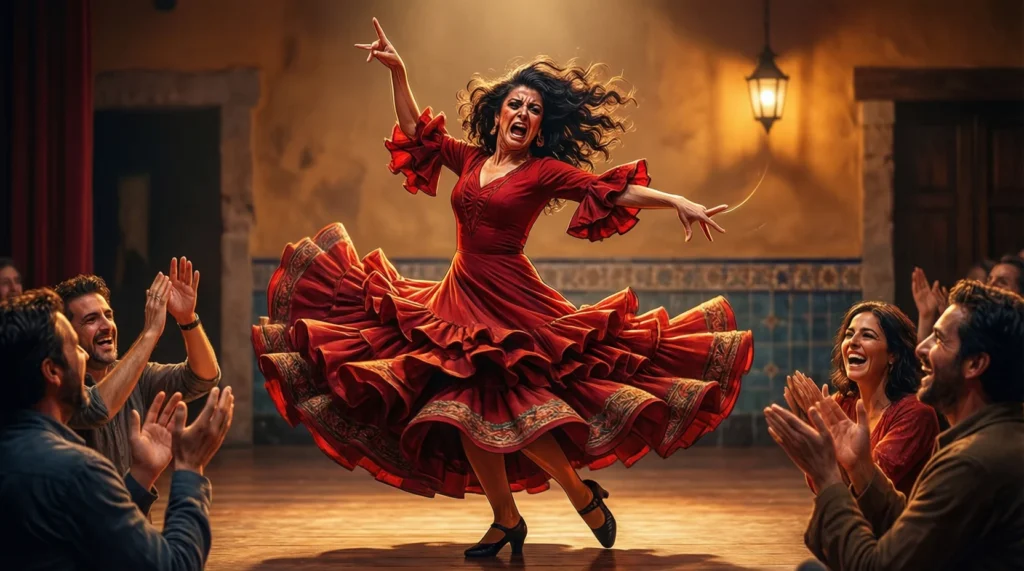
Olé is a Spanish exclamation used to express approval admiration excitement or encouragement often shouted during performances sports or impressive actions.
If you have ever watched a soccer match a flamenco performance or a Spanish celebration you have almost certainly heard people shout Olé. It is short powerful and full of emotion but for many non Spanish speakers its meaning is not always clear. That leads to a common question what does olé mean in Spanish
This article explains the meaning of olé in a clear friendly and professional way. You will learn where it comes from how it is used in Spain and Latin culture what emotions it expresses and how it compares to similar expressions in English and other languages.
What Does Olé Mean in Spanish
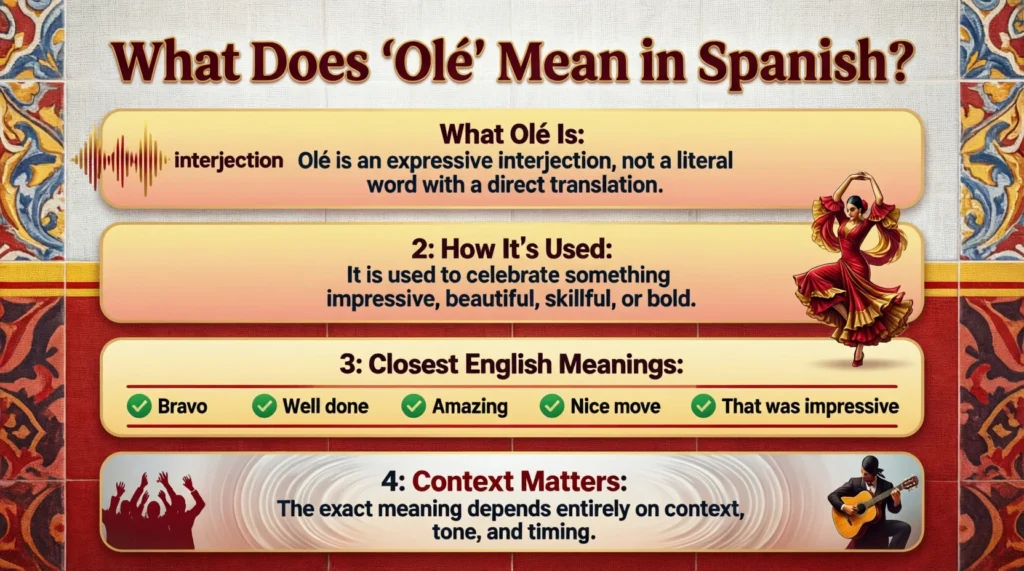
Olé is an expressive interjection rather than a literal word with a direct translation. It is used to celebrate something impressive beautiful skillful or bold.
In English olé is closest in meaning to
Bravo
Well done
Amazing
Nice move
That was impressive
The exact meaning depends entirely on context tone and timing.
Origin of the Word Olé
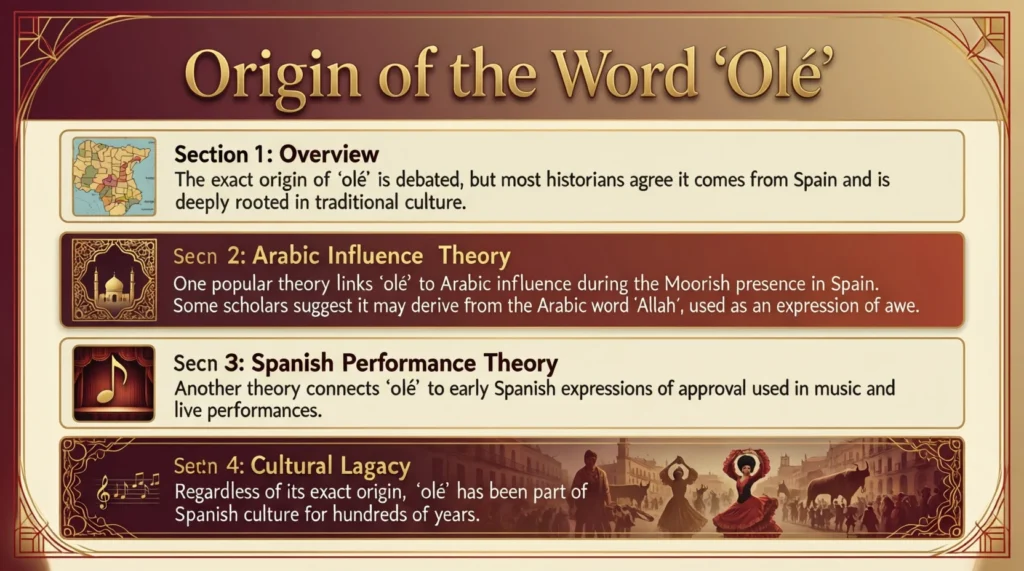
The exact origin of olé is debated but most historians agree it comes from Spain and has strong roots in traditional culture.
One popular theory connects olé to Arabic influence during centuries of Moorish presence in Spain. Some scholars suggest it may come from the Arabic word Allah used as an expression of awe.
Another theory links it to early Spanish expressions of approval in music and performance.
Regardless of its exact origin olé has been part of Spanish culture for hundreds of years.
Olé in Spanish Culture
Olé is deeply embedded in Spanish traditions and public expression. It is not something whispered or said quietly. Olé is meant to be shouted with passion.
It represents
Admiration
Joy
Approval
Respect for skill
Shared excitement
When someone shouts olé they are actively participating in the moment.
Olé in Flamenco Dancing
One of the most famous uses of olé is in flamenco.
During flamenco performances audience members shout olé to encourage the dancer singer or guitarist. It is not random and must be timed well.
Shouting olé during a powerful movement shows understanding appreciation and respect for the art.
In flamenco olé means
That was beautiful
You are doing it right
We feel your emotion
Olé in Bullfighting
Historically olé was also shouted during bullfights.
When a matador performed a particularly brave or elegant move the crowd would shout olé to show approval.
In this context olé symbolized courage skill and artistry.
While bullfighting is controversial today the expression olé remains culturally significant.
Olé in Soccer and Sports
Olé is extremely common in soccer especially in Spain and Latin American countries.
Fans shout olé when
A player makes a brilliant pass
A team dominates possession
An opponent misses the ball
A goal is scored beautifully
Sometimes fans chant olé repeatedly to celebrate control and confidence.
Olé as a Taunt or Celebration
In sports olé can sometimes carry a playful or mocking tone.
For example fans may chant olé after each pass when their team is clearly dominating the opponent. This suggests confidence and control rather than direct insult.
Tone determines whether olé feels celebratory or teasing.
Emotional Meaning of Olé
Olé is all about emotion rather than logic.
It can express
Excitement
Joy
Pride
Respect
Shared enthusiasm
It is a communal expression. One person shouting olé often leads others to join in.
Is Olé a Formal Word
No olé is informal and emotional.
It is not used in formal writing academic texts or professional communication. It belongs to spoken language performances and celebrations.
You would not use olé in business emails or serious conversations.
Olé vs Bravo
Many people compare olé and bravo.
| Expression | Usage | Context |
|---|---|---|
| Olé | Spanish cultural | Sports dance performance |
| Bravo | International | Applause performance |
Bravo is more neutral and universal while olé is more culturally specific and passionate.
Olé in English Speaking Countries
English speakers often use olé as a borrowed word especially in sports commentary.
In English it usually keeps its Spanish meaning and is used to add excitement or flair.
For example
The crowd erupted with an olé after the goal
How to Pronounce Olé
Olé is pronounced
Oh LEH
The stress is on the second syllable. The accent mark over the e shows where emphasis goes.
Correct pronunciation adds to its emotional impact.
When Not to Use Olé
Avoid using olé when
The moment is serious or somber
You are unsure of cultural context
It might sound sarcastic unintentionally
Using olé at the wrong time can seem disrespectful or awkward.
Olé in Writing and Media
Olé is often written with an accent mark but sometimes appears without it in informal writing.
In Spanish writing the accent is correct and recommended.
In English writing both forms are commonly accepted.
Similar Expressions in Spanish
Spanish has other expressions of approval depending on region.
Qué bien
Eso
Muy bien
Bravo
Olé stands out because of its strong cultural and emotional weight.
Examples of Olé in Context
Performance context
The dancer finished her routine and someone shouted olé
Sports context
After the goal the stadium exploded with cries of olé
Playful context
He finally nailed the move olé laughing
Cultural context
During the guitar solo several audience members yelled olé
Common Misunderstandings About Olé
Olé does not mean hello
Olé is not a greeting
Olé is not a complete sentence
Olé is not sarcastic by default
It is purely an emotional reaction.
Alternate Meanings of Olé
Outside Spanish culture olé may simply be used as a stylistic expression of excitement. In dictionaries it is classified as an interjection.
It does not change form or tense.
Polite Alternatives to Olé
If you want safer or more neutral alternatives try
Bravo
Excelente
Muy bien
Qué impresionante
These carry approval without strong cultural flair.
FAQs
What does olé mean in Spanish?
It is an exclamation expressing approval excitement or admiration.
Is olé used only in Spain?
It originated in Spain but is used worldwide.
Can olé be rude?
Only if used sarcastically or at the wrong time.
Is olé used in everyday conversation?
Mostly in performances sports or celebrations.
Does olé have a literal meaning?
No it is an expressive interjection.
How do you pronounce olé?
Oh LEH with stress on the second syllable.
Is olé formal Spanish?
No it is informal and emotional.
Is olé used in Latin America?
Yes especially in sports and cultural events.
Conclusion
So what does olé mean in Spanish It is a powerful exclamation used to express admiration excitement and approval especially during performances sports and moments of skill. Olé is not about literal translation but about shared emotion and cultural expression.
Understanding olé helps you better appreciate Spanish culture from flamenco and soccer to celebrations and public performances. When used at the right moment olé connects people through excitement passion and respect.
Discover More Related Articles:
- What Does Plus Minus Mean in Basketball and Why It Matters in 2026
What Does Redshirt Mean in Football? NCAA Rules Explained in 2026
What Does Libero Mean in Volleyball? A Beginner-Friendly Breakdown in 2026

Daniel Moore is a content writer and language enthusiast at TextRoast.com, specializing in decoding slang, abbreviations, and trending text expressions. He creates engaging and informative articles that help readers understand the meaning behind everyday words and online communication.