
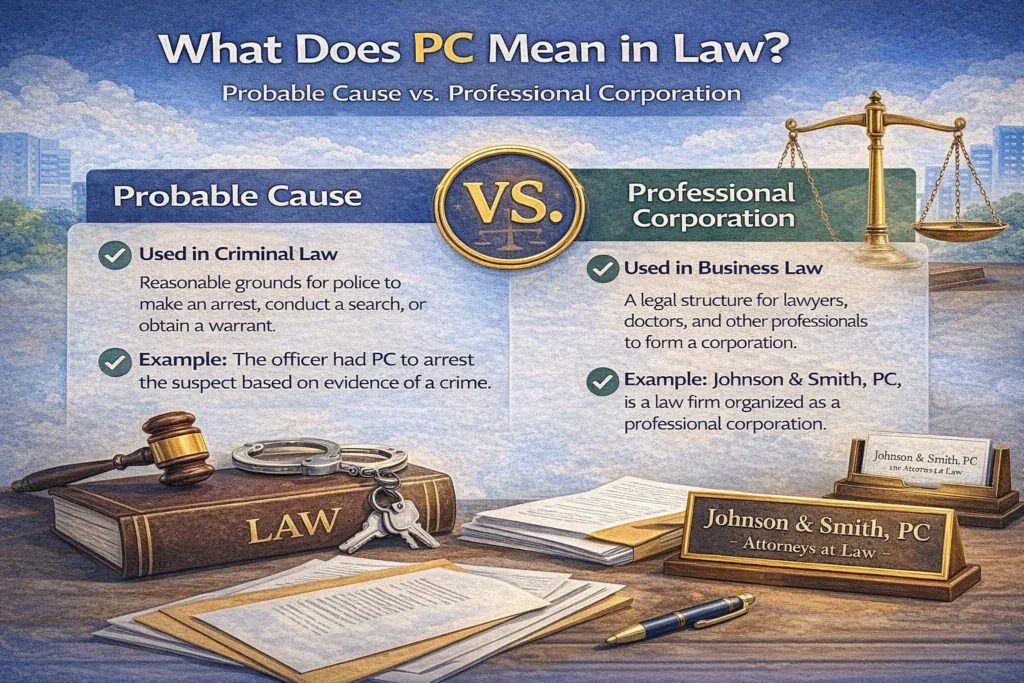
PC in law most commonly means “Probable Cause” or “Professional Corporation.”
Probable Cause is a legal standard requiring sufficient evidence to justify an arrest, search, or warrant. Professional Corporation is a business structure used by licensed professionals such as lawyers or doctors.
Legal abbreviations can feel overwhelming, especially when the same letters mean different things depending on context. One abbreviation that often causes confusion is PC. You might see it in a police report, court transcript, or even at the end of a law firm’s name.
So what does PC mean in law? The answer depends on where it appears. In most legal contexts, PC stands for Probable Cause or Professional Corporation.
Let’s explore both meanings in detail so you can understand exactly how PC is used in legal settings.
The correct meaning depends entirely on the legal context.
PC as Probable Cause in Criminal Law
The most common meaning of PC in court or police documents is Probable Cause.
What Is Probable Cause?
Probable Cause is the legal standard law enforcement must meet before:
- Making an arrest
- Conducting a search
- Obtaining a search warrant
- Filing certain criminal charges
It protects individuals from unreasonable searches and seizures under the Fourth Amendment of the U.S. Constitution.
Simple Explanation
Probable Cause means there must be reasonable facts or evidence that would make a reasonable person believe a crime has occurred.
It is stronger than suspicion but does not require proof beyond a reasonable doubt.
How Probable Cause Works
For example, if a police officer sees someone breaking into a car, that observation creates probable cause to arrest the person.
However, if an officer simply “feels” someone looks suspicious without evidence, that does not meet probable cause requirements.
Probable Cause can be based on:
- Officer observations
- Witness statements
- Physical evidence
- Surveillance footage
- Reliable informant tips
Judges review these facts before issuing search or arrest warrants.
PC Hearing in Court
You may hear about a “PC hearing.”
A Probable Cause hearing is a court proceeding where a judge determines whether there is enough evidence to move forward with criminal charges.
If the judge finds no probable cause, the case may be dismissed.
This step ensures that individuals are not prosecuted without sufficient evidence.
PC vs Reasonable Suspicion
Many people confuse probable cause with reasonable suspicion. They are different legal standards.
| Standard | Definition | Level of Evidence | Used For |
|---|---|---|---|
| Reasonable Suspicion | Specific and articulable suspicion of wrongdoing | Lower | Temporary stops |
| Probable Cause | Stronger evidence suggesting a crime occurred | Higher | Arrests and warrants |
Probable cause requires more evidence than reasonable suspicion.
PC as Professional Corporation
In business law, PC often stands for Professional Corporation.
What Is a Professional Corporation?
A Professional Corporation is a special type of legal business entity formed by licensed professionals such as:
- Attorneys
- Doctors
- Dentists
- Accountants
- Architects
When you see a law firm name like “Johnson & Smith, P.C.”, the PC indicates the firm is structured as a Professional Corporation.
Why Lawyers Use a PC Structure
Professional Corporations provide:
- Limited liability for business debts
- Separation of personal and business assets
- Formal corporate structure
- Potential tax advantages
However, professionals remain personally responsible for their own malpractice or negligence.
The structure protects business operations, not personal professional conduct.
Example of PC in a Law Firm Name
If you hire “Davis Legal Group, P.C.”, it simply means the firm operates as a Professional Corporation.
It does not relate to criminal law or probable cause in this context.
Understanding the difference depends on where you see the abbreviation.
Other Possible Legal Meanings of PC
Although less common, PC can sometimes mean:
- Penal Code, referring to statutory criminal laws
- Police Constable, in certain international jurisdictions
- Personal Counsel, in informal contexts
However, in U.S. law, Probable Cause and Professional Corporation are the dominant meanings.
Why Context Matters
The meaning of PC changes based on where it appears.
If you see PC in:
- A police report → likely Probable Cause
- A criminal complaint → likely Probable Cause
- A law firm’s name → Professional Corporation
- Corporate filings → Professional Corporation
Always look at surrounding language to determine the correct interpretation.
Real World Examples
Example 1: Criminal Case
Court document states: “The officer established PC for arrest based on witness identification.”
Here, PC clearly means Probable Cause.
Example 2: Business Filing
Business registration reads: “Anderson & Lee, P.C., Attorneys at Law.”
Here, PC means Professional Corporation.
Example 3: Court Transcript
Judge says: “The court finds sufficient PC to bind the defendant over for trial.”
This refers to Probable Cause.
Legal Importance of Probable Cause
Probable Cause plays a critical role in protecting civil liberties. Without it:
- Police could arrest without justification
- Homes could be searched arbitrarily
- Privacy rights would be compromised
It acts as a constitutional safeguard.
Practical Tips for Understanding PC in Legal Documents
- Identify the type of case. Criminal cases usually refer to Probable Cause.
- Look at capitalization and punctuation. “P.C.” after a company name signals Professional Corporation.
- Examine surrounding words like arrest, warrant, hearing, or firm.
- If unsure, consult a legal professional for clarification.
FAQs
What does PC mean in criminal law?
In criminal law, PC stands for Probable Cause, meaning sufficient evidence exists to justify an arrest, search, or warrant.
What does PC mean after a lawyer’s name?
It means Professional Corporation, indicating the law firm is organized as a corporate business entity.
Is probable cause required for every arrest?
Yes, law enforcement must have probable cause before making an arrest.
What happens if there is no probable cause?
If probable cause is lacking, charges may be dismissed or evidence may be excluded.
Is probable cause the same as beyond a reasonable doubt?
No. Probable cause is a lower legal standard than beyond a reasonable doubt, which is required for conviction.
Does PC mean police constable in U.S. courts?
No. In U.S. courts, PC typically refers to Probable Cause.
Why is probable cause important?
It protects individuals from unlawful arrests and searches, ensuring constitutional rights are upheld.
Conclusion
PC in law most commonly means Probable Cause or Professional Corporation, depending on context. In business law, Professional Corporation refers to a structured legal entity used by licensed professionals like attorneys.
The key takeaway is simple: always consider the context. You are reading a court order, police report, or business document, understanding the setting will help you interpret PC correctly and avoid confusion.
By knowing both meanings, you can confidently navigate legal terminology and better understand legal documents in everyday situations.
Discover More Related Articles:
- CAP Rate vs. ROI: What Every Property Investor Should Know in 2026
- Incurred Expenses Explained: What the Term Means in Accounting in 2026
- CC in Outlook: Meaning, Etiquette, and Best Practices in 2026

Daniel Moore is a content writer and language enthusiast at TextRoast.com, specializing in decoding slang, abbreviations, and trending text expressions. He creates engaging and informative articles that help readers understand the meaning behind everyday words and online communication.