
Have you ever wondered why oil floats on water, or why sugar dissolves easily while sand doesn’t? The answer often comes down to one small but powerful chemistry concept: polarity.
Understanding what polar means in chemistry helps explain how molecules behave, why substances mix or don’t, and how countless reactions happen in labs, industries, and even inside your body. Whether you’re a student, a curious learner, or someone brushing up on science basics, this guide breaks it all down in a clear, friendly, and real-world way.
Definition
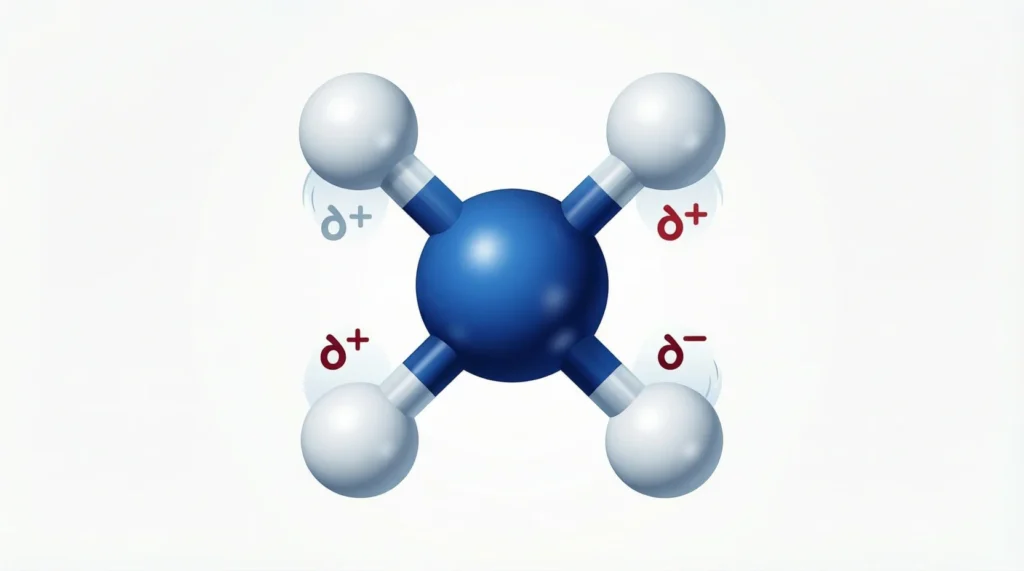
In chemistry, “polar” refers to a molecule or bond with an uneven distribution of electrical charge, creating partial positive and partial negative ends due to differences in electronegativity between atoms.In simple terms, a polar molecule has two sides: one slightly positive and one slightly negative.
Why “Polar” Matters in Chemistry
Polarity explains:
- Why water is such a powerful solvent
- Why soap cleans grease
- Why some chemicals react while others do not
- How biological molecules interact in cells
Without polarity, chemistry as we know it wouldn’t work.
Origin and Meaning of the Term “Polar”
The word polar comes from Latin: polaris, meaning “of the pole.” It was inspired by Earth’s North and South Poles.
Just like Earth has two opposite poles, polar molecules have two opposite ends:
- One end = partial positive (δ⁺)
- Other end = partial negative (δ⁻)
This terminology was adopted in chemistry in the 19th century as scientists studied electricity, magnetism, and atomic structure.
What Makes a Molecule Polar?
A molecule becomes polar based on two main factors:
1. Electronegativity Difference
Electronegativity is an atom’s ability to attract electrons.
- Large difference → polar bond
- Small or no difference → nonpolar bond
Example:
- Oxygen (very electronegative)
- Hydrogen (less electronegative)
Result: Polar O–H bond
2. Molecular Shape (Geometry)
Even if a molecule has polar bonds, it may still be nonpolar overall if the shape cancels out the charges.
Example:
- Carbon dioxide (CO₂)
- Polar bonds
- Linear shape
- Charges cancel → nonpolar molecule
- Polar bonds
Polar vs Nonpolar: Key Differences
| Feature | Polar | Nonpolar |
| Charge distribution | Uneven | Even |
| Partial charges | Yes (δ⁺ / δ⁻) | No |
| Solubility in water | High | Low |
| Intermolecular forces | Strong | Weak |
| Examples | Water, ammonia | Oxygen, methane |
Common Examples of Polar Molecules
Water (H₂O) – Friendly & Neutral
- Oxygen pulls electrons more strongly
- Bent shape
- Result: Highly polar
- Explains why water dissolves salts and sugars
Ammonia (NH₃) – Neutral
- Nitrogen attracts electrons
- Trigonal pyramidal shape
- Used in fertilizers and cleaners
Hydrogen Chloride (HCl) – Slightly Aggressive
- Very polar bond
- In water, becomes hydrochloric acid
- Strong reactivity due to polarity
Table: Polar vs Nonpolar Molecules
| Molecule | Bond Type | Shape | Polarity | Real-World Use |
| H₂O | Polar | Bent | Polar | Drinking water |
| NH₃ | Polar | Pyramidal | Polar | Fertilizers |
| CO₂ | Polar bonds | Linear | Nonpolar | Carbonated drinks |
| O₂ | Nonpolar | Linear | Nonpolar | Breathing |
| CH₄ | Nonpolar | Tetrahedral | Nonpolar | Natural gas |
Polar Bonds vs Polar Molecules
Many learners confuse these two.
Polar Bond
- Unequal electron sharing
- Happens between two atoms
- Example: O–H bond
Polar Molecule
- Overall uneven charge distribution
- Depends on bond polarity + shape
All polar molecules have polar bonds, but not all polar bonds create polar molecules.
Real-World Usage of Polarity
Cleaning Products
Soap has:
- Polar head (water-loving)
- Nonpolar tail (grease-loving)
Polarity allows dirt to wash away.
Medicine
- Drug solubility depends on polarity
- Polar drugs dissolve in blood
- Nonpolar drugs pass through membranes
Cooking & Food
- Oil (nonpolar) and water (polar) don’t mix
- Emulsifiers balance polarity
Polarity and Solubility: “Like Dissolves Like”
This famous chemistry rule means:
- Polar dissolves polar
- Nonpolar dissolves nonpolar
Examples:
- Salt dissolves in water
- Oil dissolves in gasoline
- Oil does NOT dissolve in water
Comparison With Related Chemistry Terms
Polar vs Nonpolar
- Polar = uneven charges
- Nonpolar = balanced charges
Polar vs Ionic
| Aspect | Polar | Ionic |
| Electron sharing | Unequal | Complete transfer |
| Bond strength | Moderate | Very strong |
| Example | Water | Sodium chloride |
Dipole Moment
- A measurement of polarity
- Larger dipole moment = more polar
Alternate Meanings of “Polar”
Outside chemistry, “polar” can also mean:
- Geography: North Pole / South Pole
- Opinions: Extremely opposite views
- Physics: Electrical or magnetic poles
Always check context; in chemistry, it refers to charge distribution.
Polite or Professional Alternatives
For scientific writing, alternatives include:
- Uneven charge distribution
- Dipolar molecule
- Electrically asymmetric
- Charge-separated molecule
Useful in academic or research contexts.
Conclusion
Understanding what polar means in chemistry explains many everyday and scientific processes.
- Polar molecules have uneven charge distribution
- Polarity depends on electronegativity + shape
- Explains solubility, reactions, and biological functions
- “Like dissolves like” is a practical rule
- Polarity is essential in chemistry, biology, medicine, and industry
Once you grasp polarity, chemistry stops feeling random and starts making sense.
FAQs
- What does polar mean in simple chemistry terms?
A molecule has one side slightly positive and the other slightly negative. - Is water polar or nonpolar?
Water is polar due to oxygen’s high electronegativity and bent shape. - How do you tell if a molecule is polar?
Check electronegativity differences and molecular shape. - Are all polar bonds polar molecules?
No. Shape matters. Some polar bonds cancel out. - Why doesn’t oil mix with water?
Oil is nonpolar, water is polar—different polarities don’t mix. - Is polarity important in biology?
Yes. It affects protein folding, cell membranes, and enzyme reactions. - Can a molecule change polarity?
The molecule itself doesn’t change, but its behavior can vary in different environments. - What is the difference between polar and ionic bonds?
Polar bonds share electrons unequally; ionic bonds involve full electron transfer.

Daniel Moore is a content writer and language enthusiast at TextRoast.com, specializing in decoding slang, abbreviations, and trending text expressions. He creates engaging and informative articles that help readers understand the meaning behind everyday words and online communication.