
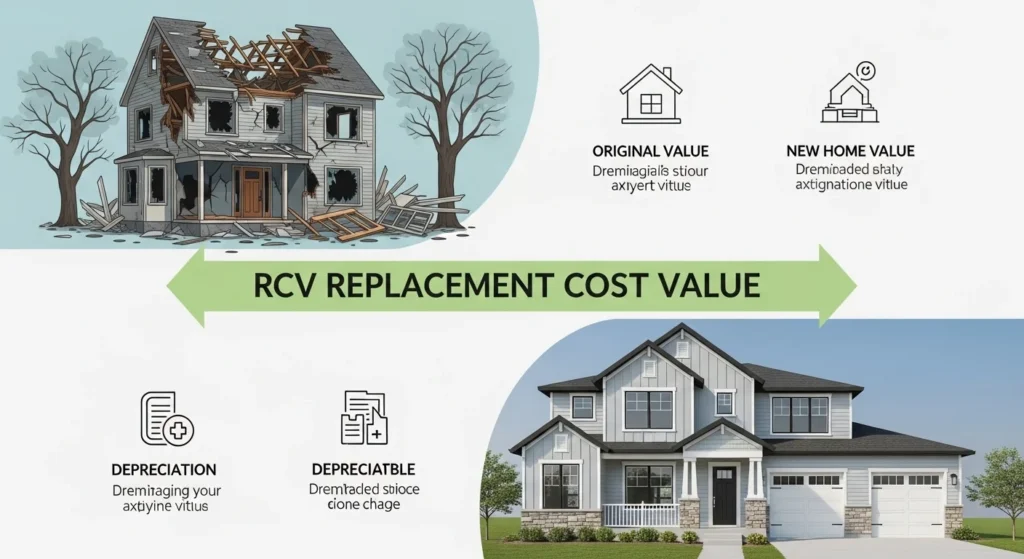
RCV in insurance stands for Replacement Cost Value. It refers to the amount it would cost to replace or repair damaged property with new items of similar kind and quality, without deducting for depreciation.
If you’ve ever filed a home or property insurance claim, you may have come across the term RCV and wondered what it actually means. It sounds technical, but understanding it could mean the difference between getting a partial payout and receiving the full value of your damaged property.
So what does RCV mean in insurance? Let’s break it down in simple, practical terms so you know exactly how it affects your claim, your coverage, and your money.
In short, RCV is what it costs today to replace something with a brand-new equivalent.
Understanding RCV in Simple Terms
Imagine your roof is damaged in a storm. Ten years ago, it cost $10,000 to install. Today, due to material and labor increases, replacing it costs $18,000.
Under an RCV policy, your insurance covers the cost to replace it at today’s price, not what it was worth after years of wear and tear.
That’s the key difference.
RCV focuses on replacement cost, not the current depreciated value.
RCV vs ACV: What’s the Difference?
One of the most common questions about RCV involves comparison with ACV, which stands for Actual Cash Value.
Here’s a clear breakdown:
| Feature | RCV (Replacement Cost Value) | ACV (Actual Cash Value) |
|---|---|---|
| Pays for depreciation? | No | Yes |
| Covers full replacement cost? | Yes | No |
| Initial payout | Higher | Lower |
| Long-term protection | Stronger | Limited |
| Premium cost | Usually higher | Usually lower |
Example
Let’s say your five-year-old TV is destroyed.
- Replacement cost today: $1,000
- Depreciated value: $400
Under RCV, you could receive close to $1,000 (minus deductible).
Under ACV, you might receive only $400.
That’s a big difference.
How RCV Works in a Claim
RCV claims often happen in two stages:
- Initial Payment (ACV) – The insurer first pays the depreciated value.
- Recoverable Depreciation – After you repair or replace the item and provide proof, the insurer pays the remaining balance.
This process ensures that the money is actually used for repairs.
Where RCV Is Commonly Used
RCV coverage is common in:
- Homeowners insurance
- Commercial property insurance
- Renters insurance
- Roof and structural damage claims
- Personal property coverage
It is especially important for high-cost items like roofs, HVAC systems, flooring, appliances, and electronics.
What Is Recoverable Depreciation?
When you see this term in a claim estimate, it relates directly to RCV.
Recoverable depreciation is the amount withheld initially due to depreciation but paid later once repairs are completed.
For example:
- Replacement cost: $20,000
- Depreciation: $5,000
- Initial ACV payment: $15,000
- After repairs: insurer pays remaining $5,000
That final $5,000 is recoverable depreciation.
Why RCV Coverage Matters
Choosing RCV coverage offers:
- Better financial protection
- Lower out-of-pocket expenses
- More accurate replacement value
- Stronger long-term property security
While RCV policies may cost more in premiums, they often provide significantly better protection during major losses.
Does RCV Cover Everything?
Not always. Some policies:
- Limit RCV to certain property types
- Apply ACV to roofs over a certain age
- Require endorsements for full RCV coverage
Always review your policy details carefully.
RCV in Home Insurance Claims
Roof claims are one of the most common examples.
If your 15-year-old roof is damaged by hail, an ACV policy may pay significantly less due to age depreciation.
An RCV policy, however, can cover the full cost of installing a new roof of similar quality, once repairs are completed.
That difference can amount to thousands of dollars.
RCV in Business Insurance
For business owners, RCV helps protect:
- Office equipment
- Inventory
- Machinery
- Furniture
- Technology
Without RCV, replacing business equipment after a disaster could be financially devastating.
Common Misconceptions About RCV
RCV means you automatically get full payment upfront.
Not always. Many insurers pay in stages.
RCV costs too much to be worth it.
In large claims, the additional coverage often pays for itself.
RCV guarantees luxury upgrades.
No. It covers replacement with similar quality, not upgrades.
FAQs
What does RCV mean in insurance?
RCV stands for Replacement Cost Value, meaning the insurer covers the cost to replace damaged property with new items of similar quality without deducting depreciation.
Is RCV better than ACV?
Generally, yes. RCV offers stronger financial protection because it does not permanently reduce your payout due to depreciation.
Do I get full RCV payment immediately?
Usually not. Many insurers first pay ACV and release the remaining recoverable depreciation after repairs are completed.
Does RCV cost more in premiums?
Yes, RCV coverage often has higher premiums compared to ACV policies. However, it provides more complete protection.
What is recoverable depreciation?
Recoverable depreciation is the portion of money withheld initially and paid later once you complete repairs or replacement.
Does RCV apply to personal property?
Yes, depending on your policy. Some policies automatically use ACV unless you add RCV coverage as an endorsement.
Is RCV required by mortgage lenders?
Many mortgage lenders require homeowners to carry replacement cost coverage to protect the property’s value.
Can older roofs be covered under RCV?
Some insurers limit RCV coverage for older roofs and may switch to ACV after a certain age. Always check your policy terms.
Conclusion
Understanding what RCV means in insurance can dramatically affect how prepared you are for a major loss. Replacement Cost Value coverage ensures you are not penalized for depreciation when replacing damaged property.
While premiums may be slightly higher, the financial protection is significantly stronger. You own a home, rent an apartment, or operate a business, reviewing your policy for RCV coverage is one of the smartest insurance decisions you can make.
When disaster strikes, knowing you have replacement cost coverage provides peace of mind and financial security.
Discover More Related Articles:
- Adjudicated vs Dismissed: Understanding the Difference in 2026
- How Subrogation Works in Insurance Claims: Step-by-Step Guide in 2026

Laura Jackson is a writer at textroast.com, where she creates engaging articles that decode the meanings behind slang, phrases, and everyday expressions. Passionate about language and communication, she makes complex or confusing terms easy to understand, turning learning into a fun and relatable experience for readers around the world.