

Redshirt in college means a student-athlete delays competing in games for one season while still practicing with the team, preserving a year of athletic eligibility.
If you follow college sports or are planning to play at the collegiate level, you may have heard the term redshirt used by coaches, commentators, or athletes. This often raises an important question: what does redshirt mean in college?
In this article, we will explain the meaning of redshirt in a clear, friendly, and professional way. You will learn where the term comes from, how redshirting works, why athletes choose it, and how it affects eligibility, scholarships, and long-term development.
What Does Redshirt Mean in College?
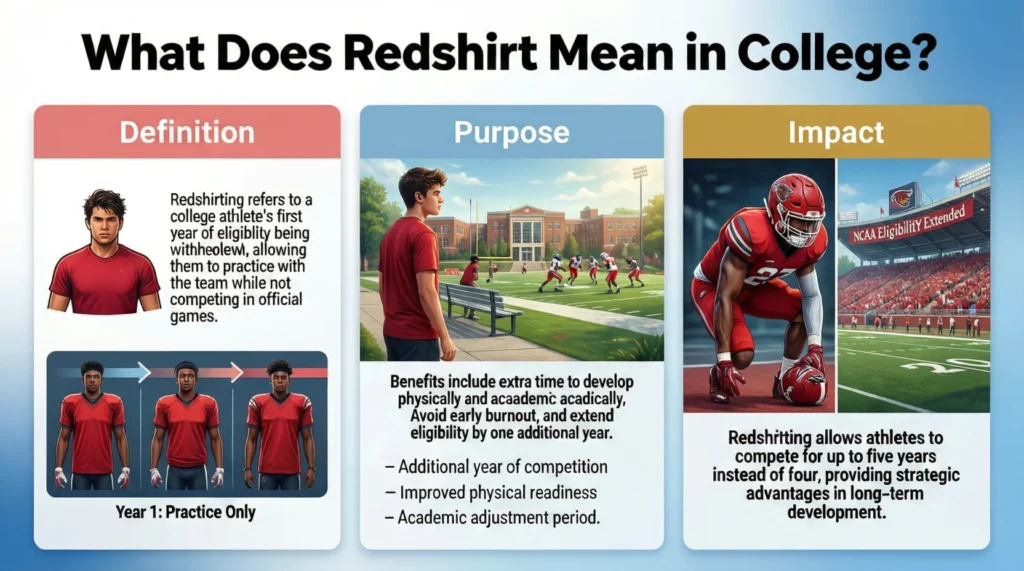
In college athletics, redshirting allows an athlete to sit out of official competition for a season without losing a year of eligibility. During a redshirt year, the athlete can still attend classes, train, practice with the team, and use school facilities.
Most college athletes have four seasons of eligibility that must be used within five academic years. A redshirt year gives the athlete an extra season to develop physically, mentally, or recover from injury.
Where Did the Term Redshirt Come From?
The term redshirt originated in college football.
In the early days of college sports, coaches would dress non-competing players in red practice jerseys to distinguish them from active players. Over time, the term “redshirt” became associated with athletes who practiced but did not compete.
Today, the term is used across nearly all college sports.
Why Athletes Choose to Redshirt
There are many reasons why a college athlete may redshirt.
To physically develop strength and size
To adjust to the academic demands of college
To learn the team’s system and playbook
To recover from an injury
To wait behind experienced players
Redshirting is often a strategic decision made by both the athlete and coaching staff.
Redshirt vs Playing Right Away
Some athletes compete immediately, while others redshirt their first year.
Playing right away offers early experience.
Redshirting offers long-term development.
Many elite college athletes, especially in football, benefit from a redshirt year before becoming starters.
Types of Redshirts in College Sports
There are different types of redshirts depending on circumstances.
Traditional Redshirt
The athlete does not compete at all during the season.
Medical Redshirt
Granted when an athlete suffers a season-ending injury early in the year.
Redshirt with Limited Games
In some sports, athletes can play in a limited number of games and still redshirt.
Rules vary by sport and governing body.
How Redshirting Works in NCAA Sports
Under NCAA rules, athletes can typically play up to a small number of games and still maintain redshirt status, depending on the sport.
This rule helps athletes gain experience without losing eligibility.
However, once an athlete exceeds the game limit, the redshirt year is no longer available.
Does Redshirting Affect Scholarships?
In most cases, redshirting does not affect athletic scholarships.
Redshirted athletes usually keep their scholarship.
They remain full members of the team.
They continue receiving academic and athletic support.
However, scholarship rules can vary by school and sport.
Academic Life During a Redshirt Year
Redshirted athletes are still full-time students.
They attend classes.
Redshirted athletes must meet academic eligibility requirements.
They balance practice, training, and schoolwork.
Many athletes find the redshirt year helpful for adjusting to college academics without game-day pressure.
Redshirt in Different College Sports
Redshirting is common across many sports.
Football often uses redshirts for physical development.
Basketball uses redshirts less often but still applies them.
Baseball and softball frequently redshirt due to roster depth.
Soccer, volleyball, and track also use redshirting strategically.
The overall goal is long-term athletic growth.
Advantages of Redshirting
Redshirting offers several benefits.
Extra year of physical development
More time to learn the sport at a higher level
Better long-term performance
Reduced pressure in the first year
Many successful college and professional athletes were redshirted early in their careers.
Potential Disadvantages of Redshirting
Redshirting is not always perfect.
Delayed competition experience
Possible frustration from not playing
Longer overall college timeline
Despite these drawbacks, many athletes find the benefits outweigh the negatives.
Redshirt vs Graduate Student Eligibility
A redshirt year is different from playing as a graduate student.
Redshirt preserves eligibility early.
Graduate eligibility applies after completing a degree.
Both extend playing time but work in different ways.
Common Misunderstandings About Redshirting
Some people believe redshirting means quitting or being cut. This is not true.
Redshirted athletes are still on the team.
They practice regularly.
They remain eligible for future seasons.
Redshirting is a strategic development tool, not a punishment.
Alternate Meanings of Redshirt
Outside of college sports, redshirt can refer to delaying school enrollment or training in other fields. In college athletics, the meaning is very specific and widely understood.
Professional Alternatives to Saying Redshirt
In formal communication, redshirt may be described as:
Preserving eligibility
Developmental year
Non-competing season
These terms explain the concept without slang.
FAQs
What does redshirt mean in college?
It means delaying competition for one season to preserve eligibility.
Can a redshirted athlete practice?
Yes, they can practice fully with the team.
Does redshirting affect graduation?
No, athletes still take classes normally.
Can freshmen redshirt?
Yes, redshirting is most common for freshmen.
Do redshirt athletes get scholarships?
Usually yes, depending on the program.
Can an athlete choose to redshirt?
It is usually a joint decision with coaches.
Is redshirting allowed in all sports?
Yes, though rules vary slightly by sport.
Is redshirting a bad thing?
No, it is often beneficial for development.
Conclusion
So, what does redshirt mean in college? It means an athlete delays competing for one season while still practicing and attending school, preserving a year of eligibility.
Redshirting is a common and strategic part of college sports that helps athletes grow, adjust, and prepare for long-term success.
For many athletes, a redshirt year becomes the foundation for a stronger and more successful college career.
Discover More Related Articles:
- What Does Box Out Mean in Basketball? How Players Secure Rebounds in 2026
- What Does RPO Mean in Football? Rules, Strategy, and Basics for 2026

David Brown is a content writer and language enthusiast at textroast.com, where he creates insightful articles that explain the meanings of words, slang, and phrases used in everyday life. His work helps readers decode modern language trends, understand cultural expressions, and make sense of online communication with clarity and fun.