
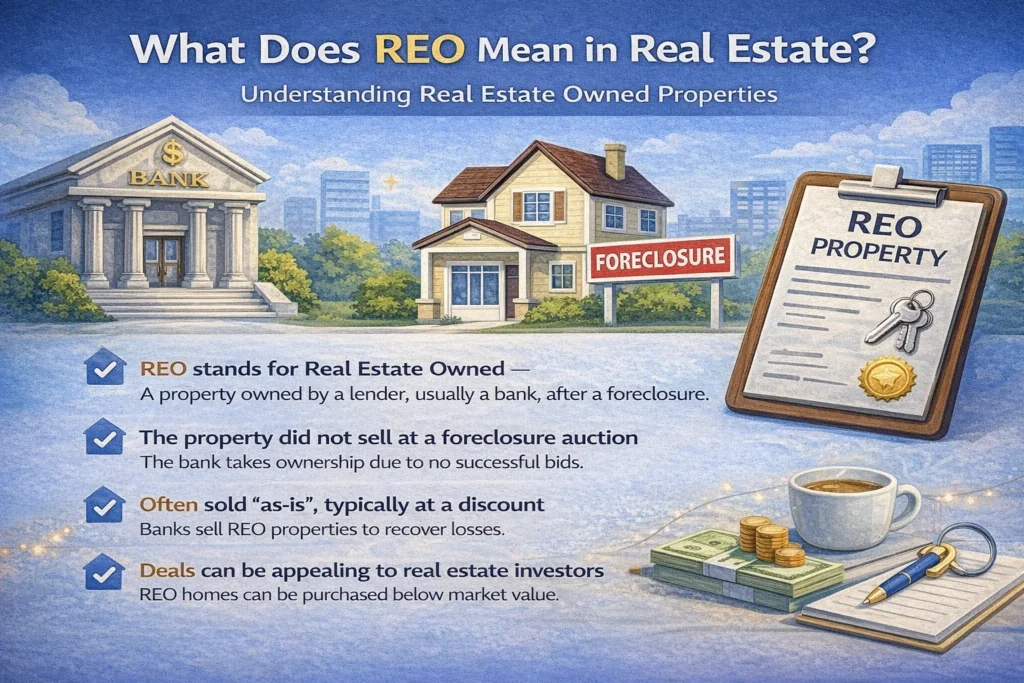
In real estate, REO stands for Real Estate Owned. It refers to a property that a lender, typically a bank, owns after a failed foreclosure auction.
If you’re exploring real estate investments, you may have encountered the term REO. In listings, investment guides, or bank sales, REO properties are a unique segment of the market.
Understanding what REO means in real estate is crucial for investors, homebuyers, and anyone interested in distressed properties. It helps you make informed decisions, avoid hidden risks, and find potential opportunities for profit.
This article provides a detailed explanation of REO properties, examples, comparisons, and answers common questions.
In simple terms:
An REO property is one that the bank has taken back because the previous owner defaulted on their mortgage and no buyer purchased it at foreclosure.
Understanding REO Properties
REO properties arise after a foreclosure process:
- Owner defaults – The homeowner fails to make mortgage payments.
- Foreclosure auction – The property is auctioned to recover the unpaid loan.
- Bank ownership – If no buyer purchases the property at auction, the bank or lender takes ownership, making it an REO property.
Banks typically want to sell REO properties quickly to recover their losses, often offering them at below market value.
REO vs Foreclosure
| Term | Meaning | Key Difference |
|---|---|---|
| Foreclosure | Legal process of taking back property due to unpaid mortgage | Can end with auction or REO |
| REO | Property owned by a bank after failed auction | Ownership has officially transferred to the lender |
Tip: All REO properties go through foreclosure first, but not all foreclosures become REO.
How Banks Handle REO Properties
Once a bank acquires an REO property, it usually:
- Clears outstanding liens or debts
- Repairs or secures the property if necessary
- Lists the property for sale, often with real estate agents
- May sell at a discount to attract buyers quickly
Some banks also auction REO properties to investors or work with REO specialists.
Examples of REO Properties
1 Example : Single-Family Home
- A homeowner stops paying the mortgage.
- The property goes to foreclosure auction.
- No bidder purchases the home.
- The bank takes ownership and lists it as an REO property for sale.
2 Example : Commercial REO
- A small office building owner defaults on a commercial loan.
- Foreclosure auction fails.
- The bank assumes ownership and hires a property management company to maintain the property before resale.
3 Example : Investment Opportunity
- REO homes are often sold below market value.
- Investors purchase, renovate, and resell for profit.
- Buyers can find affordable homes in desirable locations if they research carefully.
REO Pros and Cons
Pros
- Potential Discounts – Banks often price REO properties below market value.
- Clear Title – Banks usually clear liens, giving buyers a clean title.
- Investment Opportunity – Great for flipping or rental income.
- Less Competition than Auctions – REO sales are often more predictable than auction bidding wars.
Cons
- Property Condition – REO homes may be neglected or require significant repairs.
- Slow Process – Bank sales may take longer due to paperwork and approvals.
- Limited Negotiation – Banks have minimum acceptable prices and may not negotiate as flexibly as private sellers.
- Hidden Costs – Repairs, back taxes, or HOA fees may exist even after purchase.
How to Buy an REO Property
- Work with an experienced real estate agent – Many banks list REO properties through agents.
- Get pre-approved for a mortgage – Shows you are ready to buy.
- Research the property – Check condition, liens, and neighborhood.
- Submit an offer to the bank – Banks often have minimum price requirements.
- Inspect and negotiate – Ensure you account for repair costs before finalizing.
REO vs Short Sale
| Feature | REO | Short Sale |
|---|---|---|
| Ownership | Bank owns property | Seller still owns but sells below mortgage balance |
| Risk | Bank has clear title | Buyer may face complications with seller, bank approval |
| Timing | Often faster than short sale | Can take longer due to approval process |
| Price | Below market, sometimes fixed | Negotiable, may be lower than REO |
Tip: REO is generally cleaner legally than short sales because the bank already owns the property.
FAQs
What does REO mean in real estate?
REO stands for Real Estate Owned, referring to a property a bank owns after a failed foreclosure auction.
How is an REO property different from foreclosure?
Foreclosure is the legal process of repossessing a property. REO is the property the bank owns after an unsuccessful auction.
Are REO properties cheaper?
Often yes. Banks may sell REO properties below market value to recover losses quickly.
Do REO properties come with liens or debts?
Banks usually clear liens before selling, but buyers should verify the title.
Can I buy an REO property like a regular home?
Yes, but the process may involve bank approvals, inspections, and additional paperwork.
Is an REO property a good investment?
Yes, REO properties can be profitable for flipping or rentals, but repair costs and market research must be considered.
Who sells REO properties?
Banks, lenders, or specialized REO real estate agents typically handle the sale.
Do REO homes require repairs?
Many do. Banks sell as-is, so inspections are crucial before purchase.
Conclusion
REO properties are a significant segment of the real estate market, offering opportunities for homebuyers and investors alike. While they can provide discounts and investment potential, it’s essential to understand the legal process, property condition, and purchase requirements.
By researching carefully, inspecting thoroughly, and working with experienced professionals, you can leverage REO properties to find affordable homes or profitable investment opportunities.
Discover More Related Articles:
- Incurred Expenses Explained: What the Term Means in Accounting in 2026
- CAP Rate vs. ROI: What Every Property Investor Should Know in 2026
- Everything About LDW in Cars: How to Use It Properly in 2026

David Brown is a content writer and language enthusiast at textroast.com, where he creates insightful articles that explain the meanings of words, slang, and phrases used in everyday life. His work helps readers decode modern language trends, understand cultural expressions, and make sense of online communication with clarity and fun.