Definition
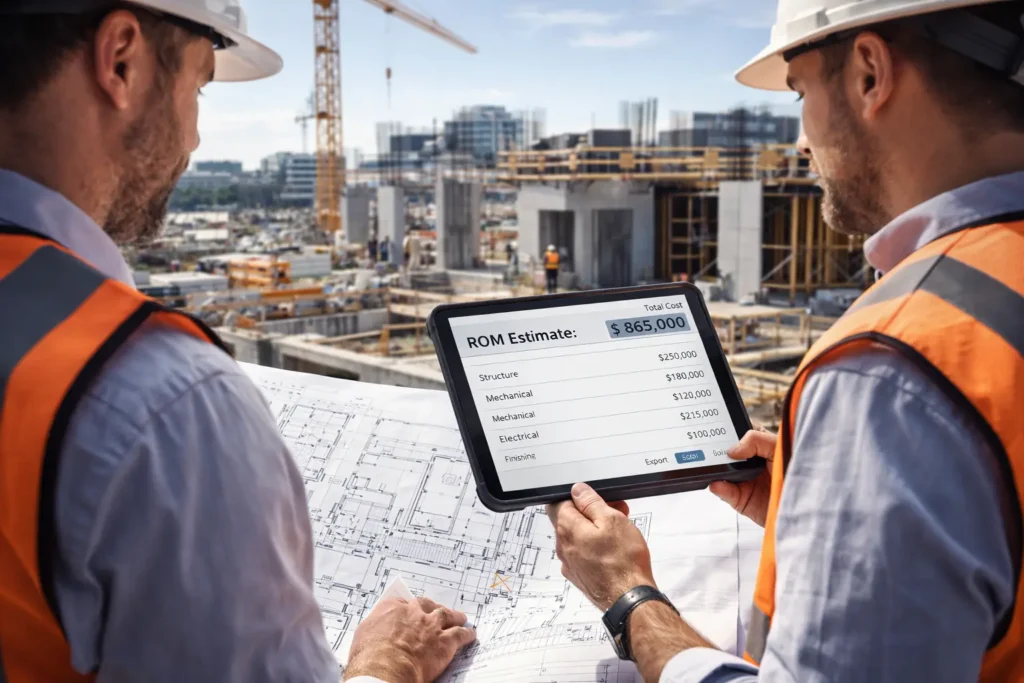
ROM in construction stands for “Rough Order of Magnitude.” It refers to an early-stage cost estimate used to give a general idea of how much a project might cost before detailed planning, design, or precise calculations are completed.
If you’ve ever been involved in a construction project or even just explored the idea of building a home you’ve probably wondered: “How much is this going to cost?” That’s where ROM comes into play.
Before architects finalize drawings or contractors break ground, professionals rely on Rough Order of Magnitude (ROM) estimates to set expectations. Think of ROM as a “ballpark figure” not exact, but incredibly useful for decision-making early in the process.
You’re a project owner, contractor, or curious learner, understanding what ROM means in construction can help you plan smarter, avoid surprises, and communicate more effectively.
What Is ROM in Construction?
Simple Explanation
A Rough Order of Magnitude (ROM) estimate is an early cost prediction used in construction projects when detailed information is not yet available. It helps stakeholders understand a project is financially feasible.
Key Characteristics of ROM
- Based on limited data or conceptual designs
- Typically has a wide accuracy range (±25% to ±50%)
- Used in early planning stages
- Helps in budgeting and decision-making
- Not intended for final contracts or precise costing
Origin and Popularity of the Term ROM
The concept of ROM didn’t originate solely in construction it actually comes from project management, engineering, and cost estimation practices. Over time, it became widely adopted in industries like:
- Construction
- IT and software development
- Manufacturing
- Infrastructure planning
Its popularity comes from its practicality. Early-stage projects always face uncertainty, and ROM provides a quick way to evaluate feasibility without waiting for detailed analysis.
Today, ROM is a standard term used in project proposals, feasibility studies, and early stakeholder discussions.
Why ROM Is Important in Construction
ROM plays a crucial role in the early stages of any construction project. Here’s why it matters:
1. Helps Determine Project Feasibility
Before investing time and money, stakeholders can assess the project is realistic within a budget.
2. Supports Early Decision-Making
Developers, investors, and clients can decide to move forward, modify plans, or cancel the project.
3. Saves Time and Resources
Instead of creating detailed estimates too early, ROM provides quick insights.
4. Sets Budget Expectations
Even though it’s not exact, it gives stakeholders a financial direction.
How ROM Estimates Are Calculated
ROM estimates are not random guesses they’re based on experience, historical data, and simple calculations.
Common Methods Used
- Historical Data Comparison
Using costs from similar past projects - Cost per Unit Method
Example: cost per square foot or meter - Expert Judgment
Based on the estimator’s experience - Analogous Estimating
Comparing with similar project types
Accuracy of ROM Estimates
ROM estimates are intentionally broad.
Typical Accuracy Range
| Estimate Type | Accuracy Range |
|---|---|
| ROM Estimate | ±25% to ±50% |
| Budget Estimate | ±10% to ±25% |
| Detailed Estimate | ±5% to ±10% |
This means if a ROM estimate is $100,000, the actual cost could realistically fall between $50,000 and $150,000.
Real-World Examples of ROM in Construction
Let’s look at how ROM is used in real-life scenarios.
Example Table: ROM Estimates in Action
| Project Type | Initial Idea | ROM Estimate | Final Cost (Later Stage) |
|---|---|---|---|
| Residential House | 2,000 sq ft home | $150,000–$250,000 | $210,000 |
| Office Building | Small commercial office | $500,000–$900,000 | $780,000 |
| Road Construction | 5 km rural road | $1M–$2M | $1.6M |
How ROM Is Used in Conversations (Tone Examples)
ROM isn’t just a technical term it’s also used in everyday professional communication.
Friendly Tone 😊
“Just to give you a rough idea, the ROM for this project is around $200,000.”
Neutral Tone
“The rough order of magnitude estimate suggests a cost range between $180,000 and $250,000.”
Cautious or Dismissive Tone ⚠️
“This is only a ROM estimate it’s not accurate enough for budgeting decisions yet.”
When Should You Use a ROM Estimate?
ROM estimates are best used during:
- Project brainstorming
- Initial client meetings
- Feasibility studies
- Investment discussions
- Early design phases
When NOT to Use ROM
- Final budgeting
- Contract agreements
- Detailed cost planning
- Procurement decisions
ROM vs Other Construction Estimates
Understanding ROM becomes easier when you compare it with other types of estimates.
Comparison Table
| Estimate Type | Stage | Accuracy | Purpose |
|---|---|---|---|
| ROM | Early stage | Low | Quick feasibility |
| Budget Estimate | Mid stage | Medium | Financial planning |
| Detailed Estimate | Final stage | High | Execution and contracts |
Related Terms and Abbreviations
Here are some similar or related terms you might encounter:
BOQ (Bill of Quantities)
A detailed document listing materials, labor, and costs.
Estimate
A general cost calculation, which can be rough or detailed.
Cost Projection
A forecast of future expenses based on trends and data.
Feasibility Study
An analysis to determine if a project is viable.
Alternate Meanings of ROM
While ROM in construction means “Rough Order of Magnitude,” it can have different meanings in other contexts:
- Read-Only Memory (Computing)
- Run of Mine (Mining Industry)
- Range of Motion (Medical Field)
Always consider the context to understand the correct meaning.
Professional Alternatives to Saying ROM
In formal communication, you might use alternatives such as:
- Preliminary estimate
- Initial cost projection
- Ballpark figure
- Conceptual estimate
- Early-stage cost range
Practical Tips for Using ROM Effectively
- Always clarify that it’s an estimate, not a final cost
- Provide a range, not a fixed number
- Base it on reliable historical data when possible
- Update it as more information becomes available
- Communicate uncertainty clearly to stakeholders
FAQ
What does ROM mean in construction?
ROM stands for Rough Order of Magnitude, which is an early estimate used to predict project costs before detailed planning.
How accurate is a ROM estimate?
ROM estimates typically have an accuracy range of ±25% to ±50%, making them less precise than detailed estimates.
When is a ROM estimate used?
It is used during the early stages of a project, such as planning, feasibility studies, and initial discussions.
Is ROM the same as a budget estimate?
No, ROM is less accurate and used earlier, while a budget estimate is more refined and used later in planning.
Can ROM estimates be used for contracts?
No, ROM estimates are not suitable for contracts because they lack precision.
How do contractors create ROM estimates?
They use historical data, cost-per-unit calculations, and expert judgment.
Why is ROM important in construction?
It helps stakeholders decide a project is financially viable before investing in detailed planning.
What is the difference between ROM and detailed estimates?
ROM is a rough early estimate, while detailed estimates are precise and used for execution and contracts.
Conclusion
Understanding what ROM means in construction can save you time, money, and confusion. A Rough Order of Magnitude estimate is not about precision it’s about direction.
It helps answer the most important early question: “Is this project worth pursuing?”
FWhile ROM estimates come with a wide margin of error, they are incredibly valuable for early planning and decision-making. The key is to use them wisely never as a final number, but as a starting point.
As your project progresses, ROM estimates should evolve into more accurate calculations, ensuring smoother execution and better financial control.
Discover More Related Articles:
- Candescent Explained: The Meaning of “Cand” Made Easy In 2026
- Confused About Conduction in Science: Here’s What It Really Means In 2026
- Understanding TDS in Water: Meaning, Measurement & Health Impact In 2026

Laura Jackson is a writer at textroast.com, where she creates engaging articles that decode the meanings behind slang, phrases, and everyday expressions. Passionate about language and communication, she makes complex or confusing terms easy to understand, turning learning into a fun and relatable experience for readers around the world.