
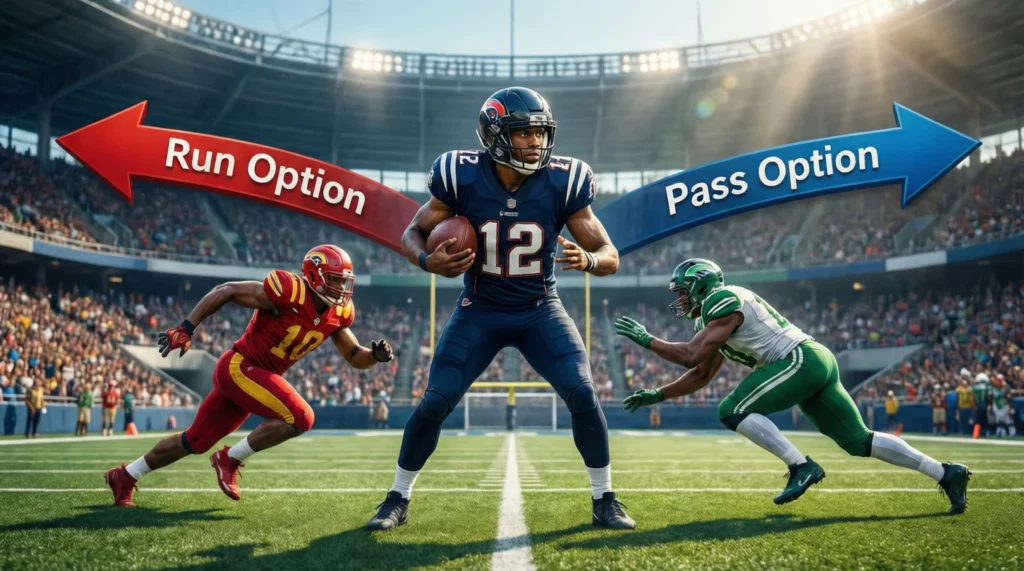
RPO in football stands for Run Pass Option.
It is an offensive play where the quarterback decides after the snap whether to hand the ball off for a run or throw a quick pass based on the defense’s reaction.
If you watch modern football, especially college games or the NFL, you have probably heard commentators mention RPO. It shows up in play breakdowns, coaching discussions, and quarterback analysis. This often leads fans to ask an important question: what does RPO mean in football?
This article explains RPO in a clear, easy to understand, and professional way. You will learn what RPO stands for, how it works, why teams use it, and how it differs from other offensive concepts.
What Does RPO Mean in Football?
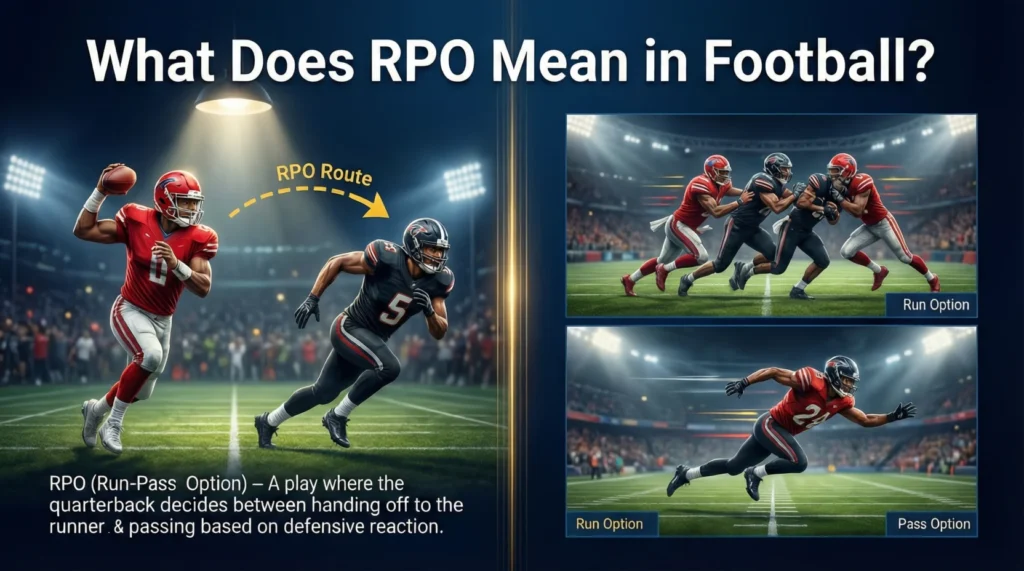
An RPO is a play that gives the quarterback multiple options on the same play. The offense lines up with both a running play and a passing play built in. After the ball is snapped, the quarterback reads a specific defender.
If that defender commits to stopping the run, the quarterback throws the ball. If the defender stays back to cover the pass, the quarterback hands the ball off to the running back.
This decision happens in seconds and is based entirely on what the defense does.
How an RPO Works Step by Step
The RPO concept follows a simple process.
The offense lines up with a run and a pass option.
The ball is snapped to the quarterback.
The quarterback reads a specific defender, usually a linebacker or safety.
If the defender moves toward the run, the quarterback throws.
If the defender drops back into coverage, the quarterback hands the ball off.
The key is that the quarterback makes the decision after the snap, not before.
Why Teams Use RPO Plays
RPOs are popular because they put the defense in a difficult position.
They force defenders to choose between stopping the run or covering the pass.
RPOs slow down aggressive defenses.
They help quarterbacks make quick, safe decisions.
RPOs allow offenses to stay unpredictable.
Because of these advantages, RPOs are a major part of many modern offenses.
RPO vs Play Action
RPOs are often confused with play action, but they are not the same.
In play action, the quarterback always throws the ball after faking a run. The decision is made before the snap.
In an RPO, the quarterback decides whether to run or pass after reading the defense.
Both use deception, but the decision making process is different.
RPO vs Option Plays
Traditional option plays usually involve a quarterback deciding whether to keep the ball or hand it off based on a defender.
RPOs replace the quarterback run with a pass option. Instead of keeping the ball and running, the quarterback throws a quick pass if the defense reacts to the run.
This makes RPOs safer and more effective in modern football.
Common Types of RPO Plays
There are several popular RPO variations.
Inside run with a quick slant pass.
Outside run with a bubble screen.
Run paired with a quick hitch or flat route.
These plays are designed to be fast and simple, allowing the quarterback to get the ball out quickly.
Example of an RPO in a Game
Imagine the offense lines up with a running back next to the quarterback. A wide receiver is running a quick slant route.
At the snap, the quarterback watches the linebacker. If the linebacker moves toward the running back, the quarterback throws the slant. If the linebacker stays in coverage, the ball is handed off.
This single defender determines the outcome of the play.
Why RPOs Are So Effective
RPOs work because football defenses must react quickly.
Linebackers are taught to stop the run. Defensive backs are taught to cover receivers. RPOs force defenders to do both at the same time.
This hesitation creates opportunities for the offense and often leads to efficient gains.
Are RPOs Legal in Football?
Yes, RPOs are legal, but they must follow certain rules.
Offensive linemen cannot block too far downfield on a pass play.
The quarterback must release the ball quickly.
These rules keep RPOs from becoming unfair advantages.
RPOs at Different Levels of Football
RPOs are used at every level.
Youth football uses simplified versions.
College football uses RPOs heavily.
The NFL uses RPOs with stricter timing and rules.
The concept remains the same, even as execution becomes more complex.
Does RPO Mean the Quarterback Runs?
Not usually. While the quarterback can run in some option plays, most RPOs focus on handing the ball off or throwing a quick pass.
The goal is efficiency and quick decision making.
Professional Alternatives to Saying RPO
In formal analysis, RPOs may be described as:
Run pass option concept
Post snap decision play
Read based offensive play
These phrases describe the same idea in more detail.
FAQs
What does RPO stand for in football?
RPO stands for run pass option.
Is RPO a run or a pass?
It can be either, depending on the quarterback’s read.
Is RPO the same as play action?
No, play action is always a pass.
Why are RPOs hard to defend?
They force defenders to choose between stopping the run or covering the pass.
Are RPOs used in the NFL?
Yes, many NFL teams use RPO concepts.
Can any quarterback run an RPO offense?
Yes, but quick decision making is essential.
Are RPOs risky?
They are generally safe because the throws are short.
Will RPOs always be part of football?
They are likely to remain important in modern offenses.
Conclusion
So, what does RPO mean in football? It stands for run pass option, a play where the quarterback decides after the snap to hand the ball off or throw a pass based on the defense’s reaction.
RPOs have changed how offenses attack defenses by combining speed, deception, and smart decision making. Understanding RPOs helps fans better appreciate modern play calling and quarterback performance.
Discover More Related Articles:
- What Does OTL Mean in Hockey? Beginner-Friendly Explanation (2026)
- What Does OPS Mean in Baseball Stats? How to Read OPS Like a Pro (2026)

David Brown is a content writer and language enthusiast at textroast.com, where he creates insightful articles that explain the meanings of words, slang, and phrases used in everyday life. His work helps readers decode modern language trends, understand cultural expressions, and make sense of online communication with clarity and fun.