Definition
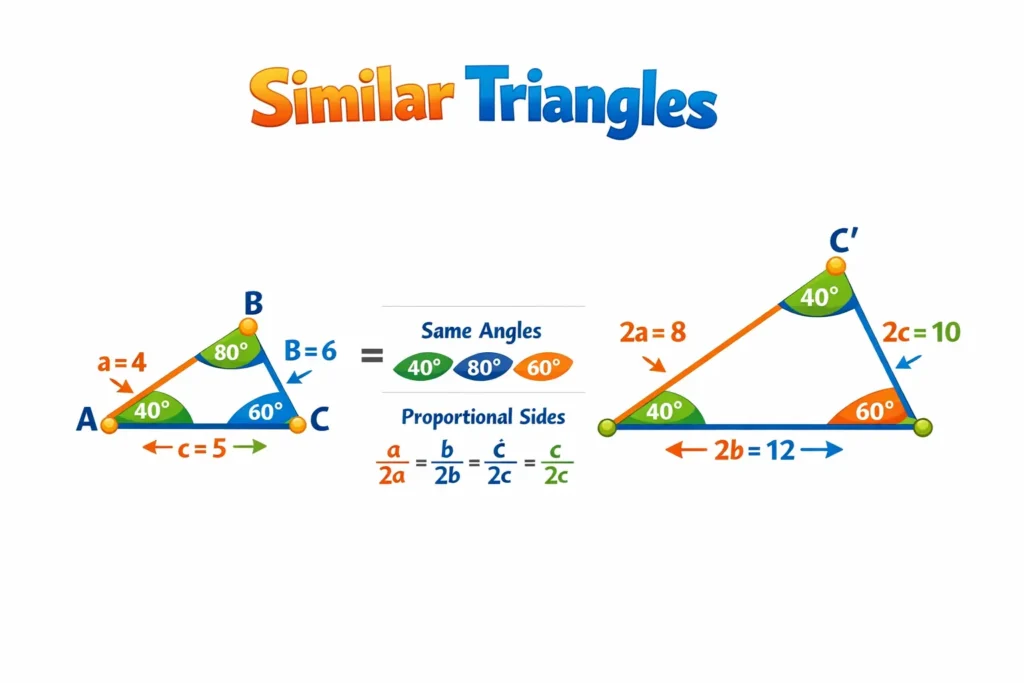
In geometry, “similar” refers to figures that have the same shape but not necessarily the same size. Their corresponding angles are equal and their corresponding sides are proportional.
Have you ever noticed how a small photo and a large poster of the same image look identical in shape, even though their sizes differ? That’s exactly what “similar” means in geometry. It’s a powerful concept that helps us understand how shapes can be scaled up or down without changing their fundamental structure.
You’re a student trying to grasp geometry basics or someone brushing up on math concepts, understanding similarity is essential. From architecture to map reading, this concept appears everywhere in real life.
In this guide, you’ll learn what “similar” means in geometry, how to identify similar shapes, real-world applications, examples, comparisons with related terms, and much more.
What Does Similar Mean in Geometry?
In simple terms, similar figures are shapes that look the same but differ in size.
Key Characteristics of Similar Figures
- Corresponding angles are equal
- Corresponding sides are proportional
- Shapes maintain the same form or structure
- One figure can be obtained from another by scaling (enlarging or shrinking)
Origin and Popularity of the Concept
The idea of similarity dates back to ancient mathematics, especially in the work of Greek mathematicians like Euclid. Similarity was essential in developing geometric proofs and understanding proportions.
Why Is It Important Today?
- Used in engineering and architecture
- Helps in creating scale models
- Essential in trigonometry and advanced geometry
- Useful in photography, design, and art
The concept remains popular because it connects math to real-world problem-solving in a simple yet powerful way.
Understanding Similar Figures with Examples
Let’s break it down with clear examples.
Example 1: Similar Triangles
If two triangles have:
- All corresponding angles equal
- Corresponding sides in the same ratio
Then they are similar.
For example:
- Triangle A has sides: 3 cm, 4 cm, 5 cm
- Triangle B has sides: 6 cm, 8 cm, 10 cm
Here, each side in Triangle B is twice the size of Triangle A.
So, the ratio is consistent → the triangles are similar.
Example 2: Similar Squares
All squares are similar because:
- All angles are 90°
- Side ratios are proportional
A square with side 2 cm and another with side 10 cm are similar.
Example 3: Real-Life Example
- A small map and a large map of the same area
- A miniature model of a building vs. the real building
- Zooming in or out on an image
These are all examples of similarity in action.
Types of Similarity in Geometry
1. Triangle Similarity
There are three main rules:
- AA (Angle-Angle): Two angles are equal
- SSS (Side-Side-Side): All sides proportional
- SAS (Side-Angle-Side): Two sides proportional and included angle equal
2. Polygon Similarity
For polygons to be similar:
- All corresponding angles must match
- All corresponding sides must be proportional
Table: Key Features of Similar Figures
| Feature | Similar Figures |
|---|---|
| Shape | Same |
| Size | Different (can vary) |
| Angles | Equal |
| Side Lengths | Proportional |
| Orientation | May differ (rotated/flipped) |
| Scaling Factor | Constant ratio |
How to Identify Similar Figures
Here’s a simple step-by-step approach:
Step 1: Compare Angles
Check if all corresponding angles are equal.
Step 2: Compare Side Ratios
Divide corresponding sides and see if ratios match.
Step 3: Confirm Consistency
If ratios are consistent → figures are similar.
Tone and Usage in Different Contexts
While “similar” in geometry is strictly mathematical, it can also be used in everyday language with slightly different tones.
Friendly Tone 😊
“These two shapes look pretty similar!”
Neutral Tone
“The figures are similar based on proportional sides.”
Slightly Dismissive Tone 😐
“They’re similar, but not exactly the same.”
Comparison with Related Terms
Understanding similarity becomes easier when compared with related concepts.
Similar vs Congruent
| Feature | Similar Figures | Congruent Figures |
|---|---|---|
| Shape | Same | Same |
| Size | Different | Same |
| Angles | Equal | Equal |
| Sides | Proportional | Equal |
👉 Key Difference:
Congruent figures are identical in both shape and size, while similar figures only share shape.
Similar vs Equal
- Similar: Same shape, different size
- Equal: Exactly the same in all aspects
Real-World Applications of Similarity
1. Architecture
Buildings are designed using scaled drawings.
2. Maps and Navigation
Maps use proportions to represent real distances.
3. Photography
Zooming maintains proportions.
4. Engineering
Machines are designed using models.
5. Art and Design
Artists scale images without distortion.
Alternate Meanings of “Similar”
Outside geometry, “similar” can mean:
- Almost the same
- Having resemblance
- Comparable
Example:
“These two ideas are similar.”
Polite and Professional Alternatives
In professional or academic writing, instead of repeating “similar,” you can use:
- Comparable
- Alike
- Equivalent in structure
- Proportional
- Corresponding
Common Mistakes to Avoid
- Assuming same size is required (it’s not)
- Ignoring side ratios
- Confusing similarity with congruence
- Forgetting angle equality
Practical Tips for Mastery
- Practice identifying angle equality
- Use ratios regularly
- Draw diagrams to visualize
- Memorize similarity rules (AA, SSS, SAS)
- Apply concepts to real-world examples
FAQs
What does similar mean in geometry?
Similar in geometry means figures have the same shape, equal angles, and proportional sides, but not necessarily the same size.
How do you know if two shapes are similar?
You check if corresponding angles are equal and corresponding sides are in the same ratio.
Are all squares similar?
Yes, because all squares have equal angles and proportional sides.
What is the difference between similar and congruent?
Similar figures have the same shape but different sizes, while congruent figures are identical in both shape and size.
Can similar figures be different sizes?
Yes, that is the main characteristic of similar figures.
What is a scale factor in similarity?
It is the ratio used to enlarge or reduce a figure while maintaining its shape.
Are circles always similar?
Yes, all circles are similar because they have the same shape.
Why is similarity important in real life?
It helps in designing, scaling, mapping, and understanding proportions in various fields.
Conclusion
Understanding what “similar” means in geometry opens the door to a deeper appreciation of shapes, proportions, and real-world applications. Similar figures share the same structure and form, even when their sizes differ.
By mastering angle relationships and proportional reasoning, you can confidently identify and work with similar shapes in both academic and practical situations.
You’re analyzing triangles, designing structures, or reading maps, similarity is a concept that connects geometry to everyday life in meaningful ways.
Discover More Related Articles:
- Construction Made Simple: What ROM Really Means & Why It Matters In 2026
- Math Symbols Explained: What the ‘ (Prime) Sign Means In 2026
- From Confusion to Clarity: Understanding Vertices in Geometry In 2026

Laura Jackson is a writer at textroast.com, where she creates engaging articles that decode the meanings behind slang, phrases, and everyday expressions. Passionate about language and communication, she makes complex or confusing terms easy to understand, turning learning into a fun and relatable experience for readers around the world.