Definition
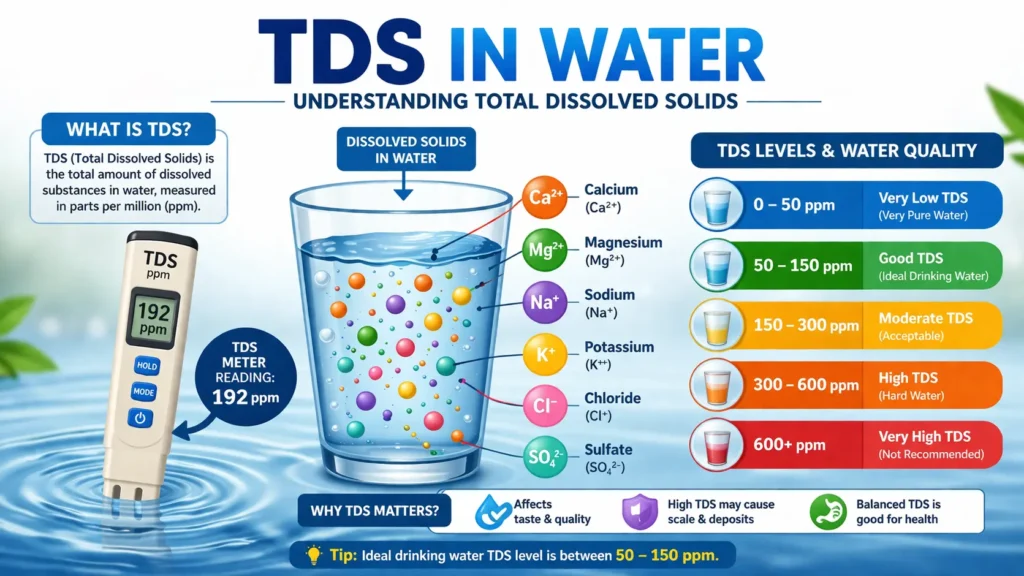
TDS in water stands for Total Dissolved Solids. It refers to the combined amount of all organic and inorganic substances dissolved in water, including minerals, salts, metals, and ions. TDS is usually measured in parts per million (ppm) or milligrams per liter (mg/L) and indicates the overall quality and purity of water.
Have you ever checked your drinking water quality and come across the term “TDS”? It often appears on water purifier displays, lab reports, or bottled water labels. But what does TDS really mean, and should you care about it?
Understanding TDS in water is essential because it directly affects taste, safety, and overall health. You’re drinking tap water, filtered water, or mineral water, it plays a crucial role in determining what exactly is dissolved in every sip you take.
In this comprehensive guide, we’ll break down everything you need to know about TDS in water in a simple, clear, and practical way.
What Is TDS in Water?
TDS stands for Total Dissolved Solids, which includes:
- Minerals like calcium, magnesium, and potassium
- Salts such as sodium chloride
- Metals like iron and lead
- Organic matter and microscopic particles
These substances are dissolved so completely that they are invisible to the naked eye.
Key Point
TDS is not a single substance. It’s a measurement of everything dissolved in water.
How Is TDS Measured?
TDS is measured in:
- ppm (parts per million)
- mg/L (milligrams per liter)
These units are essentially the same in water measurement.
Example
If it has a TDS of 300 ppm, it means there are 300 milligrams of dissolved solids in one liter of water.
Why TDS Matters in Drinking Water
TDS is important because it affects:
1. Taste
- Low it tastes flat or bland
- Moderate TDS gives a pleasant taste
- High TDS may taste salty, bitter, or metallic
2. Health
Some dissolved solids are beneficial, while others can be harmful.
- Good minerals: calcium, magnesium
- Potentially harmful substances: lead, arsenic, nitrates
3. Water Safety
High TDS levels can indicate contamination, although not always.
Ideal TDS Levels for Drinking Water
Here is a general guideline:
| TDS Level (ppm) | Water Quality | Taste |
|---|---|---|
| 0–50 | Very low | Flat |
| 50–150 | Excellent | Crisp and clean |
| 150–300 | Good | Balanced |
| 300–500 | Acceptable | Slightly heavy |
| 500–1000 | Poor | Unpleasant |
| Above 1000 | Unsafe | Not recommended |
Recommended Range
Most experts suggest a TDS level between 50 and 300 ppm for drinking water.
Sources of TDS in Water
TDS can come from natural and human-made sources.
Natural Sources
- Rocks and soil minerals
- Rivers and groundwater
- Natural salts and organic matter
Human Sources
- Agricultural runoff
- Industrial waste
- Sewage contamination
- Water treatment chemicals
Real-World Usage of TDS
You’ll commonly encounter TDS in:
- Water purifiers (RO systems display TDS levels)
- Bottled water labels
- Laboratory water testing reports
- Aquariums and hydroponics systems
Everyday Example
If your water purifier shows “TDS: 120 ppm,” it means your water contains a moderate level of dissolved solids and is generally safe for drinking.
Examples of TDS in Context
Friendly Tone 😊
“The TDS level of your water is 150 ppm, which is perfect for drinking. It even improves the taste!”
Neutral Tone
“The water sample contains 320 ppm TDS, which falls within the acceptable range but may affect taste.”
Negative or Warning Tone ⚠️
“The TDS level is above 1000 ppm, making the water unsuitable for consumption without treatment.”
High TDS vs Low TDS
High TDS Water
- May contain harmful contaminants
- Often tastes salty or bitter
- Can cause scaling in appliances
Low TDS Water
- May lack essential minerals
- Tastes flat
- Often produced by RO systems
TDS and Water Purifiers
Many modern water purifiers control TDS levels.
RO (Reverse Osmosis) Systems
- Remove up to 90–99% of dissolved solids
- Reduce both harmful and beneficial minerals
UV Purifiers
- Kill bacteria but do not reduce TDS
TDS Controllers
- Add back essential minerals after filtration
Comparison: TDS vs Hardness vs pH
These terms are often confused but have different meanings.
| Parameter | Meaning | Measures |
|---|---|---|
| TDS | Total dissolved substances | Overall water content |
| Hardness | Calcium and magnesium levels | Mineral concentration |
| pH | Acidity or alkalinity | Chemical balance |
Key Difference
- TDS = Everything dissolved
- Hardness = Specific minerals
- pH = Chemical nature of water
Is High TDS Always Dangerous?
Not necessarily.
- High TDS due to minerals can be safe
- High TDS due to heavy metals can be harmful
Important Tip
Always test water quality, not just TDS levels.
Alternate Meanings of TDS
Although TDS commonly refers to water, it can also mean:
- Tax Deducted at Source (finance context)
- Technical Data Sheet (industrial use)
However, in water discussions, it almost always means Total Dissolved Solids.
Practical Tips to Manage TDS
- Use a water purifier if TDS is above 500 ppm
- Test your water regularly
- Don’t aim for zero TDS; some minerals are beneficial
- Choose purifiers with mineral retention features
FAQ
What does TDS mean in drinking water?
It means Total Dissolved Solids, which includes all minerals, salts, and impurities dissolved in water.
What is a safe TDS level for drinking water?
A TDS level between 50 and 300 ppm is generally considered safe and ideal.
Is high TDS water harmful?
It depends on the source. High TDS from minerals may be safe, but from contaminants can be harmful.
Does boiling water reduce TDS?
No, boiling does not remove dissolved solids. It may even increase TDS slightly due to evaporation.
Is low TDS water good for health?
Very low it lacks essential minerals and may not be ideal for long-term consumption.
What is the best TDS level for RO water?
Around 80–150 ppm is considered optimal after RO filtration.
How can I check TDS at home?
You can use a digital TDS meter, which is affordable and easy to use.
Does bottled water have TDS?
Yes, bottled water contains TDS, often adjusted for taste and mineral balance.
Conclusion
TDS in water is a simple yet powerful indicator of water quality. It tells you how many dissolved substances are present in your drinking water, influencing everything from taste to safety.
The key takeaway is balance. Water with extremely high or extremely low it is not ideal. A moderate range ensures that you get essential minerals without harmful contaminants.
By understanding TDS, regularly testing your water, and using the right filtration system, you can ensure that every glass you drink is safe, healthy, and refreshing.
Discover More Related Articles:
- Upside Down T Meaning in Geometry: Everything You Need to Know In 2026
- What Is the Dot (·) in Math? A Beginner-Friendly Guide In 2026

Laura Jackson is a writer at textroast.com, where she creates engaging articles that decode the meanings behind slang, phrases, and everyday expressions. Passionate about language and communication, she makes complex or confusing terms easy to understand, turning learning into a fun and relatable experience for readers around the world.