Definition
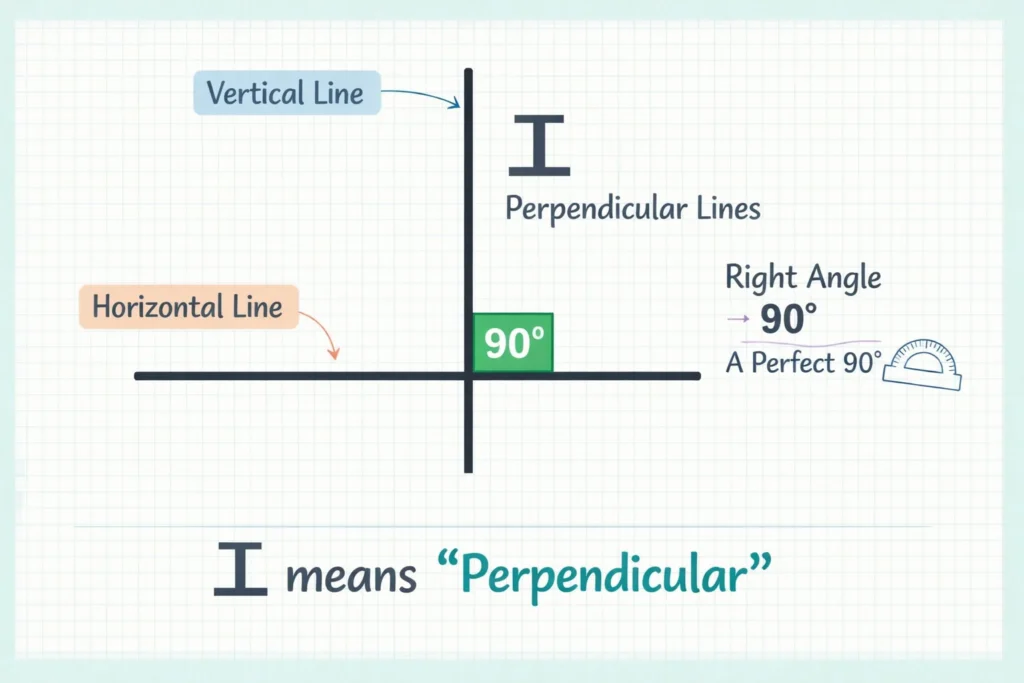
The upside down “T” symbol (⊥) in geometry means “perpendicular.” It indicates that two lines, segments, or planes intersect at a right angle (90°).
Understanding symbols is a big part of learning geometry and one symbol that often confuses students is the upside down “T”. If you’ve ever seen it in diagrams or math problems and wondered what it means, you’re not alone. Let’s break it down in a simple, clear, and engaging way so you can confidently recognize and use it.
Geometry is full of visual language. Instead of long explanations, mathematicians use symbols to communicate ideas quickly. The upside down “T” (⊥) is one of the most important symbols because it tells you something very specific: two lines meet at a perfect right angle.
Think about the corner of a book, the edges of a wall, or a plus sign (+). These everyday examples all show perpendicular lines. That’s exactly what this symbol represents precision and structure.
You’re a student, teacher, or just brushing up on math skills, understanding this symbol can make solving geometry problems much easier.
What Does the Upside Down T Mean in Geometry?
The upside down “T” symbol (⊥) is used to show that:
- Two lines intersect at a right angle (90 degrees)
- One line is perpendicular to another
- The angle formed is exactly 90°
Example:
If you see:
Line AB ⊥ Line CD
It means:
- Line AB and Line CD intersect
- The angle between them is 90°
Origin of the Perpendicular Symbol
The symbol ⊥ comes from mathematical notation developed over centuries to simplify communication. While there’s no single inventor credited for it, it became widely used in Euclidean geometry, based on the work of ancient Greek mathematician Euclid.
Why This Shape?
The symbol visually resembles two lines meeting at a right angle just like the concept it represents. This makes it intuitive and easy to recognize.
Real-World Usage of the Upside Down T Symbol
You might think this symbol is only used in classrooms, but it actually appears in many real-world applications:
Architecture and Construction
Builders use perpendicular lines to ensure walls and floors meet at perfect right angles.
Engineering
Designing machines and structures often requires exact perpendicular measurements for stability.
Computer Graphics
Perpendicular vectors are used in rendering and 3D modeling.
Everyday Objects
- Corners of rooms
- Edges of tables
- Window frames
All of these rely on perpendicular lines.
How to Use the Perpendicular Symbol in Geometry
Here’s how you’ll typically see and use the upside down T in geometry:
1. In Equations
- AB ⊥ CD
2. In Diagrams
A small square is often drawn at the angle to indicate 90°
3. In Coordinate Geometry
Two lines are perpendicular if:
- The product of their slopes = -1
Examples of the Upside Down T Symbol in Context
Let’s look at some examples to make things clearer.
Basic Example
Line PQ ⊥ Line RS
This means PQ and RS meet at a 90° angle.
Coordinate Geometry Example
If slope of Line A = 2
Then slope of perpendicular Line B = -1/2
Visual Example Description 😊
Imagine a “+” sign. The vertical and horizontal lines are perpendicular they form four right angles.
Example Table: Understanding Perpendicular Relationships
| Scenario | Description | Is it Perpendicular? |
|---|---|---|
| Two lines cross at 90° | Perfect right angle | Yes |
| Lines cross at 45° | Acute angle | No |
| Parallel lines | Never meet | No |
| X shape (not equal angles) | Not 90° | No |
| Plus (+) shape | 90° intersection | Yes |
Tone-Based Explanation (Simple, Friendly, and Clear)
Friendly Explanation 😊
The upside down T just means two lines meet like the corner of a square nice and neat at 90°!
Neutral Explanation
It indicates that two lines intersect at a right angle.
Slightly Dismissive Tone 😅
It’s just a symbol for perpendicular lines nothing complicated once you know it.
Comparison with Similar Geometry Symbols
Understanding how the upside down T differs from other symbols can help avoid confusion.
| Symbol | Meaning | Description |
|---|---|---|
| ⊥ | Perpendicular | Lines meet at 90° |
| ∥ | Parallel | Lines never meet |
| ∠ | Angle | Represents an angle |
| ≅ | Congruent | Same shape and size |
Key Difference:
- ⊥ focuses on angle (90°)
- ∥ focuses on direction (never meeting)
Common Mistakes to Avoid
Many students confuse the perpendicular symbol with other concepts. Here are some tips:
- Don’t confuse ⊥ with + (plus sign)
- Perpendicular does NOT mean equal length
- Lines must meet at exactly 90°, not “close enough”
Alternate Meanings of the Upside Down T Symbol
While ⊥ mainly means perpendicular in geometry, it can have other meanings in different fields:
In Logic
It can represent contradiction or falsehood.
In Physics
Sometimes used to indicate orthogonal vectors.
In Typography
It may appear as a stylistic symbol.
However, in geometry, its meaning is always perpendicular.
Professional or Polite Alternatives (When Writing)
If you’re writing in formal or academic settings, you might use:
- “is perpendicular to”
- “intersects at a right angle”
- “forms a 90-degree angle with”
Example:
Instead of writing AB ⊥ CD, you can say:
“Line AB is perpendicular to Line CD.”
Practical Tips for Students
- Always look for the small square in diagrams it confirms a right angle
- Remember: perpendicular = 90°
- Practice identifying perpendicular lines in everyday objects
- Use graph paper to visualize right angles
FAQS
What does the upside down T symbol mean in geometry?
It means two lines are perpendicular and meet at a 90-degree angle.
Is the upside down T always 90 degrees?
Yes, it always represents a right angle (exactly 90°).
How do you type the perpendicular symbol?
You can copy and paste ⊥ or use special character tools in Word or LaTeX.
What is the difference between perpendicular and parallel lines?
Perpendicular lines meet at 90°, while parallel lines never meet.
Can curved lines be perpendicular?
No, perpendicular relationships apply to straight lines or segments.
How do you prove two lines are perpendicular?
In coordinate geometry, if the product of slopes is -1, the lines are perpendicular.
Is the upside down T used outside math?
Yes, in logic and physics, but with different meanings.
Why is perpendicular important in geometry?
It helps define shapes, angles, and structures accurately.
Conclusion
The upside down T symbol (⊥) is a simple yet powerful sign in geometry that indicates two lines meet at a perfect right angle. In other words, it shows that the lines are perpendicular, forming a 90° angle where they intersect.
This concept appears frequently not only in math problems but also in real-world structures like buildings, roads, and designs.
Understanding this symbol makes it easier to read geometric diagrams, solve problems accurately, and build a stronger foundation in geometry and related fields like engineering and design.
Discover More Related Articles:
- Intermediate Language Skills: What You Should Know & Do In 2026
- Double Spaced… Double Confused: Here’s What It Really Means In 2026
- Mastering Mean in Excel: Learn How to Do Mean with Formulas In 2026

Laura Jackson is a writer at textroast.com, where she creates engaging articles that decode the meanings behind slang, phrases, and everyday expressions. Passionate about language and communication, she makes complex or confusing terms easy to understand, turning learning into a fun and relatable experience for readers around the world.