
Definition
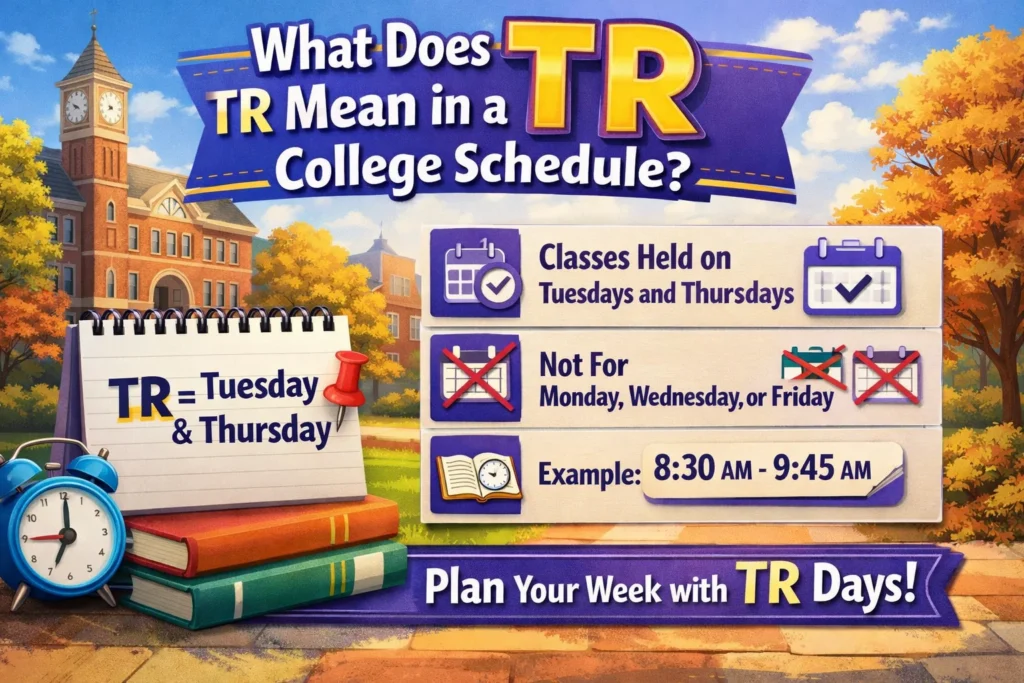
TR in a college schedule stands for “Tuesday and Thursday.” It indicates that a class meets twice a week on these specific days.
When registering for classes in college, students often see abbreviations like TR, MW, or F in course schedules. Understanding these abbreviations is crucial for planning your weekly routine and avoiding conflicts.
This article provides a comprehensive guide to what TR means in a college schedule, how it’s used, examples, and answers to frequently asked questions.
In simple terms:
- TR = Tuesday + Thursday
- Classes labeled TR usually meet for longer sessions than MW classes to cover the same amount of material in fewer days.
Understanding TR in College Schedules
Colleges use abbreviations to simplify the presentation of course days. The most common abbreviations include:
| Abbreviation | Meaning |
|---|---|
| M | Monday |
| T | Tuesday |
| W | Wednesday |
| R | Thursday |
| F | Friday |
| TR | Tuesday & Thursday |
| MW | Monday & Wednesday |
| MWF | Monday, Wednesday & Friday |
TR specifically refers to classes that occur on Tuesdays and Thursdays, often for 1.5 hours each session, compared to MW classes, which might meet the same amount of time but split differently.
Why TR Classes Exist
TR schedules are designed to:
- Reduce the Number of Class Days: Students attend fewer days per week but for longer sessions.
- Balance Course Load: Helps students mix courses with different meeting schedules efficiently.
- Provide Flexibility: Frees up days for study, work, or other responsibilities.
- Meet Credit Hour Requirements: Longer sessions on TR ensure the total class hours per semester are met.
Example:
- A 3-credit TR class meets Tuesday and Thursday, 1:00 PM – 2:30 PM, totaling 3 hours per week.
- The same 3-credit MW class meets Monday and Wednesday, 1:00 PM – 2:15 PM.
Both classes meet for the same total weekly hours but are scheduled differently.
How to Read a College Schedule with TR
College schedules often include:
- Course Code: Identifies the subject and level (e.g., ENG101).
- Section Number: Distinguishes different class sections.
- TR Days: Indicates meeting days (Tuesday & Thursday).
- Time: Shows the start and end time of each session.
- Location: Classroom or building.
- Instructor: Name of the professor or lecturer.
Example Schedule Entry:
| Course | Section | Days | Time | Location | Instructor |
|---|---|---|---|---|---|
| ENG101 – English Composition | 01 | TR | 10:00 AM – 11:15 AM | Room 203 | Dr. Smith |
| MATH110 – College Algebra | 02 | MW | 9:00 AM – 10:15 AM | Room 105 | Prof. Lee |
In this example, ENG101 meets on Tuesdays and Thursdays, while MATH110 meets on Mondays and Wednesdays.
TR vs MW vs MWF
| Schedule | Frequency | Typical Duration | Pros | Cons |
|---|---|---|---|---|
| TR | Tuesday & Thursday | 1.5–2 hours per session | Fewer days on campus; longer class sessions | Less frequent review between classes |
| MW | Monday & Wednesday | 1–1.5 hours per session | Consistent review; shorter sessions | Classes every Monday and Wednesday |
| MWF | Monday, Wednesday & Friday | 50 minutes–1 hour per session | Frequent contact; steady pace | More campus days; shorter sessions |
TR classes are convenient for students who prefer fewer days on campus and longer study periods in between classes.
Examples of TR Class Schedules
Example 1: College Student Schedule
- ENG101: TR 10:00 AM – 11:15 AM
- MATH110: MW 9:00 AM – 10:15 AM
- PSY101: MWF 1:00 PM – 1:50 PM
This schedule shows a mix of TR, MW, and MWF classes, balancing campus days and study time.
Example 2: Online/Hybrid Classes
- BIO120: TR 2:00 PM – 3:15 PM (in-person)
- HIST101: Asynchronous online, no fixed days
- ECON101: MW 11:00 AM – 12:15 PM
TR classes allow students to combine in-person and online courses effectively.
Benefits of TR Classes
- Flexibility: More free days for work, studying, or extracurricular activities.
- Longer Class Periods: Allows in-depth discussion, labs, or activities.
- Reduced Commuting: Fewer days on campus mean lower transportation costs.
- Balanced Workload: Easy to pair with MW or MWF courses for optimal weekly schedule.
Tip: TR classes often require good time management skills because longer sessions can be intensive.
Tips for Planning a TR Schedule
- Check class start and end times carefully to avoid overlaps.
- Use TR classes to schedule study blocks or part-time jobs on non-class days.
- Balance TR with shorter MW or MWF classes for variety.
- Consider commuting time, especially for early morning or late afternoon TR sessions.
- Confirm location and room number, as TR classes sometimes rotate classrooms for labs or special sessions.
FAQs
What does TR mean in college schedule?
TR stands for Tuesday and Thursday, indicating the class meets on these days.
Do TR classes meet weekly or biweekly?
TR classes meet every week on Tuesday and Thursday.
How long are TR classes?
Typically 1.5–2 hours per session for a 3-credit course.
Can TR classes conflict with other classes?
Yes, students should check schedules carefully to avoid overlapping times.
Are TR classes better than MW classes?
It depends on your preference. TR offers fewer days on campus but longer sessions, while MW provides shorter, more frequent classes.
Can TR classes be online?
Yes. TR simply refers to the scheduled meeting days, whether in-person or synchronous online sessions.
How do TR classes affect study planning?
Longer gaps between TR classes require self-discipline for studying and completing assignments.
Why do colleges use TR instead of just T and R separately?
It’s a convenient shorthand to indicate the class meets both Tuesday and Thursday in a single entry.
Conclusion
Knowing what TR means in a college schedule is essential for planning your classes effectively. TR classes offer flexibility, fewer campus days, and longer sessions, making them ideal for students who want a balanced schedule with time for study or work.
By understanding TR and other schedule abbreviations, students can optimize their weekly routines, avoid conflicts, and succeed academically while managing other responsibilities.
Discover More Related Articles:
- Understanding OTE in Compensation: Base Pay Plus Incentives in 2026
- Financial Terms Simplified: What Does Principal Mean? in 2026

Daniel Moore is a content writer and language enthusiast at TextRoast.com, specializing in decoding slang, abbreviations, and trending text expressions. He creates engaging and informative articles that help readers understand the meaning behind everyday words and online communication.