Definition
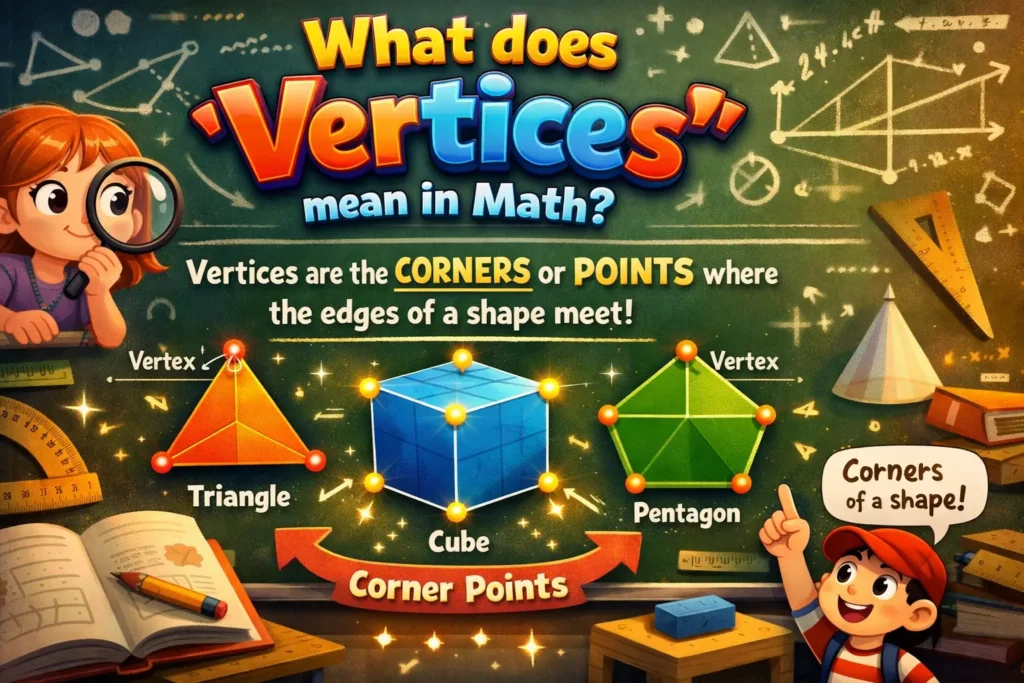
Vertices (plural of vertex) in math are points where two or more lines, edges, or sides meet. These points usually represent corners of shapes or intersections in graphs.
Understanding math doesn’t have to feel overwhelming and learning simple terms like vertices can actually make geometry much easier and even fun. You’re studying shapes, graphs, or real-life objects, the idea of vertices shows up everywhere.
Let’s break it down in the simplest way possible.
What Does Vertices Mean in Math?
In basic geometry, a vertex is simply a corner point. When we talk about vertices, we’re referring to multiple corner points.
Think about shapes you already know:
- A triangle has 3 vertices
- A square has 4 vertices
- A cube has 8 vertices
Anywhere two sides meet, you’ll find a vertex.
👉 Imagine a box or a dice 🎲 — every sharp corner you see is a vertex.
Why Vertices Matter in Math
Vertices are not just simple points—they play a key role in understanding shapes, angles, and structures.
Here’s why they matter:
- They help define the shape and structure
- They are used to measure angles
- They are important in 3D geometry and graphs
- They are used in real-world designs like buildings and computer graphics
Without vertices, shapes wouldn’t have clear boundaries or corners.
Origin of the Word “Vertices”
The word vertex comes from the Latin word “vertex”, meaning:
- “highest point”
- “peak”
- “turning point”
Over time, mathematicians adopted this word to describe points where lines or edges meet—essentially the “turning” corners of shapes.
Types of Vertices in Math
Vertices appear in different areas of math, not just basic shapes.
1. Vertices in 2D Shapes
These are flat shapes like triangles, squares, and pentagons.
Examples:
- Triangle → 3 vertices
- Rectangle → 4 vertices
- Pentagon → 5 vertices
2. Vertices in 3D Shapes
These are solid shapes like cubes and pyramids.
Examples:
- Cube → 8 vertices
- Pyramid → 5 vertices
- Cone → 1 vertex (tip)
3. Vertex in Graphs (Algebra)
In algebra, especially in graphs, a vertex is a special point.
For example:
- In a parabola, the vertex is the highest or lowest point
- It shows the turning point of the graph
Examples of Vertices in Real Life
Vertices are everywhere in daily life—you just don’t notice them!
Here are some simple examples:
- Corners of a table 🪑
- Edges of a book 📘
- Corners of a room 🏠
- Intersection of roads 🚦
- Points in 3D models and animations 🎮
Example Table of Shapes and Their Vertices
| Shape | Number of Vertices | Description |
|---|---|---|
| Triangle | 3 | Three corner points |
| Square | 4 | Four equal corners |
| Pentagon | 5 | Five-sided shape |
| Hexagon | 6 | Six corners |
| Cube | 8 | 3D shape with eight corners |
| Pyramid | 5 | Four base + one top vertex |
| Cone | 1 | Single pointed tip |
How to Identify Vertices Easily
Finding vertices is simple if you follow these steps:
- Look for corners in a shape
- Count where two sides meet
- Each meeting point = 1 vertex
💡 Tip: If it’s a smooth curve (like a circle), it has no vertices.
Vertices vs Edges vs Faces (Important Comparison)
Many students confuse vertices with edges and faces. Let’s make it clear:
| Term | Meaning | Example (Cube) |
|---|---|---|
| Vertex | Corner point | 8 |
| Edge | Line between two vertices | 12 |
| Face | Flat surface | 6 |
👉 Simple way to remember:
- Vertices = points
- Edges = lines
- Faces = surfaces
Vertices vs Corners: Are They the Same?
Yes, in most basic math contexts:
- “Vertex” = technical/math term
- “Corner” = everyday word
So, both mean the same thing, but vertex is more formal and used in education.
Vertices in Graphs (Advanced Understanding)
When studying algebra, especially quadratic equations:
- The vertex is the peak or lowest point of a graph
- It represents where the graph changes direction
Example:
For a parabola:
- The vertex is the turning point
📈 This is very important in calculus and physics.
Tone-Based Examples (Understanding Usage Context)
Even though “vertices” is a math term, how you explain it can change the tone.
Friendly Tone 🙂
“Look at the corners of your notebook—those are vertices!”
Neutral Tone 📘
“A square consists of four vertices where its sides intersect.”
Dismissive Tone 😅
“It’s just the corners—nothing complicated about vertices.”
Alternate Meanings of Vertices
While primarily used in math, “vertex” can have other meanings:
- In science: top or peak of something
- In graphs: turning point
- In computer graphics: point in 3D modeling
However, the core idea remains the same—a point where something meets or changes direction.
Practical Tips for Learning Vertices
Here are some easy tips to remember vertices:
- Count corners, not sides
- Use objects around you to practice
- Draw shapes and mark their vertices
- Remember: no corners = no vertices
Common Mistakes to Avoid
Students often make these mistakes:
- Confusing vertices with edges
- Thinking circles have vertices ❌
- Forgetting 3D shapes also have vertices
- Mixing up singular (vertex) and plural (vertices)
FAQs
What does vertices mean in simple words?
Vertices are the corners or points where two or more sides meet in a shape.
How many vertices does a triangle have?
A triangle has 3 vertices because it has three corners.
What is the difference between vertex and vertices?
Vertex is singular (one point), while vertices is plural (more than one).
Do circles have vertices?
No, circles have no vertices because they have no corners.
What are vertices in 3D shapes?
Vertices in 3D shapes are corner points where edges meet, like the corners of a cube.
What is a vertex in a graph?
In a graph, the vertex is the highest or lowest point of a curve, like in a parabola.
Are vertices and corners the same?
Yes, corners is the informal term, while vertices is the mathematical term.
Why are vertices important in math?
Vertices help define shapes, measure angles, and understand geometry and graphs.
Conclusion
Vertices may seem like a small concept, but they are one of the building blocks of geometry and mathematics. From simple shapes like triangles to complex 3D models and graphs, vertices help us understand structure, direction, and design.
To recap:
- Vertices are corner points
- They exist in both 2D and 3D shapes
- They are essential for geometry, algebra, and real-life applications
- No corners means no vertices
The next time you look at a shape, a box, or even a building, try spotting the vertices you’ll start seeing math everywhere!
Discover More Related Articles:
- Learning Roman Numerals: What VI Means and How It Works In 2026
- Construction Made Simple: What ROM Really Means & Why It Matters In 2026
- Math Symbols Explained: What the ‘ (Prime) Sign Means In 2026

David Brown is a content writer and language enthusiast at textroast.com, where he creates insightful articles that explain the meanings of words, slang, and phrases used in everyday life. His work helps readers decode modern language trends, understand cultural expressions, and make sense of online communication with clarity and fun.