Definition
“INT” in a script stands for “Interior.”
It is used in screenwriting to indicate that a scene takes place inside a building or enclosed space, such as a room, office, or house.
If you’ve ever opened a movie script or screenplay, you’ve probably noticed short abbreviations like INT. or EXT. at the beginning of scenes. At first glance, they might look confusing but they’re actually one of the most important parts of script formatting.
Understanding what INT means in a script can instantly help you read, write, or analyze screenplays like a professional. You’re an aspiring writer, filmmaker, or just curious about how movies are structured, this guide will break everything down in a clear and practical way.
In this article, you’ll learn what INT means, where it comes from, how it’s used in real scripts, and how it compares to similar terms all explained in a simple, conversational way.
What Does INT Mean in a Script?
In screenwriting, INT. is an abbreviation for Interior, which tells the reader that the scene is happening indoors.
Example:
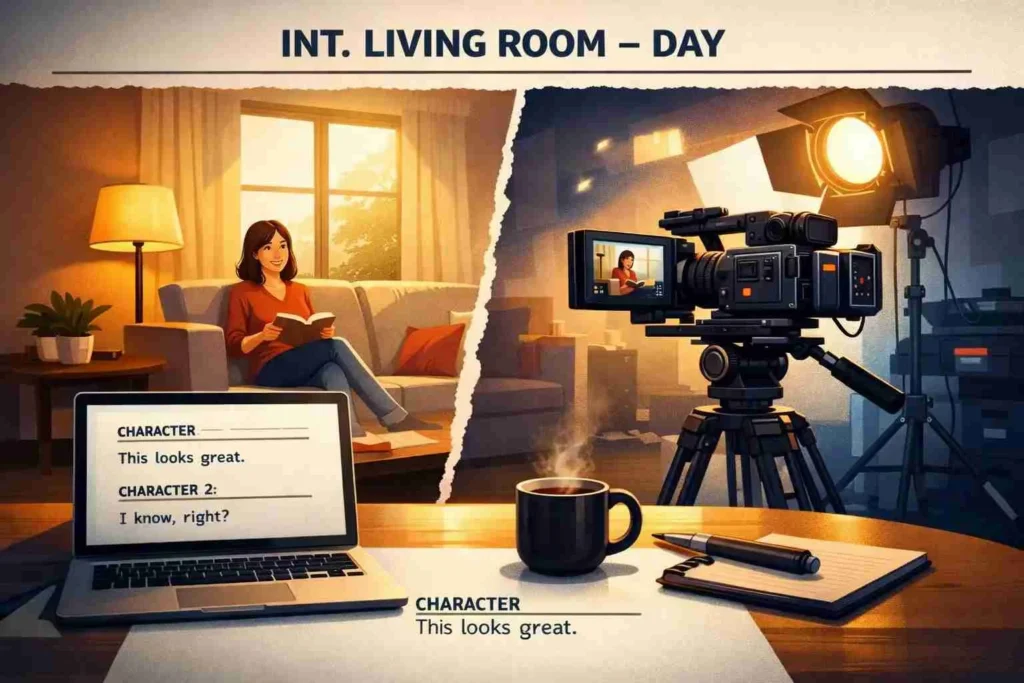
INT. LIVING ROOM – DAY
This means:
- The scene takes place inside a living room
- It is happening during the day
Why It Matters
INT is part of something called a scene heading (or slugline). It helps:
- Directors visualize the setting
- Production teams plan lighting and equipment
- Actors understand the environment
Without INT or EXT, a script would be confusing and difficult to produce.
Understanding Scene Headings (Sluglines)
A scene heading usually follows a standard format:
INT./EXT. + LOCATION + TIME
Breakdown:
| Element | Meaning |
|---|---|
| INT. | Interior (inside) |
| EXT. | Exterior (outside) |
| LOCATION | Specific place (e.g., kitchen) |
| TIME | Time of day (DAY, NIGHT, etc.) |
Example:
INT. OFFICE – NIGHT
This tells us:
- The scene is indoors
- It’s in an office
- It takes place at night
Origin of “INT” in Scriptwriting
The use of INT comes from early filmmaking and theater practices, where clear directions were essential for staging scenes.
Historical Context
- In early film production, scripts needed to be simple and standardized
- Abbreviations like INT and EXT saved space and improved clarity
- As filmmaking grew, these became industry standards
Today, INT is universally recognized in screenwriting formats such as:
- Hollywood scripts
- TV screenplays
- Short films
- Web series scripts
How INT Is Used in Real Scripts
Let’s look at how INT appears in actual script writing.
Basic Example:
INT. BEDROOM – MORNING
John wakes up and checks his phone.
More Detailed Example:
INT. COFFEE SHOP – DAY
The place is crowded. People chatter as Sarah sits alone, typing on her laptop.
Key Observations:
- INT always appears in uppercase
- It is followed by a period (INT.)
- It starts every new scene
Tone and Context in Usage
Although INT itself is neutral, the scene it introduces can carry different tones.
Friendly Tone 😊
INT. KITCHEN – MORNING
Sunlight pours in as a family laughs over breakfast.
Neutral Tone 😐
INT. OFFICE – DAY
Employees work quietly at their desks.
Negative or Tense Tone 😠
INT. BASEMENT – NIGHT
Darkness surrounds him. A strange noise echoes.
INT simply sets the location the tone comes from the description that follows.
INT vs EXT (Key Comparison)
Understanding INT becomes easier when compared with EXT.
| Feature | INT. (Interior) | EXT. (Exterior) |
|---|---|---|
| Meaning | Inside a location | Outside a location |
| Example | INT. HOUSE – DAY | EXT. PARK – DAY |
| Lighting | Controlled lighting | Natural lighting |
| Environment | Enclosed space | Open space |
| Usage | Indoor scenes | Outdoor scenes |
Combined Use (INT./EXT.)
Sometimes scenes move between inside and outside:
INT./EXT. CAR – DAY
This indicates:
- The scene involves both interior and exterior views
- Common in driving scenes
Common Examples of INT in Scripts
Here’s a practical table to help you understand real usage:
Example Table: INT in Different Settings
| Scene Heading | Meaning |
|---|---|
| INT. CLASSROOM – DAY | Inside a classroom during the day |
| INT. HOSPITAL ROOM – NIGHT | Inside a hospital room at night |
| INT. RESTAURANT – EVENING | Inside a restaurant in the evening |
| INT. CAR – DAY | Inside a car during the day |
| INT. AIRPLANE – NIGHT | Inside an airplane at night |
Why INT Is Important in Scriptwriting
INT is not just a label it plays a crucial role in storytelling and production.
1. Helps Visualize the Scene
Readers immediately know where the action is happening.
2. Assists Production Planning
Film crews need to know:
- Indoor vs outdoor setup
- Lighting requirements
- Equipment placement
3. Improves Script Clarity
Clear scene headings make scripts easier to read and follow.
Usage Tips for Writers
If you’re writing a script, here are some practical tips:
Use INT Correctly
- Always write it in uppercase: INT.
- Include a period after it
Be Specific with Locations
Instead of:
INT. HOUSE – DAY
Write:
INT. KITCHEN – DAY
Keep It Consistent
Don’t mix formats stick to standard screenplay structure.
Avoid Overcomplication
Keep scene headings short and clear.
Alternate Meanings of INT
While INT has a specific meaning in scripts, it can mean different things in other contexts:
| Context | Meaning of INT |
|---|---|
| Programming | Integer (whole number) |
| Mathematics | Integer function |
| Texting/Slang | Sometimes shorthand for “intent” |
| Business | Internal |
However, in screenwriting, INT always means Interior.
Professional Alternatives and Variations
While INT itself is standard, you may see slight variations:
INT./EXT.
Used when scenes move between inside and outside.
I/E (Less Common)
Some scripts use this shorthand, but it’s not widely preferred.
DAY/NIGHT Variations
Instead of just DAY or NIGHT, writers may use:
- MORNING
- EVENING
- LATE NIGHT
Real-Life Script Example
Here’s a mini scene to show INT in action:
INT. OFFICE – NIGHT
The room is quiet. Only the sound of typing fills the air.Ali stares at his computer screen, exhausted.He sighs.ALI
I need a break.
This simple use of INT instantly sets:
- Location: Office
- Environment: Indoor
- Time: Night
- Mood: Tired and quiet
FAQs
What does INT mean in a script?
INT means “Interior” and indicates that a scene takes place inside a building or enclosed space.
What is the difference between INT and EXT in scripts?
INT refers to indoor scenes, while EXT refers to outdoor scenes.
Can a scene use both INT and EXT?
Yes, INT./EXT. is used when a scene involves both indoor and outdoor elements.
Is INT always written in capital letters?
Yes, INT is always capitalized and followed by a period in standard screenplay format.
What comes after INT in a script?
After INT, you include the location and time of the scene.
Do all scripts use INT and EXT?
Yes, most professional scripts follow this format for clarity and consistency.
Can beginners skip using INT in scripts?
No, using INT is essential for proper screenplay formatting.
What does INT mean in other contexts?
It can mean “integer” in programming or math, but in scripts, it always means “Interior.”
Conclusion
Understanding what INT means in a script is one of the first steps toward mastering screenplay reading and writing. It may seem like a small detail, but it plays a big role in how stories are structured and brought to life on screen.
To recap:
- INT stands for Interior
- It tells you the scene is indoors
- It’s part of a standard scene heading format
- It helps with clarity, visualization, and production planning
You’re writing your first script or analyzing a film, recognizing INT will make the entire process much smoother.
Discover More Related Articles:
- Math Symbols Explained: What the ‘ (Prime) Sign Means In 2026
- From Confusion to Clarity: Understanding Vertices in Geometry In 2026
- Construction Made Simple: What ROM Really Means & Why It Matters In 2026

David Brown is a content writer and language enthusiast at textroast.com, where he creates insightful articles that explain the meanings of words, slang, and phrases used in everyday life. His work helps readers decode modern language trends, understand cultural expressions, and make sense of online communication with clarity and fun.