Definition:
In music, the symbol # (sharp) indicates that a note should be played one semitone (half step) higher than its natural pitch. For example, if you see C#, it means you play a note slightly higher than C.
If you’ve ever looked at sheet music, guitar tabs, or even a piano tutorial, you’ve probably noticed the mysterious # symbol sitting next to certain notes. At first glance, it might seem like just another musical marking but in reality, it plays a crucial role in shaping how music sounds.
you’re a beginner learning your first scale or a curious listener wondering what musicians mean when they say “F sharp,” understanding this symbol unlocks a deeper appreciation of music theory. In this guide, we’ll break down exactly what # means in music, where it comes from, how it’s used, and how it compares to similar symbols.
Let’s dive in.
What Does # Mean in Music?
In music theory, the sharp symbol (#) tells the musician to raise a note by one semitone (half step).
Simple Explanation
- A semitone is the smallest interval in Western music.
- On a piano, moving from one key to the very next key (black or white) is a semitone.
Example
- C → C# (one semitone higher)
- D → D#
- F → F#
So when you see C#, it means you don’t play the regular you play the note immediately above it.
Understanding Semitones with a Piano Example
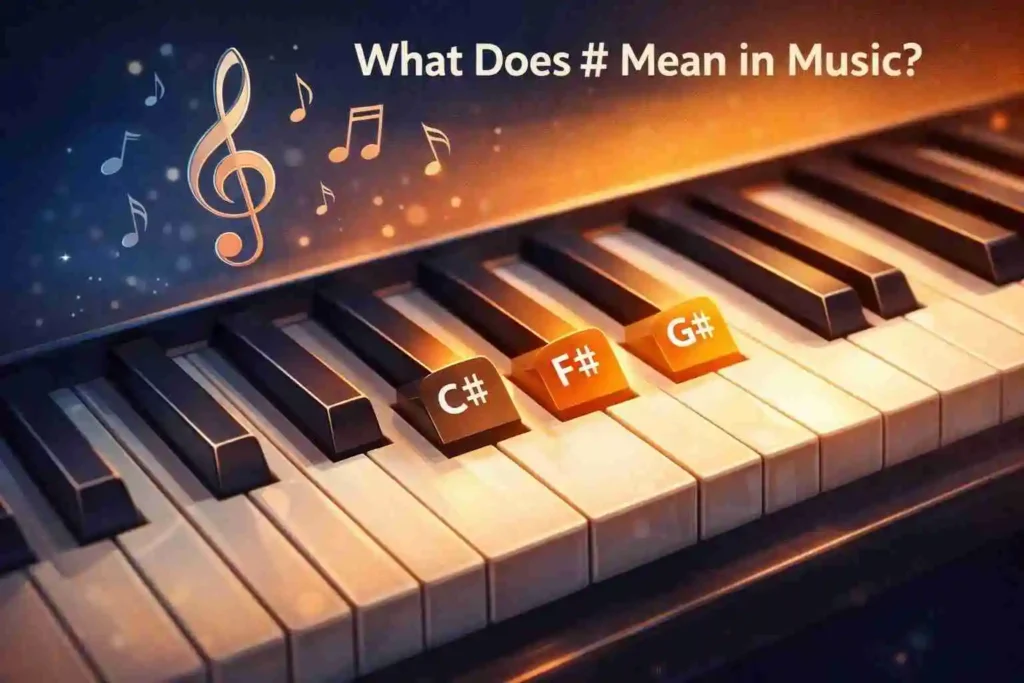
The easiest way to understand sharps is by looking at a piano.
- White keys represent natural notes (C, D, E, F, G, A, B)
- Black keys represent sharps and flats
For example:
- The black key between C and D is C# (or Db)
- The black key between F and G is F# (or Gb)
Origin of the Sharp Symbol (#)
The sharp symbol has roots in medieval music notation. Early musicians needed a way to modify pitches slightly to avoid unpleasant sounds and improve harmony.
Historical Development
- The symbol evolved from a stylized “square b” (♮ and ♯ variations) used in early notation.
- Over time, it became standardized as # in modern music.
Why It Became Popular
- Western music relies heavily on scales and tonal systems
- Sharps help create major and minor keys
- They allow composers to write more expressive and complex music
Where Is # Used in Music?
The sharp symbol appears in several important areas of music notation.
1. Key Signatures
A key signature tells you which notes are consistently sharp throughout a piece.
Example:
- Key of G major → F# is always sharp
2. Within a Musical Bar
A sharp placed before a note affects:
- Only that note
- Only within that measure (bar)
3. Scales and Chords
Sharps are essential in:
- Major scales
- Minor scales
- Chord construction
Common Examples of # in Music
Let’s look at how sharps appear in real musical situations.
Example Table: Natural Notes vs Sharps
| Natural Note | Sharp Note | Description |
|---|---|---|
| C | C# | One semitone higher than C |
| D | D# | Between D and E |
| F | F# | Between F and G |
| G | G# | Between G and A |
| A | A# | Between A and B |
Real-World Usage of # in Music
In Singing
When a vocalist sees F#, they adjust their pitch slightly higher than F.
In Guitar Tabs
- A guitarist might see “C# chord”
- This means shifting the chord shape up a half step
In Piano Playing
- Instead of pressing a white key, you often play a black key
Tone and Expression with Sharps
Sharps can influence the emotional tone of music.
Bright and Uplifting
- Keys with sharps (like D major or A major) often sound bright and energetic
Dramatic and Intense
- Sharps can add tension when used in melodies
Friendly vs Neutral vs Dramatic Examples
- Friendly tone: “Play F# lightly to keep the melody smooth 😊”
- Neutral tone: “The piece includes three sharps in the key signature”
- Dramatic tone: “That unexpected G# creates tension in the melody!”
Comparison: Sharp (#) vs Flat (♭) vs Natural (♮)
Understanding # becomes easier when you compare it with related symbols.
Comparison Table
| Symbol | Name | Function |
|---|---|---|
| # | Sharp | Raises a note by one semitone |
| ♭ | Flat | Lowers a note by one semitone |
| ♮ | Natural | Cancels previous sharps or flats |
Key Insight
- C# and Db are the same pitch, but written differently depending on context
- This is called enharmonic equivalence
Sharps in Musical Scales
Sharps are commonly used in building scales.
Example: G Major Scale
G – A – B – C – D – E – F# – G
Here:
- F is always sharp
- This is defined by the key signature
Sharps in Chords
Sharps also appear in chords.
Example
- C# Major = C# – F – G#
- F# Minor = F# – A – C#
These slight changes dramatically affect how chords sound.
Alternate Meanings of # (Brief Overview)
Although # mainly means “sharp” in music, it can have other meanings in different contexts.
Outside Music
- Social media: hashtag (#trending)
- Programming: special symbol
- Phone systems: keypad input
In Music Contexts
- In modern digital tools, # still always refers to raising pitch
Usage Tips for Beginners
If you’re just starting with music, here are some practical tips:
Learn the Keyboard Layout
- Memorize where sharps appear on a piano
Practice Scales
- Start with G major (only one sharp)
Listen Carefully
- Train your ear to hear slight pitch differences
Don’t Confuse with Hashtags
- In music, # is NOT a hashtag it’s a pitch modifier
Common Mistakes to Avoid
- Thinking # means “louder” (it doesn’t)
- Ignoring sharps in key signatures
- Mixing up sharps and flats
- Playing natural notes instead of sharp ones
Polite or Professional Alternatives
If you’re teaching or explaining music:
Instead of saying:
“You played it wrong.”
Say:
“That note should be sharp try raising it slightly.”
Or:
“Let’s adjust that to F# for accuracy.”
FAQS
What does # mean in music notation?
It means the note should be played one semitone higher than its natural pitch.
Is # the same as sharp in music?
Yes, # is the symbol used to represent a sharp note.
What is the difference between C and C#?
C# is one semitone higher than.
Are sharps and flats the same?
They can represent the same pitch (like C# and Db), but they are written differently.
Why are sharps used in music?
They help create scales, keys, and more expressive melodies.
What does F# mean on piano?
It means you play the black key just above F.
Can a note be both sharp and flat?
Not at the same time, but enharmonic notes exist (C# = Db).
Do sharps affect the whole song?
Only if they appear in the key signature; otherwise, they affect a single measure.
Conclusion
The # symbol in music may look simple, but it carries powerful meaning. By raising a note by just one semitone, it can completely change how a melody sounds, how a chord feels, and how a piece of music is interpreted.
From its historical origins to its modern-day use in songs, instruments, and digital music tools, the sharp symbol remains a fundamental part of music theory. you’re playing piano, guitar, or singing, understanding sharps helps you perform with greater accuracy and confidence.
Keep practicing, keep listening, and soon sharps will feel completely natural in your musical journey.
Discover More Related Articles:
- Construction Made Simple: What ROM Really Means & Why It Matters In 2026
- Math Symbols Explained: What the ‘ (Prime) Sign Means In 2026
- From Confusion to Clarity: Understanding Vertices in Geometry In 2026

Laura Jackson is a writer at textroast.com, where she creates engaging articles that decode the meanings behind slang, phrases, and everyday expressions. Passionate about language and communication, she makes complex or confusing terms easy to understand, turning learning into a fun and relatable experience for readers around the world.