
Definition
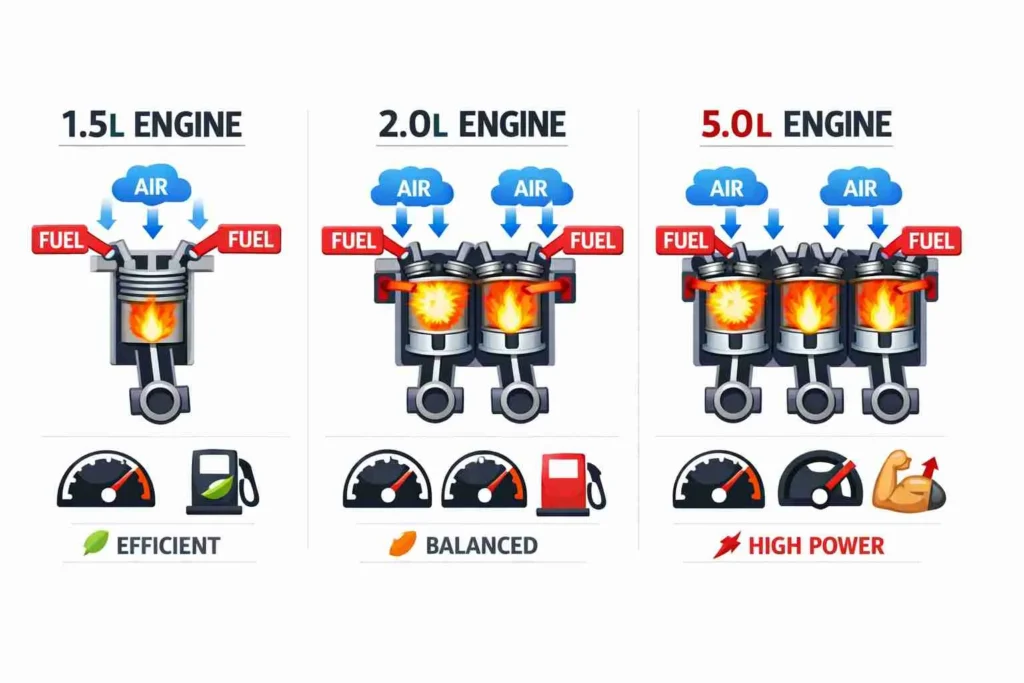
A “liter” in an engine refers to the total volume (capacity) of all the cylinders inside the engine, measured in liters. It indicates how much air and fuel the engine can take in during one complete cycle, which directly affects power and performance.
If you’ve ever looked at a car’s specifications, you’ve probably seen something like “2.0L engine” or “5.0-liter V8.” But what does that actually mean? Is a higher liter engine always better? Does it mean more speed, more fuel usage, or something else entirely?
Understanding what “liter” means in an engine is key to making smarter decisions when buying a car, comparing vehicles, or simply learning how engines work. It’s not just a number it’s a window into how powerful, efficient, and responsive a vehicle might be.
In this guide, we’ll break everything down in a simple, friendly, and practical way. By the end, you’ll know exactly what engine size means, how it impacts performance, and how to choose the right one for your needs.
What Does Liter Mean in an Engine?
In simple terms, engine liter (or engine displacement) measures the total internal volume of an engine’s cylinders.
How It Works
Inside an engine, pistons move up and down within cylinders. This motion pulls in air and fuel, compresses it, and ignites it to produce power.
The liter value represents the total space all those pistons move through.
For example:
- A 2.0-liter engine means all cylinders combined can hold 2 liters of air-fuel mixture
- A 5.0-liter engine can hold 5 liters of mixture, meaning more potential power
Why Engine Size Matters
Engine size (in liters) plays a major role in how a vehicle behaves.
Key Impacts
- Power Output
Larger engines usually produce more horsepower and torque. - Fuel Efficiency
Smaller engines tend to use less fuel. - Acceleration
Bigger engines generally accelerate faster. - Towing Capacity
Vehicles with higher liter engines can pull heavier loads.
Quick Insight
A larger engine is like a bigger lung it can “breathe” more air and fuel, producing stronger performance.
Origin of the Term “Liter” in Engines
The term “liter” comes from the metric system, where volume is measured in liters.
Originally, engine sizes were often described in cubic centimeters (cc). Over time, automakers shifted to liters because:
- It’s easier to understand (1000 cc = 1 liter)
- It simplifies marketing and communication
- It aligns with global measurement standards
Example Conversion
| Unit | Equivalent |
|---|---|
| 1000 cc | 1.0 liter |
| 2000 cc | 2.0 liters |
| 3500 cc | 3.5 liters |
Today, both terms are still used, but “liters” are more common in everyday conversation.
Real-World Usage of Engine Liters
You’ll see engine liters mentioned in:
- Car advertisements
- Vehicle specification sheets
- Reviews and comparisons
- Mechanic discussions
Common Examples
- “This car comes with a 1.5L turbo engine.”
- “That SUV has a powerful 3.0-liter V6.”
- “Muscle cars often feature 5.0L V8 engines.”
Tone Variations
- Friendly tone:
“A 2.0L engine is a great balance of power and fuel economy 🙂” - Neutral tone:
“The vehicle is equipped with a 2.5-liter engine.” - Dismissive tone:
“It only has a 1.2L engine, so don’t expect much performance.”
Examples of Engine Sizes and Their Uses
Here’s how different engine sizes typically perform in real life:
Engine Size Comparison Table
| Engine Size | Common Vehicles | Performance Level | Fuel Efficiency | Best For |
|---|---|---|---|---|
| 1.0L–1.5L | Small cars | Low to moderate | Very high | City driving |
| 1.6L–2.5L | Sedans, crossovers | Moderate | Good | Daily use |
| 2.6L–3.5L | SUVs, performance cars | High | Midieum | Balanced power |
| 3.6L–5.0L | Trucks, sports cars | Very high | Lower | Speed & towing |
| 5.0L+ | Muscle cars | Extreme | Low | Maximum performance |
Liter vs Other Engine Terms
Understanding liters becomes easier when you compare it with related terms.
Key Comparisons
1. Liter vs CC (Cubic Centimeters)
- Same concept, different units
- 1 liter = 1000 cc
2. Liter vs Horsepower
- Liter = engine size
- Horsepower = engine power output
3. Liter vs Torque
- Liter affects torque potential
- Torque measures rotational force
Comparison Table
| Term | Meaning | Measures |
|---|---|---|
| Liter (L) | Engine size | Volume |
| CC | Engine size | Volume |
| Horsepower (HP) | Engine power | Output |
| Torque | Rotational force | Strength |
Is a Bigger Liter Engine Always Better?
Not necessarily.
Advantages of Bigger Engines
- More power
- Faster acceleration
- Better towing capability
Disadvantages
- Higher fuel consumption
- More expensive maintenance
- Heavier vehicle weight
Advantages of Smaller Engines
- Better fuel efficiency
- Lower emissions
- Cheaper to maintain
Practical Tip
Choose engine size based on your needs:
- City driving → smaller engine
- Highway & performance → larger engine
- Mixed use → mid-range engine
How Engine Liter Affects Driving Experience
The engine size directly influences how a car feels on the road.
Smaller Engines
- Smooth and efficient
- Slower acceleration
- Ideal for traffic conditions
Larger Engines
- Powerful and responsive
- Faster acceleration
- Better for long drives and heavy loads
Alternate Meanings of “Liter”
While “liter” mainly refers to engine size in automotive contexts, it can also mean:
- A unit of liquid volume (water, fuel, etc.)
- Used in cooking and science
However, in vehicles, it almost always refers to engine displacement.
Polite or Professional Alternatives
In professional or technical writing, you may see:
- “Engine displacement”
- “Engine capacity”
- “Cylinder volume”
Example:
- Instead of: “It has a 2.0L engine”
- You can say: “It has a 2.0-liter engine displacement”
Practical Tips for Understanding Engine Liters
- Don’t judge performance by liters alone
- Check horsepower and torque too
- Consider fuel efficiency for long-term cost
- Match engine size to your lifestyle
FAQs
1. What does 2.0 liter engine mean?
A 2.0-liter engine means the total volume of all cylinders is 2 liters, indicating how much air-fuel mixture the engine can use.
2. Is a 1.5L engine good enough?
Yes, a 1.5L engine is great for city driving and daily commuting due to its fuel efficiency.
3. Does higher liter mean faster car?
Not always. While larger engines can be more powerful, speed also depends on design, weight, and technology.
4. What is the difference between 2.0L and 3.0L engine?
A 3.0L engine has a larger capacity, usually producing more power but consuming more fuel than a 2.0L engine.
5. Is liter the same as horsepower?
No. Liter measures engine size, while horsepower measures power output.
6. Which is better: 2.0L or 2.5L engine?
A 2.5L engine generally offers more power, while a 2.0L engine is usually more fuel-efficient.
7. Why do sports cars have large engines?
Sports cars need higher power and acceleration, which larger engines can provide.
8. Can a small engine be powerful?
Yes. Modern turbocharged engines can produce high power even with smaller liter sizes.
Conclusion
Understanding what “liter” means in an engine helps you make smarter automotive decisions. It’s not just a number it represents the engine’s breathing capacity, which influences power, efficiency, and overall driving experience.
A larger engine doesn’t always mean better. The right choice depends on how you plan to use your vehicle. You’re navigating busy city streets or cruising on highways, matching engine size to your needs is key.
Keep in mind:
- Liter = engine capacity
- Bigger engines = more power but more fuel
- Smaller engines = better efficiency
When combined with factors like horsepower, torque, and fuel economy, engine size becomes a powerful tool for understanding any vehicle.
Discover More Related Articles:
- Construction Made Simple: What ROM Really Means & Why It Matters In 2026
- Math Symbols Explained: What the ‘ (Prime) Sign Means In 2026
- From Confusion to Clarity: Understanding Vertices in Geometry In 2026

David Brown is a content writer and language enthusiast at textroast.com, where he creates insightful articles that explain the meanings of words, slang, and phrases used in everyday life. His work helps readers decode modern language trends, understand cultural expressions, and make sense of online communication with clarity and fun.