Definition
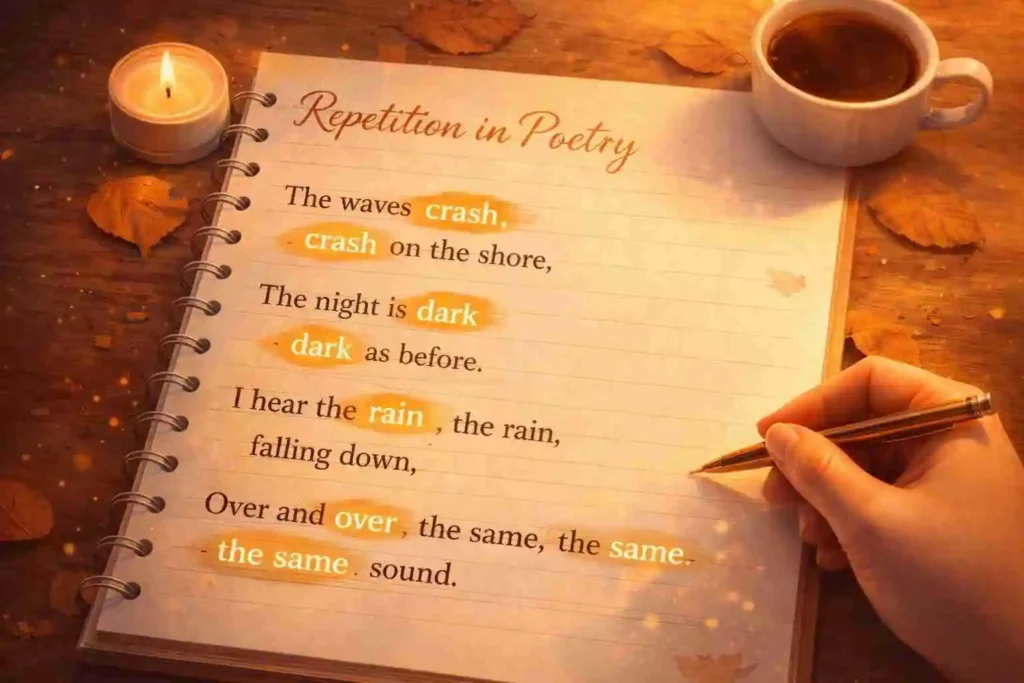
Repetition in poetry is a literary device where a word, phrase, line, or sound is deliberately repeated to emphasize an idea, create rhythm and enhance emotional impact.
Have you ever read a poem where a certain word or line keeps echoing in your mind long after you’ve finished reading? That’s the power of repetition in poetry. It’s not just about saying something again it’s about making it stick, feel and resonate deeply.
From classic poems to modern spoken word, repetition is one of the most powerful tools poets use to grab attention, build rhythm and drive meaning home. it’s a repeated phrase that creates a musical flow or a word that reinforces emotion, repetition helps transform simple lines into unforgettable verses.
In this comprehensive guide, you’ll learn exactly what repetition means in poetry, why it’s used, how it works, and how it compares to similar literary devices. Let’s dive in.
What Does Repetition Mean in Poetry?
Repetition in poetry refers to the intentional reuse of words, phrases, lines, or sounds within a poem to create emphasis, rhythm, or emotional depth.
It is not accidental or redundant. Instead, repetition is a strategic choice made by poets to:
- Highlight important ideas
- Create a musical or rhythmic effect
- Strengthen emotional expression
- Make the poem more memorable
Origin and Evolution of Repetition in Poetry
Repetition has deep roots in oral traditions, long before poetry was written down.
Early Origins
- Ancient poets relied on repetition to help audiences remember poems.
- Oral storytelling traditions used repeated phrases for rhythm and clarity.
- Religious texts and chants often include repetition for spiritual emphasis.
Growth in Literature
As poetry evolved, repetition became a deliberate stylistic tool rather than just a memory aid.
- In classical poetry, repetition added structure and form.
- In romantic and modern poetry, it became a way to express emotion and individuality.
- Today, repetition is widely used in song lyrics, spoken word poetry, and digital content.
Popularity Today
Repetition remains popular because it:
- Enhances readability
- Appeals to emotions
- Works well in both written and spoken formats
Why Do Poets Use Repetition?
Repetition isn’t just decorative—it serves several important purposes.
1. Emphasis
Repeating a word or phrase draws attention to a key idea.
2. Rhythm and Musicality
Repetition creates a beat or flow, making poems sound pleasing.
3. Emotional Impact
Repeating emotionally charged words intensifies feelings.
4. Unity and Structure
It ties different parts of a poem together.
5. Memorability
Repeated lines are easier to remember.
Types of Repetition in Poetry
There are several forms of repetition, each with its own purpose and effect.
Common Types
- Anaphora
Repetition at the beginning of lines
Example:
“I remember the day,
I remember the night,
I remember the silence.” - Epiphora (Epistrophe)
Repetition at the end of lines
Example:
“We want peace,
They demand peace,
Everyone needs peace.” - Refrain
A repeated line or group of lines in a poem or song - Alliteration
Repetition of consonant sounds
Example: “Softly singing songs” - Assonance
Repetition of vowel sounds
Example: “Hear the mellow wedding bells”
Examples of Repetition in Poetry
Let’s explore some practical examples with tone variations.
Friendly Tone 😊
“I will smile today,
I will smile tomorrow,
I will smile forever.”
👉 This creates a hopeful and uplifting mood.
Neutral Tone 😐
“The clock ticks, the clock ticks, the clock ticks.”
👉 This builds rhythm and a sense of passing time.
Negative or Intense Tone 😠
“Never again, never again, never again.”
👉 This emphasizes strong emotion or determination.
Example Table: Repetition in Action
| Type of Repetition | Example | Purpose | Effect |
|---|---|---|---|
| Anaphora | “I dream, I hope, I believe” | Emphasis | Inspiring |
| Epiphora | “We fight for freedom, live for freedom” | Reinforcement | Powerful |
| Refrain | “Let it be, let it be” | Unity | Memorable |
| Alliteration | “Wild winds whisper” | Sound effect | Musical |
| Assonance | “Light of the fire” | Flow | Smooth |
How Repetition Works in Real-World Usage
Repetition is not limited to poetry it appears in everyday communication.
In Speeches
- Politicians repeat phrases to persuade audiences
- Example: “Yes we can” repeated for motivation
And In Music
- Choruses rely heavily on repetition
- Makes songs catchy and easy to remember
In Marketing
- Slogans often repeat words or ideas
- Helps brands stay in people’s minds
Tips for Using Repetition Effectively in Poetry
If you’re writing poetry, here’s how to use repetition like a pro:
Do:
- Use repetition to highlight key ideas
- Keep it meaningful and intentional
- Match repetition with the poem’s tone
Avoid:
- Overusing repetition (can feel boring)
- Repeating without purpose
- Making it predictable
Comparison with Similar Literary Devices
Repetition is often confused with other techniques. Here’s how it differs.
| Device | Definition | Key Difference |
|---|---|---|
| Repetition | Reusing words/phrases | General concept |
| Parallelism | Similar sentence structure | Focus on grammar |
| Refrain | Repeated line/section | Specific type of repetition |
| Alliteration | Repeated consonant sounds | Sound-based only |
Alternate Meanings of Repetition
While repetition is mainly used in poetry, it has other meanings:
- General Language: Saying something again
- Music: Repeating notes or phrases
- Learning: Repeating information to remember it
Polite or Professional Alternatives
In formal writing, instead of saying “repetition,” you might use:
- Reinforcement
- Emphasis
- Recurrence
- Reiteration
These alternatives can sound more polished depending on context.
FAQs
What is repetition in poetry with an example?
Repetition is when a word or phrase is repeated for emphasis. For example: “Never give up, never give up.”
Why is repetition important in poetry?
It helps emphasize ideas, create rhythm, and make poems more memorable.
What are the types of repetition in poetry?
Common types include anaphora, epiphora, refrain, alliteration, and assonance.
Is repetition a poetic device?
Yes, repetition is one of the most widely used literary devices in poetry.
How does repetition affect the reader?
It reinforces meaning, creates emotional impact, and improves recall.
Can repetition be overused in poetry?
Yes, too much repetition can make a poem feel dull or repetitive without purpose.
What is the difference between repetition and refrain?
Repetition is a general technique, while a refrain is a specific repeated line or section.
Where is repetition used outside poetry?
It is used in speeches, songs, advertising, and everyday communication.
Conclusion
Repetition in poetry is far more than just repeating words it’s a powerful artistic technique that shapes meaning, emotion, and rhythm. When used effectively, it can transform simple lines into something unforgettable.
From ancient oral traditions to modern lyrics, repetition continues to play a vital role in how we experience language. It helps ideas stick, emotions deepen, and messages resonate.
You’re analyzing poetry or writing your own, mastering repetition can take your understanding and creativity to the next level.
Discover More Related Articles:
- Construction Made Simple: What ROM Really Means & Why It Matters In 202
- Math Symbols Explained: What the ‘ (Prime) Sign Means In 2026
- From Confusion to Clarity: Understanding Vertices in Geometry In 2026

Daniel Moore is a content writer and language enthusiast at TextRoast.com, specializing in decoding slang, abbreviations, and trending text expressions. He creates engaging and informative articles that help readers understand the meaning behind everyday words and online communication.