Definition
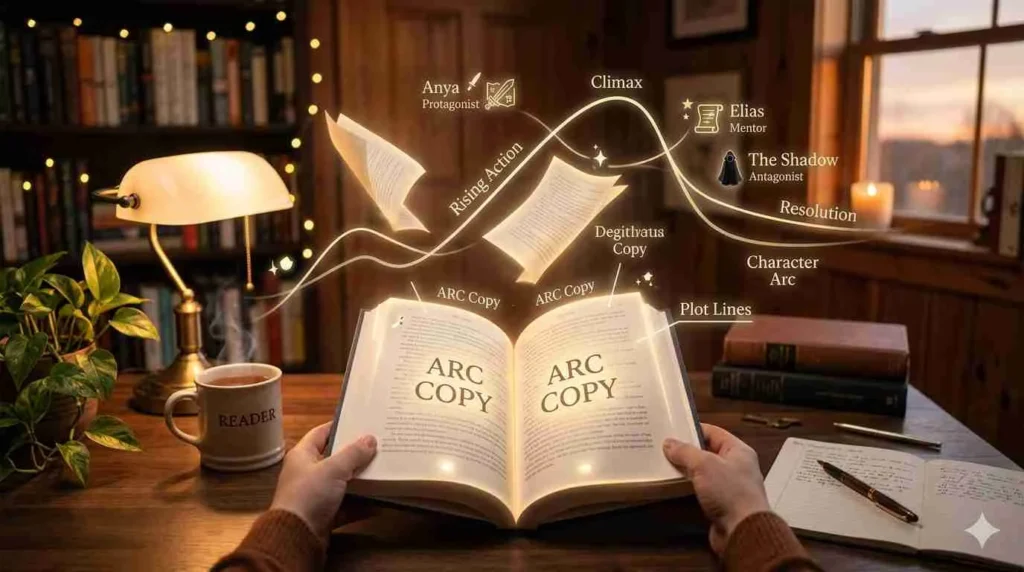
ARC in books refers to “Advance Reader Copy,” which is an early version of a book distributed to reviewers, influencers, and readers before its official release for promotional and feedback purposes.
In storytelling terms, however, “arc” can also mean the progression or development of a story, character, or plot over time, commonly known as a narrative arc or character arc.
Both meanings are widely used in the publishing and writing world, and understanding them helps readers, authors, and book reviewers communicate more clearly.
If you’ve ever seen readers talking about getting an “ARC copy” of a new book or heard writers discussing a “character arc,” you might have paused and wondered what ARC actually means. The term shows up everywhere in the book community, from BookTok and Goodreads discussions to publishing houses and writing workshops.
What makes it interesting is that “ARC” doesn’t have just one meaning. In fact, it has two major interpretations depending on context. One belongs to the publishing industry, while the other belongs to storytelling and creative writing.
This guide breaks everything down in a simple, friendly, and practical way so you can confidently understand and use the term like a pro.
What Does ARC Mean in Books? (Two Main Meanings Explained)
1. ARC as Advance Reader Copy (Publishing Meaning)
An Advance Reader Copy (ARC) is a pre-published version of a book that publishers send out before the official release date.
These copies are usually:
- Not fully finalized (may still have minor edits needed)
- Distributed for marketing purposes
- Given to reviewers, bloggers, and early readers
Purpose of ARCs:
- Generate early reviews
- Build hype before release
- Gather reader feedback
- Promote the book on social media and blogs
Example:
A fantasy novel might be released on July 1st, but ARCs are sent out in April so readers can post reviews early.
2. ARC as Narrative Structure (Storytelling Meaning)
In writing and literature, an arc refers to the progression or transformation of a story, character, or plot over time.
This is known as a narrative arc or story arc.
Types of arcs in storytelling:
- Character arc: How a character changes emotionally or mentally
- Plot arc: The structure of events in a story
- Emotional arc: The emotional journey of the reader or characters
Example:
A shy character slowly becoming confident over the course of a novel is a character arc.
Origin of the Term ARC
The word “arc” comes from the idea of a curved shape or journey, symbolizing movement from one point to another.
In storytelling, this metaphor was adopted to describe how stories rise, peak, and fall like a curve.
The publishing meaning, “Advance Reader Copy,” developed later as the publishing industry grew and needed a system to distribute pre-release books efficiently.
Why ARC Became So Popular
The term ARC gained massive popularity due to:
- Growth of online book communities
- Book review platforms like Goodreads
- Social media reading culture (BookTok, Bookstagram)
- Self-publishing and indie authors
- Early review marketing strategies
Today, ARC readers are an essential part of book promotion.
Real-World Usage of ARC in Books
Understanding how ARC is used in different contexts helps avoid confusion.
Publishing Context (Advance Reader Copy)
| Situation | Example Sentence |
|---|---|
| Receiving an ARC | “I got an ARC of this thriller before its release.” |
| Reviewing ARC | “I’m writing my review based on the ARC copy.” |
| ARC feedback | “The ARC had a few spelling errors.” |
Writing Context (Narrative Arc)
| Situation | Example Sentence |
|---|---|
| Character development | “Her character arc is very powerful.” |
| Story structure | “The plot arc feels rushed at the end.” |
| Emotional journey | “The emotional arc of the novel is beautiful.” |
Examples of ARC in Different Tones
Friendly Tone 😊
“I just finished reading an ARC of this romance novel, and I absolutely loved it!”
Neutral Tone
“The ARC version of the book contains minor differences from the final publication.”
Critical or Dismissive Tone
“The ARC felt underdeveloped and needed more editing before release.”
ARC vs Related Writing Terms
Understanding related terms helps clarify the concept even further.
| Term | Meaning | Difference from ARC |
|---|---|---|
| ARC (Advance Reader Copy) | Pre-release book copy | Used for marketing and reviews |
| Manuscript | Early draft of a book | Not formatted for readers |
| Proof Copy | Near-final version | Used for final corrections |
| Narrative Arc | Story structure | Focuses on storytelling, not publishing |
Alternate Meanings of ARC
While the book-related meanings are most common, “ARC” can sometimes refer to other things depending on context:
- ARC in comics: A storyline segment in comic series
- ARC in TV shows: A season-long or multi-episode storyline
- ARC in general writing: A structural development pattern
However, in publishing discussions, it almost always refers to Advance Reader Copy.
Professional Alternatives to ARC
If you want to sound more formal or avoid abbreviations, you can use:
- Advance Reader Copy instead of ARC
- Pre-release edition instead of ARC copy
- Early review copy instead of ARC
- Story progression instead of narrative arc
- Character development journey instead of character arc
These alternatives are useful in academic writing or professional publishing discussions.
Common Mistakes People Make About ARC
Many beginners confuse ARC with:
- Final published book
- First draft manuscript
- Beta reading version
- Audiobook release
Remember:
An ARC is not final. It is an early version meant for feedback and promotion.
Why ARC Readers Are Important
ARC readers play a huge role in modern publishing.
Benefits of ARC readers:
- Provide honest early reviews
- Help authors improve their books
- Increase visibility before launch
- Build community engagement
Many authors rely on ARC teams to create buzz before release day.
FAQs
1. What does ARC mean in books?
ARC means Advance Reader Copy, which is an early version of a book shared before official release for reviews and promotion.
2. Is an ARC the final version of a book?
No, an ARC is not final. It may still contain minor errors or changes before publication.
3. What is a character arc in books?
A character arc is the transformation or development a character goes through in a story.
4. Why do publishers send ARCs?
Publishers send ARCs to generate early reviews, build excitement, and promote upcoming books.
5. Can anyone get an ARC?
Not always. ARCs are usually given to reviewers, bloggers, influencers, and sometimes loyal readers.
6. Are ARC books free?
Yes, ARCs are typically free but come with the expectation of an honest review.
7. What is a story arc in writing?
A story arc is the structure of events in a narrative, showing how the plot develops from beginning to end.
8. Is ARC the same in books and TV shows?
The concept is similar, but in TV shows, an arc usually refers to a storyline spanning multiple episodes.
Conclusion
Understanding what ARC means in books helps you navigate both reading and writing communities with confidence. In publishing, an ARC is an Advance Reader Copy used for early reviews and marketing. In storytelling, an arc refers to the progression of characters, emotions, or plot throughout a narrative.
Both meanings share a common idea of movement and development, it is a book journey before release or a story unfolding over time. Once you understand this, you’ll notice how often the term appears in book discussions, reviews, and writing conversations.
You are a reader enjoying early copies or a writer crafting compelling characters, knowing how arcs work adds depth to your experience with books and storytelling.
Discover More Related Articles:
- Candescent Explained: The Meaning of “Cand” Made Easy In 2026
- Confused About Conduction in Science: Here’s What It Really Means In 2026
- Understanding TDS in Water: Meaning, Measurement & Health Impact In 2026

Daniel Moore is a content writer and language enthusiast at TextRoast.com, specializing in decoding slang, abbreviations, and trending text expressions. He creates engaging and informative articles that help readers understand the meaning behind everyday words and online communication.