Definition
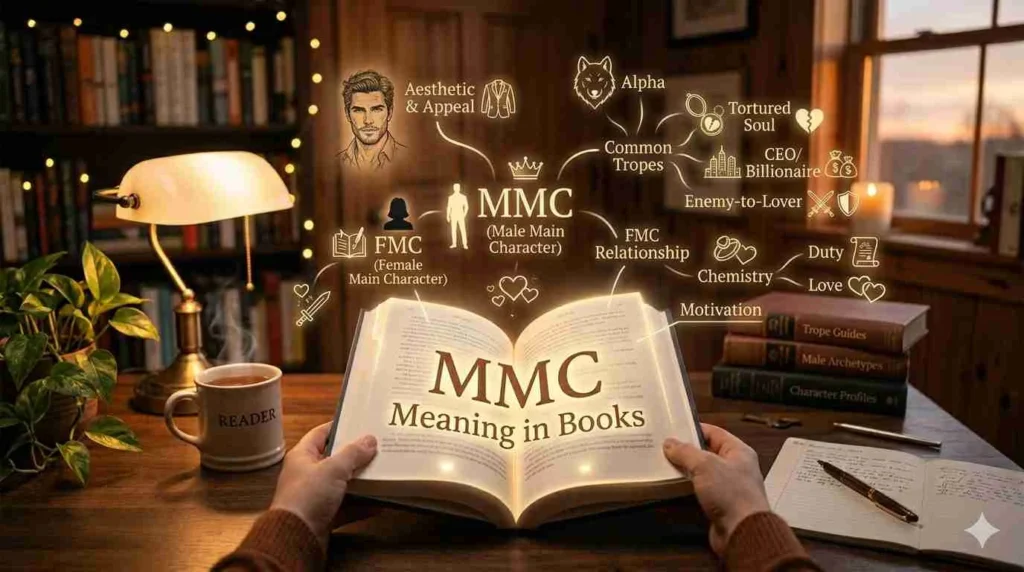
MMC in books stands for “Male Main Character,” referring to the central male protagonist in a story who drives the plot, experiences character development, and plays a key role in the narrative.
If you’ve ever browsed book discussions on social media, Goodreads reviews, or BookTok recommendations, you may have seen readers casually using the term MMC. At first glance, it might look like confusing internet slang but in the book world, it carries a very specific meaning that helps readers quickly identify character roles and story focus.
Understanding what MMC means in books is especially useful for romance readers, fiction lovers, and anyone exploring character-driven storytelling. You’re reading fantasy epics, contemporary romance, or young adult fiction, the MMC often shapes how the entire story unfolds.
This guide breaks down everything you need to know about MMC its meaning, usage, examples, tone, comparisons, and even how readers and writers use it in everyday discussions.
What Does MMC Mean in Books?
In literature and online book communities, MMC stands for Male Main Character.
It refers to the primary male protagonist in a story, often the character whose journey, emotions, conflicts, and growth are central to the plot.
Simple Explanation:
The MMC is the “main guy” in the book whose story matters the most.
He may be:
- A romantic lead in a love story
- A hero in fantasy or adventure fiction
- A complex anti-hero in psychological drama
- A supporting narrator in multi-POV novels (though still central)
Origin and Popularity of MMC in Book Culture
The term MMC didn’t originate from traditional literary theory. Instead, it became popular in online reading communities, especially:
- BookTok (TikTok book discussions)
- Bookstagram (Instagram book reviews)
- Romance reader forums
- Fanfiction platforms like Wattpad and AO3
Readers started using abbreviations like MMC (Male Main Character) and FMC (Female Main Character) to quickly describe character dynamics without long explanations.
Why It Became Popular:
- Faster communication in reviews
- Easier tagging in social media posts
- Helps categorize romance tropes
- Useful for spoilers without revealing names
Today, MMC is widely recognized in modern reading culture, especially in romance and fantasy genres.
How MMC Is Used in Books and Discussions
The MMC is not just a label it describes the emotional and narrative importance of a character.
Common Usage Examples:
- “The MMC is a grumpy billionaire who falls in love unexpectedly.”
- “I loved how the MMC had strong character development throughout the story.”
- “This book has a morally grey MMC, and it’s amazing!”
Tone Variations in Usage:
| Context | Example | Tone |
|---|---|---|
| Romance | “The MMC is so protective 😍” | Positive / affectionate |
| Fantasy | “The MMC becomes the chosen one.” | Neutral / descriptive |
| Drama | “The MMC makes questionable decisions.” | Critical |
| Fan reaction | “I hate what the MMC did here 😤” | Emotional / negative |
Readers often use MMC not just to describe, but to express emotional reactions toward the character.
Types of MMC in Literature
Different genres portray MMCs in different ways. Here are some common types:
1. Romantic MMC
- Focus: Love story
- Traits: Charming, brooding, protective, emotionally complex
- Example: A wealthy CEO or mysterious bad boy
2. Heroic MMC
- Focus: Saving the world or achieving a goal
- Traits: Brave, moral, determined
- Example: Fantasy warrior or chosen one
3. Anti-Hero MMC
- Focus: Inner conflict and flawed behavior
- Traits: Dark, morally grey, unpredictable
- Example: Criminal mastermind or conflicted assassin
4. Relatable MMC
- Focus: Everyday life struggles
- Traits: Realistic, emotional, grounded
- Example: College student or working professional
MMC vs FMC: Key Comparison
A common question in book discussions is how MMC compares to FMC.
| Term | Full Form | Meaning | Role |
|---|---|---|---|
| MMC | Male Main Character | Main male protagonist | Drives story from male perspective |
| FMC | Female Main Character | Main female protagonist | Drives story from female perspective |
Key Difference:
- MMC = Male lead focus
- FMC = Female lead focus
In many romance novels, both MMC and FMC share equal importance, creating dual perspectives.
Alternate Meanings of MMC
Although in books MMC mostly means Male Main Character, it can sometimes mean other things depending on context:
Other possible meanings:
- Multi-Media Controller (technology context)
- Medical Management Committee (healthcare context)
- Micro-Mini Computer (older tech usage)
However, in reading communities, MMC almost always refers to Male Main Character, so context is key.
Why Readers Use MMC Instead of Full Names
Using abbreviations like MMC has become a habit in modern book culture.
Reasons:
- Saves time in reviews and discussions
- Avoids spoilers by not revealing character names
- Works across multiple books and genres
- Easy tagging on social media platforms
Instead of saying:
“The male protagonist of the story…”
Readers simply say:
“The MMC…”
MMC in Different Genres
Romance Books
- MMC is often the love interest
- Emotional depth and chemistry matter most
Fantasy Books
- MMC may be a hero, warrior, or chosen one
- Focus on journey and battles
Thriller / Mystery
- MMC could be detective or investigator
- Focus on solving crimes
Young Adult Fiction
- MMC often experiences personal growth
- Themes of identity and relationships
Polite and Professional Alternatives
If you want to avoid slang or abbreviations like MMC, you can use:
- Male protagonist
- Main male character
- Central male lead
- Primary male character
- Male lead role
These are more formal and suitable for academic writing or professional book reviews.
Real Examples of MMC in Popular Storytelling
Here are some simplified examples of how MMC appears in stories:
- A brooding vampire who struggles with morality in a romance novel
- A young wizard destined to defeat dark forces in a fantasy series
- A detective solving complex crimes in a thriller
- A college student navigating friendship and love in contemporary fiction
Each MMC drives the story forward in a unique emotional direction.
Common Misunderstandings About MMC
1. MMC always means “hero”
Not true. The MMC can also be flawed or morally grey.
2. MMC is always the narrator
Not necessarily. Some books have third-person narration.
3. MMC always gets the happy ending
Not always especially in tragic or thriller genres.
FAQs
What does MMC mean in books?
MMC stands for Male Main Character, referring to the primary male protagonist in a story.
Is MMC the same as hero?
Not always. The MMC can be a hero, anti-hero, or even a morally complex character.
What is the difference between MMC and FMC?
MMC is the male main character, while FMC is the female main character in a story.
Why do readers use MMC instead of names?
It helps simplify discussions and avoids spoilers while talking about books.
Is MMC used only in romance books?
No, MMC is used in all genres including fantasy, thriller, and fiction.
Can a book have more than one MMC?
Yes, especially in multi-POV stories where multiple male leads exist.
Is MMC an official literary term?
No, it is informal slang used in online reading communities.
What does MMC mean on BookTok?
On BookTok, MMC refers to the male main character in a book being discussed or reviewed.
Conclusion
Understanding what MMC means in books makes it easier to navigate modern reading communities and online book discussions. Simply put, MMC refers to the Male Main Character the central male figure whose journey shapes the story.
From romance novels to fantasy epics, the MMC can take many forms: heroic, flawed, emotional, or complex. While the term is informal, it has become a powerful shorthand in today’s reading culture, especially on platforms like BookTok and Bookstagram.
If you’re a reader, knowing this term helps you engage more deeply in book conversations. And if you’re a writer, understanding MMC helps you shape stronger, more memorable male characters that resonate with readers.
Discover More Related Articles:
- Candescent Explained: The Meaning of “Cand” Made Easy In 2026
- Confused About Conduction in Science: Here’s What It Really Means In 2026
- Understanding TDS in Water: Meaning, Measurement & Health Impact In 2026

David Brown is a content writer and language enthusiast at textroast.com, where he creates insightful articles that explain the meanings of words, slang, and phrases used in everyday life. His work helps readers decode modern language trends, understand cultural expressions, and make sense of online communication with clarity and fun.