Definition
Caliber in guns refers to the internal diameter of a firearm’s barrel or the diameter of the bullet it fires. It is usually measured in inches or millimeters and helps identify the size, type and compatibility of ammunition used in a firearm.
If you have ever heard someone say “that’s a 9mm” or “it’s a .45 caliber,” you’ve already come across one of the most important terms in firearms: caliber.
But what does caliber actually mean in guns, and why is it such a big deal?
Caliber is more than just a technical measurement. It helps define how powerful a gun is, what type of ammunition it uses, how it performs, and even how it feels when fired. Whether you’re reading about handguns, rifles, or historical firearms, understanding caliber is essential for making sense of everything else.
In simple terms, caliber is the language of bullet size. Once you understand it, the world of firearms becomes much clearer and far less confusing.
Let’s break it down step by step in a simple, friendly, and practical way.
What Does Caliber Mean in Guns?
In firearms, caliber refers to the diameter of a gun’s barrel or the bullet that fits inside it.
However, there is a small twist that often confuses beginners:
- Sometimes caliber refers to the barrel’s internal diameter
- Sometimes it refers to the bullet’s diameter
- And sometimes it is used as a general label for a type of cartridge
For example:
- A 9mm pistol fires bullets that are approximately 9 millimeters wide.
- A .45 caliber handgun fires bullets that are approximately 0.45 inches wide.
Even though the system seems simple, real-world firearms naming can be slightly inconsistent, which is why understanding the concept matters more than memorizing numbers.
Origin of the Word “Caliber”
The word caliber has a fascinating linguistic background.
Most historians trace it back to the Arabic word “qālib”, meaning mold or template. It later passed through French and Italian military terminology before becoming part of English firearm vocabulary.
Originally, it described a standard shape or mold used for casting objects. Over time, it became associated with the standardized size of gun barrels and bullets.
This historical evolution explains why the term is still used so widely today, not only in firearms but also metaphorically in everyday language.
Why Caliber Is So Important in Firearms
Caliber plays a major role in how a firearm behaves. It influences:
- Power and stopping ability
- Recoil (kickback when firing)
- Accuracy and range
- Ammunition size and weight
- Firearm purpose (self-defense, hunting, sport shooting, military use)
For example:
- A smaller caliber like .22 LR is low recoil and beginner friendly
- A medium caliber like 9mm balances power and control
- A larger caliber like .45 ACP delivers more stopping power but heavier recoil
Understanding caliber helps people choose the right firearm for the right situation.
How Caliber Is Measured
Caliber is usually measured in two main ways:
1. Inches (Imperial System)
Common in the United States:
- .22 caliber = 0.22 inches
- .45 caliber = 0.45 inches
2. Millimeters (Metric System)
Common internationally:
- 9mm = 9 millimeters
- 7.62mm = 7.62 millimeters
Important Note
The actual bullet diameter may not always match the name exactly due to historical naming conventions.
For example:
- A “.38 Special” actually fires bullets closer to .357 inches
This is why caliber names are sometimes more traditional labels than exact measurements.
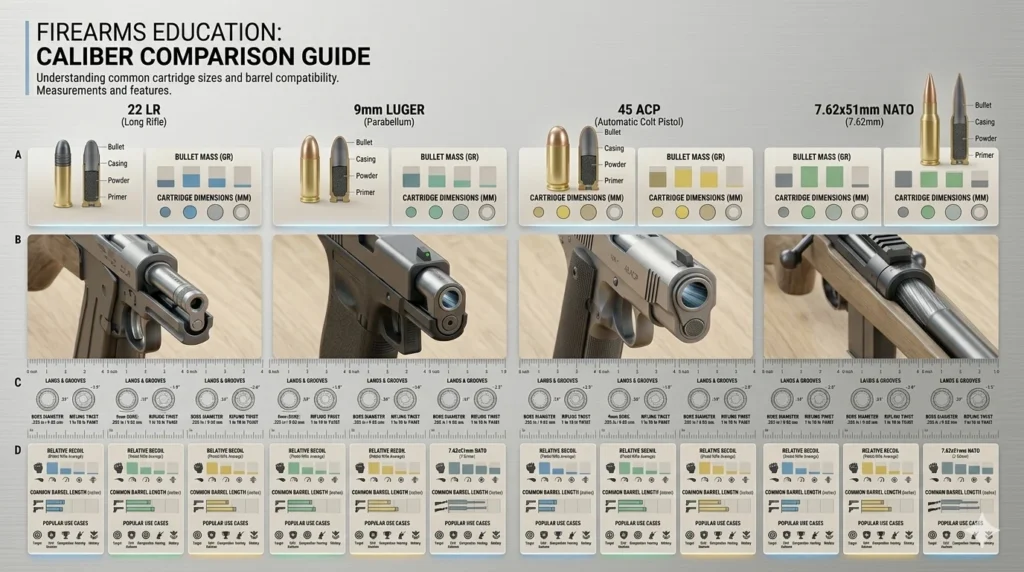
Common Gun Calibers and Their Uses
Here is a simple breakdown of popular calibers and what they are typically used for:
| Caliber | Type of Firearm | Common Use | Characteristics |
|---|---|---|---|
| .22 LR | Rifle / Pistol | Training, target shooting | Low recoil, low cost |
| 9mm | Handgun | Self-defense, law enforcement | Balanced power and control |
| .45 ACP | Handgun | Self-defense | High stopping power, heavier recoil |
| .223 Remington | Rifle | Sport shooting, varmint hunting | Fast, flat trajectory |
| 7.62mm | Rifle | Military, long-range shooting | High power and penetration |
Each caliber serves a different purpose depending on the firearm type and intended use.
Caliber vs Cartridge: What’s the Difference?
Many people confuse caliber with cartridge, but they are not the same.
Caliber:
Refers only to the diameter of the bullet or barrel.
Cartridge:
Refers to the complete ammunition unit, including:
- Bullet
- Case
- Gunpowder
- Primer
For example:
- 9mm is a caliber
- 9×19mm Parabellum is a full cartridge
So while caliber tells you size, cartridge tells you the full ammunition specification.
Caliber vs Gauge (Shotguns Explained)
Shotguns do not use caliber. Instead, they use gauge.
Here’s how they differ:
- Caliber: measured in inches or millimeters
- Gauge: based on the number of lead balls that equal one pound
Example:
- 12 gauge shotgun is much more powerful than a 20 gauge shotgun
This system is older and unique to shotguns, which is why it can feel confusing at first.
Real-World Examples of Caliber Usage
Let’s look at how people naturally use the term “caliber” in everyday conversation:
Friendly tone example:
- “I bought a 9mm pistol for home protection.”
Neutral tone example:
- “This rifle uses .223 caliber ammunition for sport shooting.”
Technical tone example:
- “The firearm is chambered in 7.62×39mm caliber for intermediate range performance.”
Dismissive or casual tone example:
- “That small caliber won’t do much against large game.”
These examples show that caliber is not just technical—it also carries meaning depending on context.
Why Different Countries Use Different Caliber Systems
The world uses two main systems:
Metric system countries:
- Use millimeters (mm)
- Example: 9mm, 7.62mm
Imperial system countries:
- Use inches
- Example: .45, .308
This difference comes from historical measurement systems, not performance differences.
Alternate Meanings of “Caliber”
Outside of firearms, the word caliber has another meaning.
It can describe the quality or level of ability of a person or thing.
For example:
- “She is a lawyer of high caliber.”
- “The team showed exceptional caliber in the match.”
In this context, it means excellence, skill, or standard not bullet size.
Polite and Professional Ways to Talk About Caliber
Depending on your audience, you can use different terms:
Instead of saying:
- “big caliber gun”
You can say:
- “larger caliber firearm”
- “high-power firearm”
- “larger bore weapon”
Instead of:
- “small caliber gun”
You can say:
- “low recoil firearm”
- “smaller diameter firearm”
These alternatives sound more professional and neutral.
Common Misunderstandings About Caliber
Many beginners get confused about caliber, especially due to myths and internet misinformation.
Here are some clarifications:
- Bigger caliber does not always mean better accuracy
- Smaller caliber does not always mean weaker effectiveness
- Caliber alone does not determine stopping power
- Barrel length, bullet design, and velocity also matter
So, caliber is important, but it is only one part of firearm performance.
FAQs
What does caliber mean in guns?
Caliber refers to the diameter of a firearm’s barrel or the bullet it fires, usually measured in inches or millimeters.
Is higher caliber always more powerful?
Not necessarily. Power depends on multiple factors like velocity, bullet design, and firearm type.
What is the most common handgun caliber?
The 9mm is one of the most widely used handgun calibers globally.
Does caliber affect recoil?
Yes, larger calibers generally produce more recoil due to increased bullet size and power.
Is caliber the same as bullet size?
Almost, but not exactly. Caliber is a general measurement, while bullet size can vary slightly depending on cartridge design.
Why do some calibers use numbers like .45 or .38?
These are measurements in inches and come from older imperial naming systems.
What is the difference between caliber and gauge?
Caliber is used for rifles and handguns, while gauge is used for shotguns.
Can two guns have the same caliber but different performance?
Yes, barrel length, ammunition type, and firearm design can significantly change performance.
Conclusion
Understanding what caliber means in guns is essential for anyone learning about firearms.
To summarize:
- Caliber refers to bullet or barrel diameter
- It is measured in inches or millimeters
- It helps identify ammunition type and firearm compatibility
- It does not alone determine power or performance
- It is different from cartridge and gauge
- It is also used outside firearms to describe quality or skill
Once you understand caliber, reading about guns, ammunition, and firearm types becomes much easier and far less confusing.
You are learning for education, curiosity, or general knowledge, caliber is one of the foundational concepts in the world of firearms.
Discover More Related Articles:
- Confused About Conduction in Science: Here’s What It Really Means In 2026
- Understanding TDS in Water: Meaning, Measurement & Health Impact In 2026
- Candescent Explained: The Meaning of “Cand” Made Easy In 2026

David Brown is a content writer and language enthusiast at textroast.com, where he creates insightful articles that explain the meanings of words, slang, and phrases used in everyday life. His work helps readers decode modern language trends, understand cultural expressions, and make sense of online communication with clarity and fun.