
Definition
Grain in ammo refers to the weight of the bullet, not the size or power of the cartridge. One grain is a unit of measurement equal to 1/7000th of a pound, and in ammunition, it is used to describe how heavy the bullet projectile is. For example, a 115 grain 9mm bullet is lighter than a 147 grain 9mm bullet.
If you’ve ever picked up a box of bullets and noticed numbers like “55 grain,” “115 grain,” or “230 grain,” you might have paused and wondered what that actually means. At first glance, it sounds like something related to powder, pressure, or even bullet size. But the truth is much simpler, and far more important for shooters, hunters, and firearm enthusiasts.
The “grain” measurement plays a key role in how a bullet behaves. It affects speed, recoil, accuracy, and even the type of shooting experience you get. You’re target shooting at the range, hunting game, or simply learning about firearms, understanding grain helps you make smarter and safer choices.
In this guide, we’ll break down everything you need to know about bullet grain in ammo in a clear, friendly, and practical way.
What Does Grain Mean in Ammo?
In ammunition, grain (gr) is a unit of weight used to measure the mass of the bullet projectile.
One grain is extremely small:
- 1 grain = 0.0648 grams
- 7,000 grains = 1 pound
So when you see “124 grain 9mm,” it means the bullet itself weighs 124 grains, not the entire cartridge.
Key Point to Remember
The grain measurement only refers to the bullet weight, not:
- The casing
- The gunpowder inside
- The overall cartridge weight
This distinction is important because many beginners mistakenly think grain refers to power or speed. It doesn’t directly measure either, but it influences both.
Origin of the Grain Measurement
The term “grain” dates back centuries to early systems of measurement used in Europe. It originally came from the average weight of a single grain of wheat or barley.
Over time, it became standardized in the firearm and ammunition industry as a precise unit of mass. Even though modern science uses grams and kilograms, the firearms world still uses grains because:
- It is highly precise for small measurements
- It is a long-established standard in ballistics
- Reloading ammunition relies heavily on grain accuracy
Today, every ammunition manufacturer uses grain weight as a universal reference.
Why Grain Weight Is Important in Ammo
Bullet grain isn’t just a number on a box. It directly influences how a bullet performs.
Here’s how:
1. Bullet Speed (Velocity)
- Lighter bullets (lower grain) usually travel faster
- Heavier bullets (higher grain) tend to be slower
2. Recoil
- Light grain = less recoil (generally smoother shooting)
- Heavy grain = more recoil (stronger kick)
3. Accuracy
- Some firearms perform better with specific grain weights
- Heavier bullets may stabilize better at long range
4. Penetration and Impact
- Heavier bullets often penetrate deeper
- Lighter bullets may expand or fragment more quickly
5. Shooting Purpose
Different grain weights are designed for different uses:
- Target shooting
- Self-defense
- Hunting small or large game
Common Bullet Grain Examples
To understand grain better, let’s look at real-world ammunition examples:
9mm Ammo
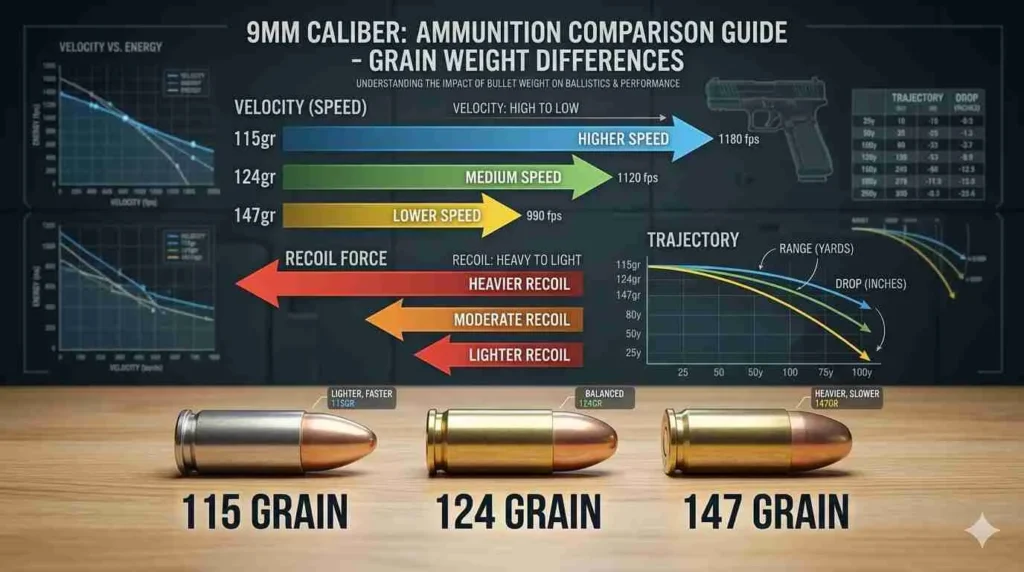
- 115 grain: Fast, light recoil, common for target shooting
- 124 grain: Balanced performance
- 147 grain: Slower, heavier recoil, deeper penetration
.223 / 5.56 Ammo
- 55 grain: Standard military-style round, high velocity
- 62 grain: Improved stability and penetration
- 77 grain: Long-range precision shooting
.45 ACP Ammo
- 185 grain: Faster for a .45 round
- 230 grain: Standard, heavy hitting, strong recoil
Grain vs Other Ammo Terms
Many people confuse grain with other ammunition terms. Let’s clear that up.
| Term | Meaning | What It Measures |
|---|---|---|
| Grain (gr) | Bullet weight | Mass of the projectile |
| Caliber | Bullet diameter | Width of the bullet |
| Velocity | Bullet speed | Feet per second (fps) |
| Energy | Impact power | Measured in foot-pounds |
| Powder charge | Gunpowder amount | Energy behind bullet |
Simple Explanation
- Grain = how heavy the bullet is
- Caliber = how wide the bullet is
- Velocity = how fast the bullet travels
Does Higher Grain Mean More Power?
This is one of the most common misconceptions.
The answer is: not always.
A heavier grain bullet:
- Can carry more momentum
- Often penetrates deeper
- May travel slower
A lighter grain bullet:
- Can move faster
- May have flatter trajectory
- Can lose energy faster at long distance
So “more grain” does not automatically mean “more powerful.” Power depends on a combination of grain, velocity, and firearm type.
Real-World Usage of Grain in Ammunition
Different shooters choose different grain weights depending on their purpose.
Target Shooting
- Usually lighter grain
- Less recoil means better control
- More cost-effective shooting sessions
Self-Defense
- Mid to heavy grain
- Balanced penetration and expansion
- Reliable stopping power
Hunting
- Heavier grain preferred
- Better penetration for larger animals
- More impact energy retention
Competitive Shooting
- Carefully selected grain for consistency
- Often matched to specific firearm tuning
Pros and Cons of Different Grain Weights
Lighter Grain Bullets
Pros:
- Faster velocity
- Less recoil
- Flatter trajectory
Cons:
- Less penetration
- Can be affected more by wind
- May lose energy faster
Heavier Grain Bullets
Pros:
- Greater penetration
- Better energy retention
- More stable in some conditions
Cons:
- Slower speed
- More recoil
- Can drop more over distance
Example Comparison Table
| Ammo Type | Grain Weight | Speed | Recoil | Best Use |
|---|---|---|---|---|
| 9mm | 115 gr | High | Low | Target shooting |
| 9mm | 147 gr | Medium | High | Defense |
| .223 | 55 gr | Very high | Low | Training |
| .223 | 77 gr | Medium | Medium | Long-range accuracy |
| .45 ACP | 230 gr | Low | High | Stopping power |
Alternatives and Related Concepts
While grain is the standard measurement, there are related ideas worth knowing:
1. Bullet Weight in Grams
Some countries use grams instead of grains:
- 124 grain ≈ 8 grams
- 230 grain ≈ 15 grams
2. Bullet Construction Types
- Full Metal Jacket (FMJ)
- Hollow Point (HP)
- Soft Point (SP)
These affect performance more than grain alone in some cases.
3. Powder Charge vs Bullet Grain
Reloaders often adjust powder charge depending on bullet grain weight for optimal performance.
Common Misunderstandings About Grain
“Grain means bullet size”
Incorrect. It refers only to weight.
“Higher grain always means stronger bullet”
Incorrect. Power depends on multiple factors.
“Grain affects gun compatibility”
Partially true. Some firearms perform better with certain grain ranges.
“All bullets of the same caliber are the same”
Incorrect. A 9mm 115 grain and 147 grain behave very differently.
Polite Ways to Ask or Talk About Grain
If you’re new to firearms or discussing ammo with others, here are polite and professional ways to phrase it:
- “What grain weight do you recommend for this firearm?”
- “Is 124 grain suitable for target shooting?”
- “Which grain performs better for control and accuracy?”
- “Could you explain the difference between these grain options?”
FAQs
What does the grain mean in ammo?
It refers to the weight of the bullet projectile, measured in grains, where one grain is 1/7000th of a pound.
Is higher grain ammo more powerful?
Not always. Higher grain means a heavier bullet, but power depends on velocity and energy too.
What is better, 115 grain or 124 grain 9mm?
115 grain is faster with less recoil, while 124 grain offers a balanced performance.
Does grain affect recoil?
Yes. Heavier grain bullets usually produce more recoil.
What grain ammo is best for beginners?
Lighter grain ammo is often preferred due to reduced recoil and easier control.
Is grain the same as caliber?
No. Grain measures weight, while caliber measures bullet diameter.
Why do different grains exist in ammo?
Because different shooting needs require different balance of speed, recoil, and penetration.
Can I mix different grain ammo in one gun?
Yes, but performance will vary. It is best to test what works best for your firearm.
Conclusion
The grain measurement in ammunition might seem like a small detail, but it plays a big role in how a bullet performs. It affects speed, recoil, accuracy, and suitability for different shooting purposes.
In simple terms:
- Lower grain = faster, lighter recoil
- Higher grain = heavier, deeper impact
There is no “best” grain for everyone. The right choice depends on your firearm, your goal, and your shooting style.
Once you understand grain, you’re no longer just picking ammo randomly you’re making informed decisions that improve safety, accuracy, and performance.
Discover More Related Articles:
- Confused About Conduction in Science: Here’s What It Really Means In 2026
- Understanding TDS in Water: Meaning, Measurement & Health Impact In 2026
- Candescent Explained: The Meaning of “Cand” Made Easy In 2026

Laura Jackson is a writer at textroast.com, where she creates engaging articles that decode the meanings behind slang, phrases, and everyday expressions. Passionate about language and communication, she makes complex or confusing terms easy to understand, turning learning into a fun and relatable experience for readers around the world.