Definition
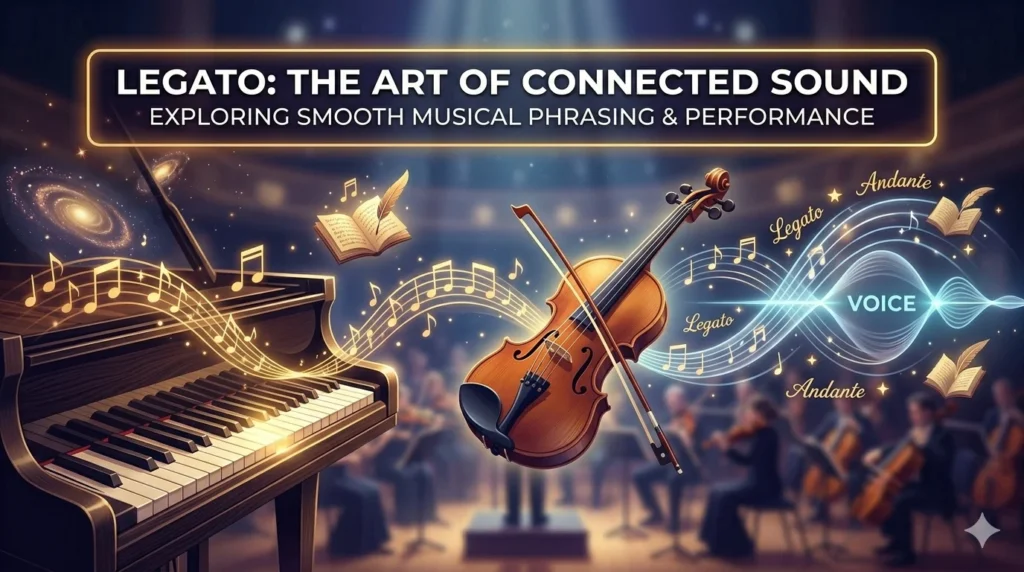
Legato in music means playing or singing notes smoothly and connectedly, with no noticeable breaks or silence between them. It creates a flowing, seamless sound where each note blends into the next, often described as “smooth and connected” musical phrasing.
Have you ever listened to a piano melody that feels like one long, flowing river of sound, or a violin line that sounds like it never stops breathing? That smooth, emotional flow is often the result of a musical technique called legato.
Legato is one of the most important expressive tools in music. It is not just a technical instruction written on sheet music; it is a way of shaping emotion, mood, and storytelling through sound. You are listening to classical compositions, modern film scores, jazz improvisations, or even pop ballads, legato playing is everywhere.
Understanding what legato means in music helps musicians perform more expressively and helps listeners appreciate the emotional depth behind a melody. Let’s explore it in detail.
What Does Legato Mean in Music?
In simple terms, legato means “tied together.” It comes from Italian musical terminology and instructs performers to play notes in a smooth, connected manner without breaks between them.
Key idea:
Legato = Smooth + Connected + Flowing sound
When music is played legato:
- Notes overlap slightly or connect seamlessly
- There is no sharp separation between sounds
- The melody feels continuous and lyrical
This technique is widely used in both instrumental and vocal music to create emotional expression and fluid motion.
Origin of the Term “Legato”
The word legato originates from the Italian verb legare, which means “to bind” or “to tie together.”
Italian musical terms became standard during the classical music era because many influential composers, such as Mozart, Vivaldi, and Verdi, were Italian or worked in Italy’s musical tradition.
Over time, legato became a universal instruction in sheet music across all genres and instruments.
Today, even modern digital music production uses the concept of legato when programming synthesizers and MIDI instruments.
How Legato Works in Practice
Legato is not just about playing notes softly or slowly. It is about connecting them without interruption.
On different instruments:
Piano
- Notes are played so that one key is released exactly as the next is pressed
- The sustain pedal is sometimes used to enhance smoothness
Violin
- Bow moves continuously without lifting
- Changes between notes are smooth and controlled
Flute or Voice
- Air flow remains steady
- Tongue articulation is minimal or soft
Guitar
- Hammer-ons and pull-offs are often used instead of picking every note
Musical Notation of Legato
In written music, legato is shown using a curved line called a slur.
Example:
- A slur connects two or more notes
- It tells the musician to play them smoothly and connected
Sometimes the word “legato” is also written above a passage for clarity.
Emotional and Expressive Meaning of Legato
Legato is not just technical, it is deeply emotional.
It often creates feelings like:
- Calmness
- Romance
- Flowing movement
- Sadness or longing
- Cinematic storytelling
That is why legato is extremely common in movie soundtracks and emotional piano pieces.
For example, a legato violin melody can sound like a human voice singing without interruption, which makes it powerful and expressive.
Real-World Examples of Legato in Music
Here are some everyday examples where legato is commonly used:
- A soft piano ballad where notes blend smoothly
- A violin solo in a romantic film score
- A singer holding connected syllables in a love song
- A jazz saxophone improvisation with flowing phrasing
- A synthesizer pad in electronic music creating a continuous sound texture
Legato vs Other Musical Techniques
To fully understand legato, it helps to compare it with related terms.
1. Legato vs Staccato
| Feature | Legato | Staccato |
|---|---|---|
| Sound | Smooth and connected | Short and detached |
| Style | Flowing | Sharp and separated |
| Emotion | Calm, emotional | Energetic, playful |
| Example | Violin melody | Piano jumps |
2. Legato vs Tenuto
- Legato: Notes fully connected
- Tenuto: Notes held for full value, slightly emphasized but not necessarily connected
3. Legato vs Portamento
- Legato: Smooth connection between notes
- Portamento: Sliding transition between notes (especially in voice or strings)
Instruments That Use Legato Most
Some instruments naturally support legato better than others.
Highly legato-friendly instruments:
- Violin
- Cello
- Flute
- Voice
- Saxophone
- Trombone
Instruments requiring technique for legato:
- Piano
- Guitar
- Percussion instruments
Techniques to Play Legato Properly
Musicians use different techniques depending on the instrument:
For piano:
- Overlapping finger transitions
- Careful timing between key releases and presses
- Use of sustain pedal (carefully controlled)
Or For guitar:
- Hammer-ons
- Pull-offs
- Slides
For wind instruments:
- Continuous airflow
- Smooth tonguing or slurring
And For singers:
- Controlled breath support
- Smooth vowel transitions
- Minimal consonant interruption
Example Table: Legato in Different Contexts
| Context | Example | Effect |
|---|---|---|
| Classical piano | Chopin nocturnes | Emotional flowing melody |
| Film music | Romantic soundtrack themes | Cinematic smoothness |
| Vocal performance | Ballads | Emotional storytelling |
| Jazz | Saxophone improvisation | Smooth melodic lines |
| Electronic music | Synth pads | Continuous ambient texture |
Common Mistakes When Playing Legato
Even though legato sounds simple, beginners often struggle with it.
Common mistakes include:
- Leaving small gaps between notes
- Overusing pedal on piano, causing muddy sound
- Pressing notes too hard, breaking flow
- Not controlling breath in wind instruments
- Over-articulating syllables in singing
Avoiding these mistakes helps create a truly smooth musical phrase.
Why Legato Is Important in Music
Legato is essential because it:
- Enhances emotional expression
- Makes melodies sound natural and human
- Improves musical storytelling
- Creates a sense of flow and continuity
- Balances contrast with sharp techniques like staccato
Without legato, music can sound mechanical or disconnected.
Is There an Alternate Meaning of Legato?
In most cases, legato is strictly a musical term.
However, in modern usage:
- It can metaphorically describe anything smooth or continuous
- Example: “a legato transition between scenes” in film editing discussions
Still, its primary and official meaning remains musical.
How to Describe Legato in Simple Words
If you want to explain legato in a beginner-friendly way, you can say:
- “Play it smoothly, without stopping between notes.”
- “Let the notes flow like water.”
- “Connect each sound gently into the next.”
These descriptions help students understand the feeling behind the technique.
FAQs
What does legato mean in music?
Legato means playing notes smoothly and connected without breaks or silence between them.
Is legato a technique or a style?
Legato is both a playing technique and an expressive musical style used to create smooth phrasing.
How do you know if music is legato?
You can identify legato when notes flow continuously without separation, often shown by a slur in sheet music.
What instruments can play legato?
Most instruments can play legato, but string, wind, and vocal instruments do it most naturally.
Is legato the same as smooth playing?
Yes, but more precisely, legato means notes are directly connected, not just played smoothly.
What is the opposite of legato in music?
The opposite is staccato, where notes are short, detached, and separated.
Do singers use legato?
Yes, singers use legato by connecting words and maintaining smooth vocal flow.
Why is legato important in music?
It adds emotion, expression, and natural flow, making music sound more human and expressive.
Conclusion
Legato is one of the most expressive and widely used techniques in music. It transforms simple notes into flowing melodies that feel natural and emotional.
Key points to remember:
- Legato means smooth, connected notes
- It comes from Italian meaning “to tie together”
- It is used in almost all music genres
- It enhances emotional expression and musical flow
- It is different from staccato and other articulation styles
You are learning an instrument or simply enjoying music, recognizing legato helps you understand how musicians shape emotion through sound.
Discover More Related Articles:
- Candescent Explained: The Meaning of “Cand” Made Easy In 2026
- Confused About Conduction in Science: Here’s What It Really Means In 2026
- Understanding TDS in Water: Meaning, Measurement & Health Impact In 2026

David Brown is a content writer and language enthusiast at textroast.com, where he creates insightful articles that explain the meanings of words, slang, and phrases used in everyday life. His work helps readers decode modern language trends, understand cultural expressions, and make sense of online communication with clarity and fun.